
Crypto! The currency of choice for criminals, money launderers, kidnappers, influence peddlers, arms/drug/human traffickers, and dictators stuffing their own pockets.
Trump & Sons is launching its own cryptocoin. No one is even talking about such quaint notions as corruption or conflict of interest. That’s so over! This White House is For Sale, baby! Even if you don’t necessarily get what you paid for.
“The stablecoin is the fourth digital currency that Mr. Trump and his business partners have marketed to the public over the last year. World Liberty already offers a cryptocurrency called WLFI. This month, the company announced it had sold $550 million of those digital coins. A business entity linked to Mr. Trump receives a 75 percent cut of the sales.
“Days before his inauguration, Mr. Trump also started selling a so-called memecoin — a type of digital currency based on an online joke or a celebrity mascot. Melania Trump put her own memecoin on the market that same weekend.
…
“Mr. Trump’s aggressive forays into the crypto market have come at the same time that his administration eases enforcement of crypto companies and rolls back regulations. His efforts to profit from an industry that he oversees amount to an enormous conflict of interest, with virtually no precedent in American history, government ethics experts have said.
…
“The emphasis on international payments raises the prospect that foreign governments or business entities might use the coin to curry favor with Mr. Trump, said Corey Frayer, who worked on crypto policy at the Securities and Exchange Commission under the Biden administration.
“’There’s a lot of opacity around this marketplace, and prior relationships with illicit finance,’ Mr. Frayer said.”
You think? Really?
http://www.nytimes.com/2025/03/25/technology/trump-crypto-stablecoin.html

Most people probably won’t pay much if any attention to this story, but it is very scary because it is part of a trend where big, wealthy, powerful institutions make concessions to Trump as soon as their financial interests are threatened–when they might not even have to. The road to subservience begins here, and we seem to have gone a good distance already.
The threats against major law firms are part of a larger strategic effort to make the entire American legal system into an arm of the Trump White House. Trump is targeting any firms and individual lawyers who have ever challenged him and issuing executive orders that cripple their ability to operate effectively. The message is clear: If big, rich law firms like this will bend the knee and cooperate, what chance do smaller firms have to resist the pressure? If you were trying to fight one of Trump’s decrees in court, would you trust this firm to represent you?
Trump has already effectively subverted federal law enforcement by installing his eager toadies to run DOJ, the FBI, and other agencies and firing everyone who normally would provide oversight and ethical guidance. If the country’s major law firms won’t take on cases and provide effective representation for people or issues that Trump wants to destroy, then it’s game over.
This instance is especially troubling because “Brad S. Karp, the chairman of the law firm Paul, Weiss, Rifkind, Wharton & Garrison, championed himself as a bulwark against what he saw as an unlawful and unpredictable presidency. Mr. Karp, who has a long history of fund-raising for Democrats, sought to unite major law firms in “a call to arms” to fight Mr. Trump in court on issues like his administration’s policy of separating migrant children from their parents. He publicly said lawyers were obligated to defend the rule of law.” Now that he has kissed the ring, what does that say?
One thing it says is that principles will be tossed aside whenever corporate revenues are threatened. Capitalism has no social conscience, especially if the money stops coming in.
Predictably, as soon as the ink was dry, Trump apparently misrepresented the deal. “By the time Mr. Trump made his announcement on Thursday, there were already signs that Paul Weiss had been burned in making a deal with Mr. Trump. The copy of the agreement that Mr. Karp shared with Paul Weiss differed in some ways from Mr. Trump’s characterization of the deal in a post on his social media platform, Truth Social. Although Mr. Trump said the law firm had specifically agreed to not follow any diversity, equity and inclusion policies in its hiring practices, there is no reference to D.E.I. in the agreement that Mr. Karp shared. Mr. Trump has mounted an aggressive campaign against diversity initiatives in the federal government, labeling it as a form of workplace discrimination. There also was no mention of Mr. Pomerantz, the former Paul Weiss partner, in the copy of the agreement circulated by Mr. Karp. Five people briefed on the matter said Mr. Karp said he did not criticize Mr. Pomerantz with the president, in spite of Mr. Trump’s assertion to the contrary.” Guess whose version is going to count?
In any case, what really matters isn’t what the deal actually said, but rather the fact that they did it at all. Once you start the compromises, you’re been had.
We should not be surprised that he voted to pass the Trump/Musk spending bill.
On Gaza:
“Genocide is described as a country or some group tries to wipe out a whole race of people, a whole nationality of people. So if Israel was not provoked and just invaded Gaza and shot at random Palestinians, Gazans, that would be genocide. That’s not what happened. In fact, the opposite happened. And Hamas is much closer to genocidal than Israel. And I told Netanyahu, I said to him what I thought: You gotta reduce the number of casualties and make sure aid gets in and stuff like that. Here is the difficulty: Hamas has a different way of waging warfare, of using innocent Gazans as human shields. They put rockets in hospitals. They put their military supplies in schools. What is a country supposed to do when rockets are being fired from a school? So Israel’s been in a much more difficult position because of what Hamas did. And it’s not that Israel is above criticism. Of course it is not above criticism. But Hamas — I’m sorry, it matters so much to me. I feel so deeply about it. No one blames Hamas. I mean, the news reports every day for a while showed Palestinians being hurt and killed. I see the pictures of a little Palestinian boy without a leg, or one that sticks in my head, there’s a little girl, like 11, 12, crying because her parents were both killed. I ache for that. But on the news, they never mention that Hamas used the Palestinian people as human shields. And so when these protesters come and accuse Israel of genocide, I said, “What about Hamas?” They don’t even want to talk about Hamas.
“One final thing. This is very important. Jewish people were subject, at least in my judgment, to the worst genocide ever. I put in the book, on the day they got Kyiv, the Nazis asked 33,000 Jews to line up by a trench, strip naked, and they shot them all dead. Every day Auschwitz killed 20,000 people. My family was killed from a place called Chortkiv in western Ukraine. And this was vicious and horrible. And it is vicious of the opponents to call this genocide. Criticize it? For sure. Say Israel went too far? For sure. And you know what it does? It increases antisemitism, because they’re making Israel and the Jewish people look like monsters, which they are not.”
Comment: Schumer is basically repeating Israeli government talking points. Somehow, at least 45,000 Palestinians were killed by Israeli forces because Hamas was using civilians “as human shields”. (I.e., they lived in the Gaza Strip.) And “nobody blames Hamas’?! Really? Well, maybe Israel went a little too far, but what about the Holocaust!
On Trump cutting funds for Columbia University:
“Columbia did not do enough. I criticized them. And believe me, I believe in free speech, I believe in the right to protest, as you read in my book. I started my career protesting the Vietnam War. I say to some people, “If I were your age, I’d be protesting something or other.” So I get that, and I love it, and it’s about America. But when it shades over to violence and antisemitism, the colleges had to do something, and a lot of them didn’t do enough. They shrugged their shoulders, looked the other way. Columbia among them. So what did they do? They took away $400 million. I’m trying to find out what they took away. Are they taking away money from cancer research, or Alzheimer’s? What is the $400 million? It could be hurting all students. Students who go there who have nothing to do with the protest, students who might have protested peacefully, or Jewish students who were victims of some of those protests. So I think we have to see. My worry is that this $400 million was just done in typical Trump fashion: indiscriminately, without looking at its effect.”
Comment: So maybe Columbia just had it coming? Who knows?
On arresting and preparing to deport Mahmoud Khalil:
“I don’t know all the details yet. They’re trying to come out, and there’ll be a court case which will determine it. If he broke the law, he should be deported. If he didn’t break the law and just peacefully protested, he should not be deported. It’s plain and simple…It’s a legal issue, and it’s, what are Columbia’s rules, and what does it mean breaking them, and what are the legal rules? What did he do? I don’t know what he did, I don’t know what the charge against him is. So it’s a little premature to make a decision, except if he didn’t break the law, he should not be deported. If he broke the law, he should.”
Comment: Khalil is a legal permanent resident of the US married to a US citizen, and therefore his speech is protected by the 1st Amendment. He should never have been arrested or have to appear in court, since no evidence has been presented that he ever broke any law. So basically, Schumer is saying again, yeah, who knows, maybe he had it coming.
On what if Trump refuses to abide by court rulings:
“I believe this, and it’s a little bit in concert with what I’ve said to you before: I believe Republican senators, on this issue, will stand up. I’ve talked to some of them. About five or six have said publicly they will work to uphold the courts, and to uphold the law if Trump tries to break it. And we can do that legislatively if we have to. That’s my hope. That’s what we’ve got to work toward. And I think there’s a decent chance that that would happen, particularly if Trump, three months from now, is less popular.”
Comment: WTF?
On whether Democrats have failed to recognize that the political reality has fundamentally changed:
“I think we’re fighting very hard on every front. Initially, we’ve had some successes, but we’ve got to keep at it, and we’ve got to be open to new suggestions and ways to do it. But I think what we’re doing is working, so far.”
Comment: So, yes. Schumer still thinks the old ways apply.
Columbia University has become ground-zero for MAGA efforts to stifle “liberal bias” on university campuses. The Trump administration has canceled $400 million in federal grants to the university, ostensibly for Columbia’s failure “to protect American students and faculty from antisemitic violence and harassment.” The focus on the university stems from demonstrations on campus last year protesting Israeli military actions that have damaged or destroyed 90% of structures in Gaza, leaving nearly 2 million people homeless and killing at least 45,000 Palestinians. So far, the university administration seems to be capitulating to the administration’s demands.
But what, exactly, constitutes antisemitism? The Trump administration’s letter sent to Columbia accepts the definition of the IHRA (International Holocaust Remembrance Alliance) published in 2016: “Antisemitism is a certain perception of Jews, which may be expressed as hatred toward Jews. Rhetorical and physical manifestations of antisemitism are directed toward Jewish or non-Jewish individuals and/or their property, toward Jewish community institutions and religious facilities.” In its explanatory examples, that document explicitly states that “criticism of Israel similar to that leveled against any other country cannot be regarded as antisemitic.” [holocaustremembrance.com/resources/working-definition-antisemitism]
I.e, protesting actions of the Israeli government is not in itself antisemitic. If it’s okay to, say, protest Chinese treatment of Uyghurs, it’s equally legitimate to protest Israeli treatment of Palestinians.
The administration then followed up by arresting and threatening to deport Mahmoud Khalil, a prominent participant in the protests who is Palestinian but is a legal US permanent resident holding a “green card” and married to a US citizen. Khalil isn’t charged with any crime. His arrest was reportedly based a provision in the Immigration and Nationality Act which says any “alien whose presence or activities in the United States the Secretary of State has reasonable ground to believe would have potentially serious adverse foreign policy consequences for the United States is deportable.” Marco Rubio accused Khalil of having “led activities aligned to Hamas.” But no evidence has been shown of his having any contact with Hamas, taking direction from it or providing material support to it. According to the New York Times, “the rationale is that the anti-Israel protests Mr. Khalil helped lead were antisemitic and fostered a hostile environment for Jewish students at Columbia…Mr. Rubio’s argument is that the United States has a foreign policy of combating antisemitism around the world and that it would undermine this policy objective to tolerate Mr. Khalil’s continued presence in the United States.” [www.nytimes.com/2025/03/10/us/trump-rubio-khalil-columbia-student-protests.html]
Trump said on March 10 that Khalil is “the first arrest of many to come” and that “we know there are more students at Columbia and other Universities across the Country who have engaged in pro-terrorist, anti-Semitic, anti-American activity, and the Trump Administration will not tolerate it.”
But by the very definition that the Trump administration uses in its demand letter to Columbia, protesting the actions of the Israeli government is explicitly cited as NOT antisemitism, so how then can participation in such protests be grounds for arrest and deportation?
And then there is that First Amendment about freedom of speech, which applies equally to all legal residents of the United States as well as citizens. That means that even if Khalil had expressed support for Hamas (which as far as we know he did not), that would be protected speech under the First Amendment.
Clearly, other things are at play here.
Conservatives since Reagan have whined about the “leftist” political environment of American universities, which they claim brainwashes students with liberal ideas. Colleges were hotbeds of protests during the Vietnam War, but since then campuses have been oddly quiet and concerned more about cultural issues like gender equity and “Me Too” and “cancel culture”. Even during Trump 1.0, students seemed mostly tuned out, and the resistance came mainly from older adults. The George Floyd and Black Lives Matter protests had some resonance on campuses, but the leadership and impetus came from elsewhere.
Still, MAGA Republicans have stayed obsessed with slaying the perceived ideological threat coming from America’s universities. In Florida, Ron DeSantis has aggressively gone after state colleges, demanding changes in curricula to eliminate any hint of “wokeness” and firing administrators and liberal Board of Trustees members and installing his own. Similar things are happening in other states run by Republican governors and legislatures. But elite private universities remained outside their control.
Now Trump has found the weapon to bludgeon even private Ivy League schools into submission: money. Major research universities whether public or private depend heavily on grants from the federal government to pay for research programs and subsidize graduate students who are the grunts who carry them out. If the money is cut off, universities have to cut their research programs and cannot recruit and admit nearly as many students, all of which has cascading effects on faculty retention and general operating expenses. The result has been a spectacle of university presidents from elite schools groveling in front of MAGA Republicans and sometimes losing their jobs anyway. As a recent essay by Harvard faculty members Ryan Enos and Steven Levitsky observed: “Most universities — including Harvard — have responded to these attacks with strategies of self-preservation. They are lying low, avoiding public debate (and sometimes cooperating with the administration) in the hope of mitigating the coming assault.” [www.thecrimson.com/article/2025/3/14/enos-levitsky-harvard-columbia-trump/?fbclid=IwY2xjawJBtvhleHRuA2FlbQIxMQABHfVQ5wPkTR9KPCi2BjvfUqjqHABJ0u1Ap-8bveMdJ6vFsF1IH9Sz05ToLw_aem_ncqO7c5xGT_mvAy4PSoG0A]
But even Trumpistas need a justification to deny funds to higher education, and they have found the perfect instrument by claiming to be leading the fight against antisemitism on campus—especially when the definition of antisemitism can be expanded to include criticism of the government of Israel. So when protests over the Israeli devastation of Gaza erupted at Columbia last year, it seemed they had found the perfect storm: a big high-profile protest for Palestinian rights at an Ivy League school with a large number of Jewish students (and faculty) and an embattled and intimidated university president in the country’s largest media market. Columbia was made the example of what could happen if university administrations didn’t bend the knee, and universities across the country all took notice, especially when they found their own programs taking hits as DOGE rampaged through the federal government. Johns Hopkins found $800 million in its grants had been cancelled. The gutted and MAGA-led Department of Education launched investigations of alleged antisemitism at 60 other universities.
As the Enos/Levitsky article in the Harvard Crimson noted, the MAGA strategy is working. “America’s leading universities have remained virtually silent in the face of this authoritarian assault on institutions of higher education…To our knowledge, no major university leadership has publicly denounced the attack on Columbia or Mahmoud Khalil. In the face of an open assault on a peer Ivy League institution and basic principles of free speech, Harvard remains silent. With American democracy on the line, the University has crawled into a protective shell.”
As they also note, the Trump administration’s claim to be fighting campus antisemitism is bogus. Ironically, there are few sectors of American society more antisemitic than the murkier depths of TrumpWorld. (Remember the tiki-torch-bearing khaki-clad bros in Charlottesville chanting “Jews will not replace us!”) Trump’s white evangelical base isn’t too keen on American Jews either, but they do love Israel because they think it will usher in the Second Coming. Basically, in America, Israeli Jews are accepted as white people, while Palestinians are not.
It is worth noting yet again that much of the most detailed, accurate, and effective criticism of Israel’s actions in Gaza and the Left Bank has been made by Jews both in Israel and the US. Indeed, demonstrators from Jewish Voice for Peace entered the lobby of Trump Tower in New York on March 13 to protest the arrest of Mahmoud Khalil, chanting “not in our name” and “stop arming Israel.” Some 98 of them were arrested. [apnews.com/article/columbia-university-protests-khalil-trump-tower-8e2f455134a2f1b82458e32aecbb59f7]
Every American administration since Israel was created in 1948 has paid hypocritical lip service to the notion of Palestinian rights, while continuing to back Israel to the hilt. Even so, that support reached a new level during Trump 1.0, when he reversed decades of US policy by moving the US embassy from Tel-Aviv to Jerusalem, recognizing Israeli sovereignty over the Golan Heights, and ending US efforts under Obama to curb new Jewish settlements in the West Bank. Biden (shamefully in my view) continued to provide the very weapons that leveled Gaza, while feebly and completely ineffectively calling for a ceasefire to end the slaughter of its inhabitants. Now Trump has raised US policy to an unprecedented level of absurdity by advocating the removal of 2 million Palestinian inhabitants of Gaza and turning the area into a fabulous resort for “world people”, while effectively endorsing full Israeli sovereignty over the entire West Bank. Even Netanyahu couldn’t quite believe his ears.
Decades of official US policy catering to Israel as well as pro-Israeli treatment by US news media and popular entertainment lauding Israeli heroism and success have had the intended effect of creating a heavy bias within the American public in favor of Israel. Meanwhile, the history of Palestinian displacement and oppressive treatment by the Israeli government, military, and settler groups has barely penetrated the American consciousness. We hear about it when Israeli Jews are killed by suicide bombers, but we don’t hear about Israeli reprisals that kill far more Palestinians.
Then there is the Holocaust, the fact and horror of which no intelligent and educated person can question. It is widely considered to be the ur-atrocity of the 20th century, responsible for the systematic killing of 6 million Jews (and perhaps an equal or greater number of non-Jews). Western guilt over the Holocaust played a very significant role in the establishment of the state of Israel after World War II and it has remained an emotional touchstone ever since. But it is not an all-purpose excuse and justification for anything and everything that Israel has done and might do in the future.
Because of all this, Americans are primed to believe it when charges of antisemitism are raised and conversely to shrug off or minimize the significance of Israeli government policies and actions that dispossess or imprison or kill or subject Palestinians to chronic humiliation and harassment. The scales of public opinion are grossly and unfairly out of balance.
No moral person wants to be accused of antisemitism, which is precisely why making such an accusation is the ultimate defense for a cynical fascist like Donald Trump. He can stifle free speech and impose his own version of “political correctness” on universities throughout the country by arbitrarily withholding federal money while posing as a champion of the battle against antisemitism. In the meantime, his tactics and policies across the board are straight out of the fascist playbook. In this version, the “enemy” and scapegoats aren’t Jews; they are brown immigrants and anyone who calls out his lawlessness and corruption. He uses anti-antisemitism as cover to subvert democratic values and intimidate the opposition. And Trump’s fake anti-antisemitism is really pro-ethnic-cleansing.
On August 24, 1939, Stalin’s Soviet Union and Hitler’s Germany signed a secret pact that became known as the Molotov-Ribbentrop Pact after its existence came to light after World War II. The agreement divided eastern Europe into two spheres of influence, and both Germany and the USSR pledged not to invade the other’s domain—an agreement that held until Germany invaded two years later. The consequences were immense. The Soviets got a free hand in the Baltics, Finland, and other areas. With the assurance that Moscow would not do anything, Germany invaded Poland a week after the signing of the pact, precipitating World War II.
It now seems fair to speculate that we are seeing the results of another secret agreement, which we may legitimately call the Trump-Putin Pact. We know that there have been a number of recent phone conversations between the two, the substance of which remains unknown. But the outlines of the deal with Putin are starting to emerge. The eagerness of Trump to not only accept but advocate well-known Russian positions on the Ukraine conflict and even to deny Russian aggression in the 2022 invasion amounts to nothing less than a stunning reversal of what had been (prior to January 20) steadfast support by the US to Ukraine. Essentially, the US has switched sides and is now supporting Russia, leaving our European allies in turmoil and NATO in shambles.
Today’s disastrous “press conference” in the White House with Ukrainian President Zelinsky, was clearly the “reveal” of the repudiation of America’s alliances and its new alignment with Moscow. It was both an ambush and a public lynching, with J. D. Vance acting as Trump’s attack dog to humiliate Zelensky and set him up for Trump to eviscerate him before the press for “having no cards to play” and “showing no respect” before unceremoniously ejecting him from the White House. This occurred even after Zelensky showed readiness to accept some kind of deal for US access to Ukrainian mineral resources after initially rejecting Trump’s thuggish take-it-or-leave-it demands. What happens now is anyone’s guess, but the outcome is being openly celebrated in Moscow.
What Russia gets out of the pact is fairly obvious. It would get to keep the parts of Ukraine it already occupies, without any security guarantees for Kiev, which leaves open the very real possibility of further Russian incursions and the virtual certainty of Russian subversion and covert attacks on Ukrainian democracy. Without membership in the EU, let alone in what is left of NATO, Ukraine would be left as a geopolitical orphan, vulnerable to Russian expansionism. Putin will have achieved his premier goal—the effective neutralization of NATO and the expectation that if it tries to re-absorb the Baltic countries, the US would acquiesce. American leadership and credibility everywhere will be destroyed. The humiliation of America will be complete.
What’s still not clear is what Trump gets out of the deal. It’s clear that he has always wanted to emulate Putin, aspiring to be the capo de tutti capi who is the supreme arbiter doling out favors to America’s oligarchs while he plunders the government for his own enrichment. He is become a destroyer of worlds, a sociopath annihilating anyone who has ever crossed him and making them all his toadies. But there has to be something more than this in it for him. Whatever it is, there can be no further doubt that America is being led by a man who is a Russian asset and continues to be slavishly supported by a Republican party that is willing to go along with it.
This is a day of everlasting shame for this country!
Today the Washington Post’s senior editor David Shipley resigned in apparent protest over owner Jeff Bezos’ directive that Post editorials henceforth would now advocate for “personal liberties and free markets” and not publish opposing viewpoints on those topics. The only reasonable interpretation is that criticism of America’s oligarchs is now verboten and that America’s second most important newspaper was undergoing a rightward change of direction.
This isn’t the first time Bezos has weighed in to quash Post editorials. He famously axed an editorial endorsing Kamala Harris for president, an action which cost the Post thousands of subscribers. Then Bezos nixed an editorial cartoon that showed him, along with other recognizable oligarchs, kneeling before an imperial Trump and holding up bags of money. And those are only the ones we know about.
This past Sunday, MSNBC abruptly announced the firing of Joy Reid, whose 7 pm weekday show has been a platform for her sharp and insightful analysis of TrumpWorld, with a particular emphasis on black voices. The reason given for firing her was “declining ratings” (something that has affected the entire MSNBC lineup, not just The Reid Out, as liberals have increasing tuned out on the news). This frankly smells like bullshit, particularly when her announced replacements were former Democratic strategist Symone Sanders Townsend, former RNC chairman Michael Steel, and Alicia Menendez—none of whom, individually or collectively, possess anything like the star power or analytical brilliance of Joy Reid. Moreover, the announcement came the day after Trump went on a rant against MSNBC directing most of his vitriol on its star, Rachel Maddow. My working hypothesis is that the suits decided that someone needed to be sacrificed to appease Dear Leader, but removing Maddow entirely would be a bridge too far, so they cut her on-air presence from five days a week to one, and they threw Joy Reid overboard, knowing that removing a charismatic anchor who fearlessly calls out racism would go over well with the MAGA white nationalists now running the ship of state.
The announcement also revealed that MSNBC is being separated from NBCUniversal and will join most of Comcast’s other cable channels, including CNBC and USA Network, in a new company dubbed SpinCo (!) led by the veteran NBCUniversal executive Mark Lazarus, who comes from the sports world, not news. What is also unclear is whether the connection between MSNBC and NBC News will be severed. I’m betting the answer is yes. This would make sense to the corporate suits at a time when major news organizations are being systematically excluded from White House access, because it would remove the “taint” of MSNBC’s political point of view and show that NBC News is firmly back in the “impartial” blandness of network news broadcasts.
Other news organizations are clearly scrambling to secure, if not favor, at least access to the Trump White House. At the end of January, the NYT revealed that Paramount (the parent company of CBS) was prepared to pay a substantial settlement to Trump to resolve an apparently frivolous lawsuit involving a pre-election 60 Minutes interview with Kamala Harris. This was a month after ABC News paid $15 million to resolve Mr. Trump’s defamation lawsuit against the network and its anchor George Stephanopoulos, who had imprecisely said that the president had been found “liable for rape” in a civil trial in New York. (Trump had been found liable for “sexual abuse.”) Also in January, Meta, the parent company of Facebook and Instagram, said it had agreed to a $25 million settlement to resolve a lawsuit that Mr. Trump filed after the social networks suspended his accounts in 2021. Mind you, this is all money to be paid directly to Trump.
Even the New York Times has started to seem a little squishy at times when it comes to Trump, and has beefed up its roster of conservative columnists in an obvious effort to appear more “balanced” and seems to be publishing a lot more soft news “lifestyle” stories than previously.
The fact is that there are very few organizations in America that actually practice serious investigative journalism and do more than dutifully parrot news releases that are spoonfed to them. Vast sections of the country are basically “news deserts” where MAGA disinformation is disseminated—essentially uncontested—by Fox News, or Sinclair, or iHeartMedia (formerly ClearChannel) in addition to the denizens of the murkier depths of the Internet.
What happens if we lose the few organizations that still practice journalism as opposed to propaganda? Where do we go to keep informed?
The degradation of the once-great Washington Post hits me hard personally because for decades it was my hometown newspaper. When Bezos bought the paper, it was in dire financial straits. The purchase kept it alive at a time when newspapers all over the country were dying, and for a time he left it alone to pursue its traditional journalistic values. And then came Trump’s second coming.
So what do we do now?
I think it’s important to recognize that news organizations like the Post still do important work when operating under intrusive or even oppressive management. Even in its currently reduced state, the Post is still putting out real journalism, so I’m not ready to give up on it yet. Even the Murdoch-owned Wall Street Journal still produces important news stories, despite its Trumpian editorial board and loathsome owners. Regional newspapers like the Miami Herald are still doing important investigative stories even though they are only shells of their former selves, and they need our support. We can’t just depend on Internet websites, because so often the stories they post are a direct result of the work done by larger organizations like the Times and the Post that have the resources to do the research and fact-checking required and the ability to withstand the legal challenges that often result. But they need our support in terms of subscriptions and eyeballs.
These are dark times, and it’s probably going to get a lot worse. But this is no time to tune out!
What are we to make of the astounding passivity of the Democrats in the face of Trump’s wanton smashing of America’s rule of law, the federal government, and US foreign policy? What doesn’t the party understand about what is happening?
Here’s James Carville’s1 recommendation in today’s New York Times: “And there’s nothing Democrats can legitimately do to stop it — even if we wanted to. With no clear leader to voice our opposition and no control in any branch of government, it’s time for Democrats to embark on the most daring political maneuver in the history of our party: roll over and play dead. Allow the Republicans to crumble beneath their own weight, and make the American people miss us.”
Last week NYT columnist Tom Friedman2 said this: “I’ve kind of given up on politics when dealing with Trump because at least until the midterms, there are no levers to pull. The Senate is all in on him. The House is all in on him. The Supreme Court is all in on him. His media ecosystem’s all in on him. I’m now entirely betting on physics, on the hard realities of things…eventually, the laws of gravity will make themselves felt. Unfortunately, as I said, we are in the back seat and he’s driving.” I.e., we’re helpless and maybe something will turn up.
Democrats continue to vote in shameful numbers to confirm Trump’s appointments. Marco Rubio got 99 votes (presumably a “Senate courtesy”) and then promptly turned around and became Trump’s hatchet man in betraying Ukraine. Given Rubio’s long record of spineless obsequiousness, everyone should have seen this coming.
We now have a Justice Department and FBI that are being purged of apolitical professionals and replaced with MAGA zealots. The same process has started in the armed forces. Today columnist Michelle Goldberg3 writes: “We’re in an uncanny interregnum where Trump and his coterie are laying the foundation for autocracy but have yet to fully consolidate their power. The liberal democracy most of us grew up taking for granted is brittle and teetering, but its fall still feels unthinkable, even if it also seems increasingly inevitable. Perhaps this is one reason Democrats, with a few admirable exceptions, seem so frozen. People who’ve spent their lives working within a system of laws and civic institutions may be particularly unsuited to respond to that system’s failure.”
The problem about passivity and “just letting it happen” is that there is no guarantee that mid-terms will even take place—or if they do, that it won’t be under restraints that make regaining power all but impossible. That’s what happened when the Nazis took power in 1933. There was one more election after that in which opposition parties were placed under severe restrictions, but even so the NSDAP still couldn’t win a clear majority. There were no elections after that. (I don’t really like making so many comparisons to 1930s Germany, but unfortunately they just are way too apt.)
The other big problem with passivity is that it breeds contempt. Even longtime Democrats like me have lost respect for the party leaders when they see them essentially acquiescing to the destruction of American governance. We want to see resolute resistance! Fuck “working across the aisle”! Haven’t we all seen just how that works? Above all, we want to see real passion and anger! If Democrats act like wusses, no one will respect them—or vote for them.
Here’s Joseph O’Neill in the New York Review of Books4: “Democrats have disgraced themselves. They’ve looked terrified and defeated and confused. They’ve hidden behind consultant-devised talking points about grocery prices. They’ve cast votes to confirm Trump’s extremist cabinet nominees (for example, the oil executive Chris Wright as energy secretary, the notorious right-wing hack Lee Zeldin to head the Environmental Protection Agency, the unprincipled Marco Rubio as secretary of state). They’ve proposed obviously futile legislation such as the Stop the Steal Act to counter DOGE. We’re talking about full-time, professional politicians with support staff and expense accounts and good lawyers. They have solicited and accepted pro bono labor and vast campaign contributions from millions of concerned citizens. They must start to fight back with whatever power they have.”
So far, the only thing that seems to make any difference is mobilization on the streets and showing up to make things hot for senators and congressmen when back in their districts. But this needs to happen on a far more massive scale! And it needs to be organized and coordinated. Unfortunately, the Democratic Party is what we have. We can’t depend on isolated individuals and grassroots groups to do this. The Democratic Party needs to step up!
Some Republicans mumble privately that they are afraid to do the right thing because they have received threats to them or their families. This is bullshit! The worst thing that has happened to any Republican who bucked Trump was being primaried. In this country, poll workers get death threats, and they still do their jobs. In this country, school kids are under a more credible danger when they are in class. If any Republicans with a conscience still exist, the only thing that is going to make them turn on Trump is if they fear us more than they fear him.
- http://www.nytimes.com/2025/02/25/opinion/democrats-trump-congress.html ↩︎
- http://www.nytimes.com/2025/02/20/opinion/trump-putin-ukraine-europe.html?fbclid=IwY2xjawIrASZleHRuA2FlbQIxMQABHcAefGc2J_IWxAoxiRZ9q1TRbZzGpzScs1jx8y1ABYzhyK4Yo0P2wWaJ9g_aem_GrDQS4_O2mnsPOC9vfnPYA ↩︎
- http://www.nytimes.com/2025/02/24/opinion/fbi-trump-dan-bongino.html ↩︎
- http://www.nybooks.com/online/2024/11/09/all-bets-are-off-joseph-oneill/?utm_medium=email&utm_campaign=NYR-022525-Hammer_theme&utm_content=NYR-022525-Hammer_theme+CID_056b66e6f4b3f4c53adb11950ddb52d5&utm_source=Newsletter&utm_term=Joseph%20ONeill%20interviewed%20by%20Daniel%20DrakeAll%20Bets%20Are%20Off ↩︎
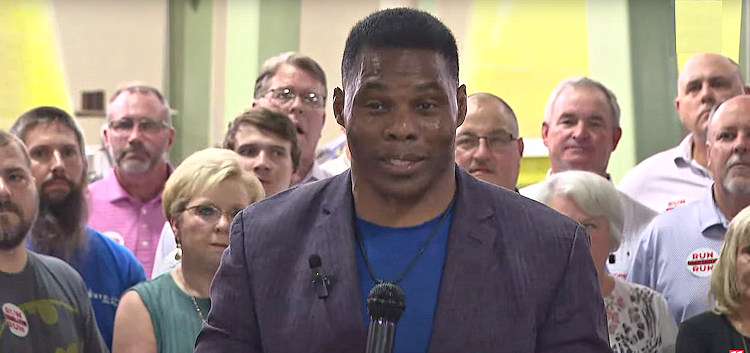
There is something truly odious about the decision by Georgia Republicans to nominate Herschel Walker to replace Raphael Warnock as senator. Walker is manifestly unqualified for the office, as evidenced by his preposterously incoherent statements, his obvious ignorance of the issues, and his frequent lies about his own resume and personal history. But the malign cynicism of his nomination goes much deeper. It simultaneously allows a virtually all-white party to set up a black face as cover for an ongoing effort to suppress black voters and, perhaps more important, express their contempt for black people and for the institution of the Senate itself. I can just hear in my mind the whoops of self-congratulatory laughter among the Georgia Good Ol’ Boys when Trump gave them their brilliant idea.
It’s easy to see why they did it. Walker is good-looking and famous. Football is King in the South and especially in rural and suburban Georgia where there isn’t much else happening and where the reliable Republican votes are, especially among white people. He was a legend on the idolized University of Georgia football team, which he left after the 1982 season (before graduating) to sign with the New Jersey Generals of the USFL, which was bought in 1983 by Donald Trump. He then played for the Cowboys, Vikings, Eagles, and Giants before retiring after the 1997 season. He then lived in Texas until this year, when he moved to Atlanta to start his senate campaign, which was pushed by Donald Trump who had put Walker on his President’s Council on Sports, Fitness, and Nutrition. Once Walker announced his senate candidacy with Trump’s backing, other prospective candidates just melted away.
Walker offers white voters a kind of self-absolution for racism, while assuring them that it doesn’t exist and that nothing needs to change. How many times will this sentence (or a less genteel variation) be uttered or thought: “I’m not racist, I voted for that black guy, Herschel Walker”? The growing litany of Walker’s misrepresentations, outright lies, revelations about sexual abuse and unacknowledged children, and bumbling gibberish (to use Leonard Pitts, Jr.’s word) makes no difference. Indeed, it’s kind of a plus because it feeds a pernicious stereotype and provides something to laugh at surreptitiously–a contemporary version of what historian Henry Louis Gates, Jr. calls the “visual rhetoric of white supremacy”. It makes the Senate race into a kind of minstrel show for the amusement of white folks. All the better that Walker’s opponent occupies the pulpit that once belonged to Martin Luther King, Jr.! What could be better than to use a black man to oppose the battle against persistent institutional racism in American society that Dr. King fought and continues to be waged by real leaders like Rafael Warnock?
It appears that most black voters understand what’s going on and are not deceived. The New York Times could find almost no black people who will vote for Walker in his home town of Wrightsville, Georgia, which has a football stadium and a street named after him. But in Georgia, where vote margins are often razor-thin, it doesn’t take much to flip an election.
Those cynical Good Ol’ Boys in the Georgia Republican Party may well have the last laugh.
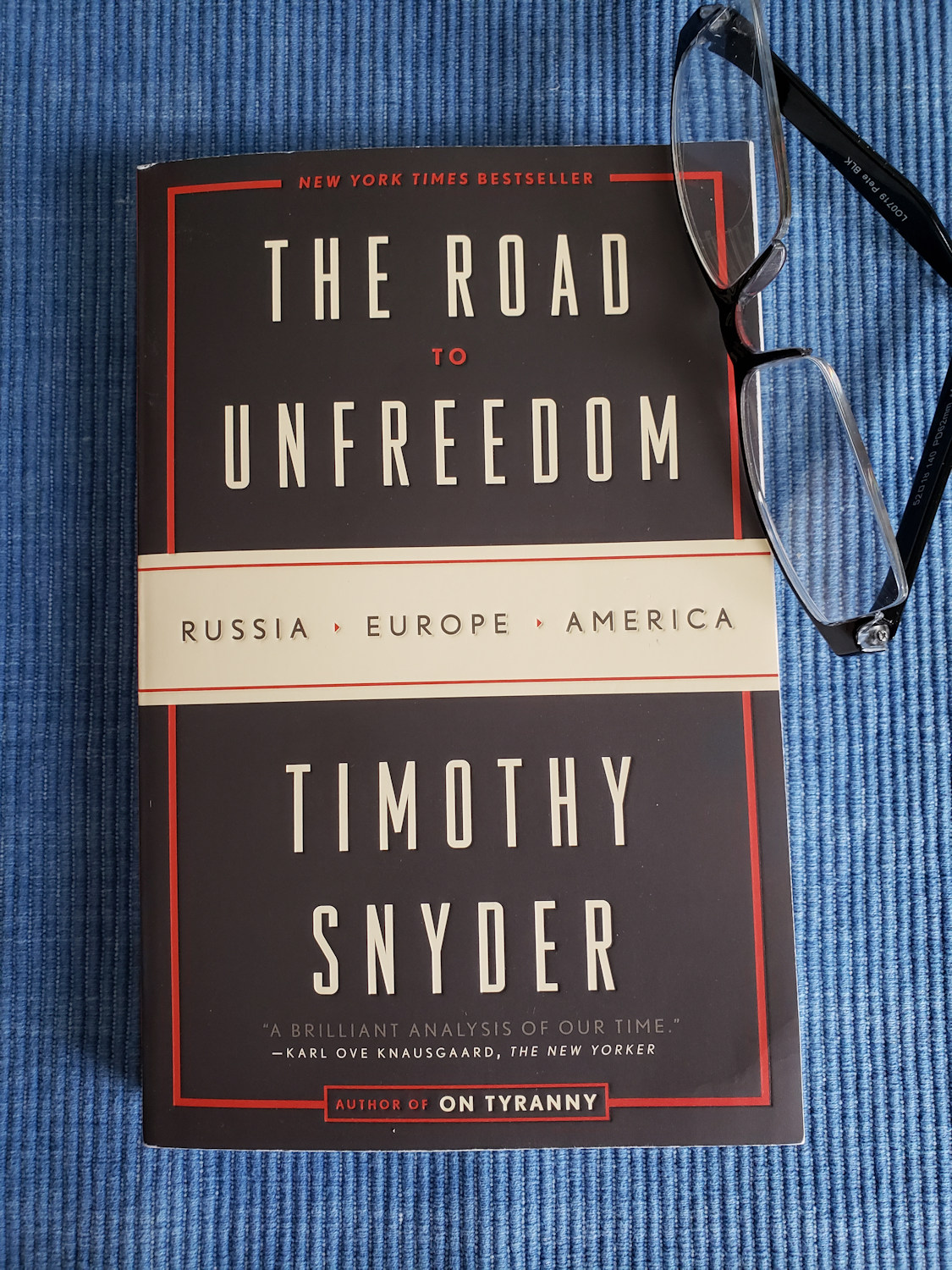
Of everything I’ve read since the rise of Donald Trump, The Road to Unfreedom by Timothy Snyder comes closest to providing a unified theory for understanding the bewildering events of the past decade. Snyder is a professor of history at Yale with a distinguished resume of books and other publications on modern European history. This book was published in 2018, well before the January 6 coup attempt or the Big Lie about the 2020 election or the 2022 Russian invasion of Ukraine, but reading it brings these and other shocking recent events into clear focus–not as isolated “Black Swan” incidents but as part of a much broader pattern with clearly discernible antecedents. The problem was that few were paying attention.
Americans tend to think of what happens here as largely unrelated to political and intellectual movements elsewhere in the world. We’ve all been inculcated since birth with the idea of American exceptionalism . We were also taught to believe in the inevitability of American progress and the sacred invincibility of our democratic institutions, culminating in the triumphal notion of the “end of history” that circulated in the 1990s. Part of the brilliance of Snyder’s analysis is that it shifts the point of view so that the US is no longer at the center as the main protagonist, but rather more on the periphery as a powerful presence but more acted upon than driving the action.
Instead, the focus of this book is Russia and Europe, particularly Ukraine, and it is organized chronologically covering the years from 2011 through 2016. First, however, is a sort of prologue covering the early years of Putin’s reign starting in 1999 with the fall of Boris Yeltsin–the years when Vladimir Putin really became Putin and consolidated his power over a corrupt oligarchy with himself at the center deciding who gets what. With the collapse of Communism and then the failure of democracy to take root in Russia, Putin needed a new national myth to replace the discredited “inevitable triumph” of Communism. He found it in the writings of a long-dead Russian fascist named Ivan Ilyin who had fled to Switzerland during the Soviet era, only to be resurrected and rehabilitated posthumously by Putin. Ideas, even crazy ones, can be powerful once they gain traction.
Ilyin’s central notion was that Russia was divinely ordained to be the center and leader of the vast Eurasian continent stretching from Kamchatka to Portugal organized around Christian fascism. In his view, Western liberal democracy (and the West in general) was the enemy, and Russia was eternally innocent–justified in doing anything to defend itself and advance its power. Ilyin saw Communism as something imposed on Russia by the decadent West. He insisted that Russia was an “organism of nature and the soul”, not something confined within boundaries. Among other things, he denied that Ukraine had any separate existence outside of the Russian organism. Allowing Russians to vote in free elections, according to Ilyin, was like allowing embryos to choose their species. The “redeemer” at the head of the nation was mystically in tune with the people, so there was no need for any institutions that might restrain his actions.
I readily admit to having been ignorant of all this, but Snyder presents it (persuasively, in my view) as the intellectual underpinning and justification for what came next–that is the 2014 military invasion of Ukraine and the massive cyber attacks on democratic governments in Europe and the US as well as the brutal repression of democratic movements within Russia itself. The importance of these events and how they were accomplished went largely ignored in the US news media.
First Putin had to cripple his domestic opposition. In December 2011 he manipulated an estimated 26% of the vote into a majority for his United Russia party in the Russian parliament. Large popular demonstrations ensued, but in March 2012 with the help of massive cyber election fraud, Putin was elected President. To quell popular protests over the fraud, he needed a phantom enemy. The result was a virulent government-sponsored campaign against gays, using the trope that homosexuality was a weaponized import from the West which had infiltrated and manipulated the anti-Putin opposition. Snyder observes that “the purpose of the anti-gay campaign was to transform demands for democracy into a nebulous threat…voting=West=sodomy.” This was combined with a blitz on Russian media claiming that those protesting election fraud had been unleashed by Hillary Clinton and were paid by Western governments and institutions. New laws were passed limiting free speech, and a law banning insults to religious sensitivities made the state police the enforcers of the Russian Orthodox church. Putin specifically exalted Ilyin’s loony ideas about a mystical Eurasia, led by Moscow.
In January 2012, Putin published an article in which he declared that Russians and Ukrainians would never be divided and threatened war against those who failed to understand. The new doctrine challenged the notion that Ukraine was a sovereign nation, which legitimized Russian political meddling and covert cyber operations at a time when Ukraine was seeking association with the European Union–something that Putin was determined to prevent. Putin also elevated to prominence on Russian media other writers and personalities who espoused similar ideas about a kind of Eurasian “manifest destiny” under Russian hegemony and fostered a new think tank called the Izborsk Club that generated and promulgated such notions about Western sexual decadence and anti-semitism which became the intellectual hub of a new Russian Orthodox Christian nationalism. About the same time, Putin was doubling the Russian arms budget.
In 2013, Putin stepped up his efforts to cultivate right-wing Western politicians that opposed the EU like Nigel Farage in the UK and Marine Le Pen in France, providing them a media home on the state-owned network RT (formerly Russian Today), which was broadcast widely in Western Europe in English, Spanish, German, and French. It was also around this time that Russians in Putin’s orbit glommed onto Donald Trump (then fully engaged in the “birther” lie) as a future US presidential prospect.
Snyder argues that the grand strategy here has been to weaken the EU and the US by promoting internal discord and division, deploying media and–better yet–Internet resources that Western countries with a tradition of open discourse were ill-equipped to resist and exploiting existing tensions and fissures in Western societies.
But the immediate objective was Ukraine, where the venal and Moscow-friendly president Viktor Yanukovych was being subjected to increasing pressure from Putin, who had visited Kyiv in July 2013 and declared that Russia and Ukraine were “one people”. But Yanukovych (who had hired future Trump campaign manager Paul Manafort to advise his 2010 election come-back) was also under intense popular pressure to sign an association agreement with the EU, which most Ukrainians saw as protection against being re-absorbed by Russia. On November 13, 2013 Yanukovych (after speaking to Putin) suddenly announced that he would not sign the EU agreement. That set off massive protests in Kyiv’s Maidan square, which only grew through the winter months in numbers and tenacity after Yanukovych used violence to try to quell them and introduced Russian-style dictatorship laws in January 2014. The standoff in Kyiv produced a change in Russian objectives which a policy paper re-defined in February as control over the industrial complex in the eastern Donbas region and the gas transport system in the entire country. The paper also concluded that Yanukovych was finished politically and had outlived his utility. After a final outburst of killing protestors on the Maidan, Yanukovych fled to Russia. Just a few days later, on February 24, 2014 Russia seized Crimea. After a sham election, Putin accepted “the wishes of the people of Crimea” and asserted Russian sovereignty over the region. Then in March, Russian Foreign Minister Lavrov used the killing of a Ukrainian by a Russian in the Donbas as the pretext to justify Russian intervention in that region, all the while denying that Russian military forces were involved.
If you were a little hazy on how this all transpired, you might be forgiven, because it was only sketchily covered by US news organizations. Governments in the US and Europe were in shocked disbelief that Russia would actually take over territory in another country, even though it had already done so in Georgia (Abkhazia and South Ossetia) and reduced its own internal Republic of Chechnya to ruins to crush a rebellion there, and Putin had telegraphed his intentions publicly. Analysts and commentators were confused about how to interpret what happened. Maybe Russia was right about Ukraine really wanting being part of a single Russia (though months of huge protests in the Maidan clearly indicated otherwise). Maybe the Maidan really was a “right-wing coup” as Russian media insisted. The fact that many Ukrainians spoke Russian as their primary language was assumed to mean that their national allegiance lay with Moscow as well. The Donbas region under Russian control was constantly referred to in the media as a “separatist” or “break-away” region, implying that the choice to be under Russian control was homegrown and spontaneous. (Snyder deals with all of these questions with nuance and precision). In any case, the Western response was limited to economic sanctions, and pretty soon it all disappeared from the news–in this country, at least.
Snyder contends that “the Russian invasion of southern and then southeastern Ukraine involved the most sophisticated propaganda campaign in the history of warfare.” As Dmitry Kiselev, the head of the Russian state agency for international news, stated: “Information war is now the main type of war”. Internally, Russian media had been thoroughly bludgeoned into submission as independent journalists were beaten, killed, or driven into exile, so what Russian citizens read or heard was largely under state control. In March 2014, Russian television began showing maps of an area in eastern and southern Ukraine labeled Novorossiia (New Russia). What is now so striking about that map, is that “Novorossiia” covers almost exactly the areas that Russian forces succeeded or attempted to seize in the second Russian invasion in 2022!
The problem was how to deal with the outside world. Putin and his surrogates simply denied what had occurred and Western editors dutifully repeated his lies. As time went on and new incidents penetrated the veil of Western indifference, like the shoot-down of a Malaysian airline in June 2014, the Russian propaganda machine would spew out lies and completely fabricated stories to deflect blame onto Ukraine or Western countries. It didn’t matter that the stories were obviously false and often self-contradictory. They were out there in the ether and inevitably some of it stuck as it was repeated and amplified–as Snyder puts it, a campaign of “implausible denial”.
This was accompanied by what Snyder calls the “broadest cyber offensive in history” against Ukraine, shutting down the power grid, railways, and television, among other things. This got little attention in the West until later in 2014 when Russian hackers penetrated the email networks in the White House, State Department, and Joint Chiefs of Staff. It was about this same time that Cambridge Analytica, the Mercer-financed cyberdata firm then headed by Steve Bannon, started testing messages about Putin on the American public. European targets were also hit, including the German Bundestag and Angela Merkel’s CDU party. Snyder notes also that almost immediately after Merkel announced that Germany would accept millions of refugees fleeing the Middle East, Russian bombers began dropping non-precision bombs on Syria, thereby precipitating an even larger surge of refugees into Western Europe as well as a predictable backlash among voters in Germany and elsewhere. Russian propaganda memes were taken up by Europeans and Americans on the far right, as well as some leftist and libertarian figures such as Stephen Cohen and Katrina vanden Heuvel (writing in The Nation) and Ron Paul (father of senator Rand Paul).
Only in the last 60 pages of the book does Snyder tackle the subject of Donald Trump, who was “openly and exuberantly” backed by Russian officials. Trump’s dealings with shady Russians goes back to the 1980s, when they started buying apartments in his buildings, presumably to launder money, But it wasn’t until the 2000s that figures from Putin’s Russia really started to take an interest in him as someone who could be potentially groomed, and that interest seemed to pick up sharply when Trump became the principal peddler of the “birther” lie–something that RT had been energetically spreading around. Much of what follows will be familiar to anyone who paid attention to the botched Mueller Report or the plethora of investigative reporting during the 2016 campaign and the next several years, but there are nuggets here that I (who really did try to pay attention) don’t remember seeing previously. For example, that “in June 2015 when Trump announced his candidacy, the [Russian] Internet Research Agency expanded to include an American Department. About ninety new employees went to work on-site in St. Petersburg, while others were sent on missions to the United States. The Internet Research Agency also engaged about a hundred American political activists who did not know who they were working for.” Or that “[Jared] Kushner failed to mention, after his father-in-law’s election victory, that his company Cadre held a weighty investment from a Russian whose companies had channeled a billion dollars to Facebook and 191 million to Twitter on behalf of the Russian state.”
But Snyder’s narrative doesn’t depend so much on any single data point as it does on their cumulative weight. While you may have been aware of most of these elements, simply seeing them laid out in relentless chronological order is stunning and overwhelming. As Michael Morell, former acting head of the CIA wrote in a New York Times op-ed in August 2016, “In the intelligence business, we would say that Mr. Putin had recruited Mr. Trump as an unwitting agent of the Russian Federation.” Whether it was indeed “unwitting” we may never know with certainty. Snyder notes that “much of what Russia did was to take advantage of what it found. Hyperpartisan stories on Fox News or outbursts on Breitbart gained viewership thanks to retransmission by Russian bots. Russian support helped fringe right-wing sites such as Next News Network gain notoriety and influence. Its videos were viewed about 56 million times in October 2016.”
A lot has happened in the four years since this book was published. But based on the patterns that Snyder has laid out, not much of it should be surprising. You don’t need to believe that Trump is under orders from Putin to see the parallels between what Putin did in Russia and what Trump attempted–and to a considerable degree succeeded in doing–in the US. He came astonishingly close to overturning a election that he decisively lost and has convinced his party to pretend that he actually won. He has gotten them to implement measures that could insure, if he does run again, that he might well win regardless of the vote. As I have written previously, Putin is Trump’s business model.
Perhaps even more damaging has been the destruction of public trust in democratic institutions, starting with faith in the integrity of elections. If elections are all rigged, why bother to vote? If the courts are all politicized, then the constitution is up for grabs. If a former president can get away with a breathtaking list of crimes up to and including sedition, why should anyone respect the law? It is in this sense that Putin’s aggressive nihilism has had its most spectacular success, taking root and metastasizing in America. In Europe, as well, anti-democratic Christian nationalist forces have gained strength. Brexit happened, weakening the EU. In France, Macron narrowly survived a challenge from Putin acolyte Marine Le Pen. In Italy, hard right Giorgia Meloni, leader of a party with post-Fascist roots, is poised to take over the government. Hungary’s Viktor Orban has consolidated his power in a virtual dictatorship and has become a icon for rightist parties around the world, specifically including the US Republican Party.
Not everything has gone in that direction, of course. Ukraine’s heroic and increasingly successful resistance to Russian aggression in 2022 surprised Western skeptics and rallied most of Europe in its defense, while decisively disproving the “one people” myth. If Ukraine wasn’t a coherent nation before, it certainly is now. Joe Biden’s election has at least temporarily halted the slide into the Trumpian abyss. And yet, there is a pervading sense that we are teetering on the edge where things could fall either way.
The one quibble I have with Snyder’s analysis is with his framing duality between what he calls the “politics of inevitability” and “the politics of eternity”. The first is like faith in the inexorable triumph of Communism or, alternatively, of democracy and the free market–the “end of history”, if you will. The second requires a dispirited sense that things won’t ever get better, that everything is an endless cycle of humiliation, death, and rebirth. Both use a kind of quasi-religious iconography, and both produce a kind of blindness to reality. I can see what he’s driving at, but I also think that these concepts are too amorphous and confusing to be very helpful and are really unnecessary.
That one nitpick aside, this is a stunningly brilliant and prescient analysis of our current world, impressive in both its Big Picture insight and in the meticulous detail of his argumentation. At under 300 pages (excluding endnotes), it’s not a difficult read, and it will give you an understanding of how we got to where we now find ourselves. I wholeheartedly recommend it.
“In America, Negroes do not need to be told what fascism is. We know.” –Langston Hughes
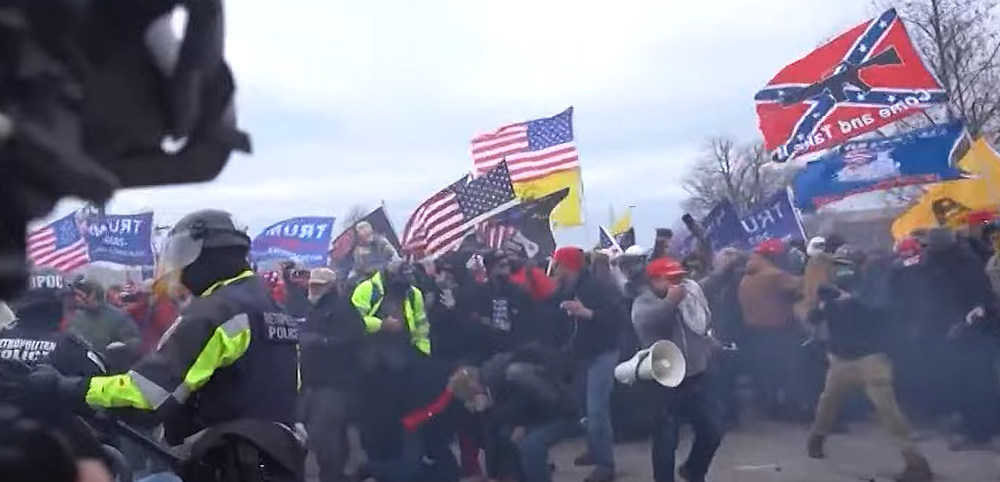
Americans usually think of fascism as something that happened somewhere else–in Europe, or Latin America, not in the United States. But as the country lurches toward the all-too-possible prospect of being under the control of an increasingly fascist Republican Party, it’s time to re-think that. Fascism is actually as American as apple pie–many scholars argue that it originated in the American South–and it has ebbed and flowed throughout our national history. What’s different now is that it is starting to affect nice white people, who in the past could look the other way and either ignore it or call it something else.
In the wake of the January 6 insurrection and coup attempt, which Republicans now dismiss as inconsequential or even normal, a group of eminent historians met with President Biden last week to warn that American democracy is seriously endangered. Republicans and the radical right ecosystem unanimously erupted in outrage that the FBI had carried out a search warrant at Mar-a-Lago for classified documents whose possession by Trump was clearly illegal. This week, conservative New York Times columnist David Brooks published a thumb-sucking piece arguing that prosecuting Donald Trump for his crimes could make it more likely that he will be re-elected. Nothing that Trump did or does seems to shake his hold on white Americans, a large majority of whom remain his ardent supporters. In the 2020 election, after being impeached, Trump received the votes of an estimated 61% of white men and 55% of white women. Immediately after the January 6 insurrection, 147 members of Congress–all Republican and all but 2 of them white–voted against certifying the election results. For most of White America, Donald Trump is its champion.
Its high time to recognize this for what it is: Fascism, which is not an ideology, but rather a style of politics based on racism, hyped grievances, and the threat or actuality of violence.
A brilliant essay by Sarah Churchwell published in 2020 in the New York Review of Books explores the origins of American fascism. Since it’s behind a paywall (albeit a very inexpensive one), I’ll try to summarize it here.
Churchwell cites academic experts on fascism, who note that “fascism can never seem alien to its followers; its claims to speak for ‘the people’ and to restore national greatness mean that each version of fascism must have its own local identity….Historically, fascist movements were also marked by opportunism, a willingness to say almost anything to get into power, rendering definitions even murkier.” This is why a rigorous definition of fascism is such a slippery problem. But there are features common to all such movements, which include: “nostalgia for a purer, mythic, often rural past; cults of tradition and cultural regeneration; paramilitary groups; the delegitimizing of political opponents and demonization of critics; the universalizing of some groups as authentically national, while dehumanizing all other groups; hostility to intellectualism and attacks on a free press; anti-modernism; fetishized patriarchal masculinity; and a distressed sense of victimhood and collective grievance. Fascist mythologies often incorporate a notion of cleansing, an exclusionary defense against racial or cultural contamination, and related eugenicist preferences for certain “bloodlines” over others.” Is this starting to sound more familiar now?
At the time of Hitler’s rise to power, African-American newspapers recognized the similarities between Nazism and Jim Crow and also drew causal connections. The Pittsburgh Courier wrote in 1933 that “German universities under the new regime of the Third Reich were explaining that they drew their ideas from ‘the American pathfinders Madison Grant and Lothrop Stoddard,’ and that “’racial insanities’ in America provided Nazi Germany with ‘a model for oppressing and persecuting its own minorities.’ The African-American New York Age similarly wondered if Hitler had studied “under the tutelage” of Klan leaders, perhaps as “a subordinate Kleagle or something of the sort.” Historians have revealed how Hitler used American race laws as models for the Nuremberg Laws. W. E. B. DuBois also made the connection in his 1935 Black Reconstruction in America, and more than a generation later, Amiri Baraka wrote in 1991 that the end of Reconstruction “heaved Afro America into fascism. There is no other term for it. The overthrow of democratically elected governments and the rule by direct terror, by the most reactionary sector of finance capital… Carried out with murder, intimidation and robbery, by the first storm troopers, again the Hitlerian prototype, the Ku Klux Klan, directly financed by northern capital.” It took a while for white historians to catch up. It wasn’t until 2004 that Robert O. Paxton in his book The Anatomy of Fascism observed that the Ku Klux Klan can be viewed as the world’s first fascist movement. At its height in the mid-1920s the Klan had about 5 million members.
In the 1930s, there were other American groups modeled after Mussolini’s Black Shirts and Hitler’s Brown Shirts whose purpose was to threaten and intimidate blacks, Jews, and Catholics. Then there was the Canadian-born self-proclaimed “fascist” Catholic priest, Father Charles Conklin, whose radio broadcasts from Detroit reached an audience of 30 million Americans with their anti-Semitic propaganda and defended Kristallnacht as just retribution for Jewish “crimes”. And Louisiana governor Huey Long who “imposed local martial law, censored the newspapers, forbade public assemblies, packed the courts and legislatures with his cronies, and installed his twenty-four-year-old lover as secretary of state.” Roosevelt feared he would become a Hitler-type candidate for president, but he was killed during an assassination attack in 1935. More than 200,000 people attended his funeral. Sinclair Lewis’s 1935 novel It Can’t Happen Here about a fascist American president, was modeled on Long, who once told Lewis’s wife that “American Fascism would never emerge as a Fascist but as a 100 percent American movement; it would not duplicate the German method of coming to power but would only have to get the right President and Cabinet.” FDR’s vice president Henry Wallace wrote in 1944 that “American fascism will not be really dangerous, until there is a purposeful coalition among the cartelists, the deliberate poisoners of public information, and those who stand for the K.K.K. type of demagoguery.” Which is pretty much what we have now.
Churchwell notes some of the obvious examples of fascist markers during the Trump presidency, but adds that “American fascist energies today are different from 1930s European fascism, but that doesn’t mean they’re not fascist, it means they’re not European and it’s not the 1930s. They remain organized around classic fascist tropes of nostalgic regeneration, fantasies of racial purity, celebration of an authentic folk and nullification of others, scapegoating groups for economic instability or inequality, rejecting the legitimacy of political opponents, the demonization of critics, attacks on a free press, and claims that the will of the people justifies violent imposition of military force.” Fascism is propelled more by feelings than thought, and it needs to mobilize passions, which partly explains why Trump’s support base never wavers. She concludes: “Trump is neither aberrant nor original. Nativist reactionary populism is nothing new in America, it just never made it to the White House before. In the end, it matters very little whether Trump is a fascist in his heart if he’s fascist in his actions.”
In the two years since Churchwell’s essay was published, we have seen The Big Lie metastasize and become the sacred text of the Republican Party, which has closed ranks around Trump and dares not cross him in any meaningful way for fear of retribution from the faithful base. Republicans in states they control have gerrymandered themselves into permanent supermajorities to the point that they can’t lose elections. Republican-controlled state legislatures are passing laws that potentially would allow them to overturn elections, including presidential elections, and have nominated candidates for secretaries of state (who control the election machinery) who endorse the Big Lie. Republican-controlled states are passing laws imposing criminal penalties for teachers who deviate from the sanitized and white-centric approved curriculums for history, civics, and even math. Control measures about concealed or open carry of firearms have been eliminated in many Republican-controlled states, as radical right militias proliferate and grow and the stockpile of military-grade weapons in private hands has reached frightening levels. A decades-long campaign to dominate the court system by installing rightist judges at the state and national level has now reached fruition with complete control of the Supreme Court. The list of these fascist-style measures already in force or in the works goes on and on.
Trump is the essential symbol and catalyst for the movement, but he’s no longer necessary to be its actual leader. He works just as well as a virtual deity in the metaverse and/or as a martyr, and there are plenty of mini-me’s like DeSantis or Abbott or Hawley or Cruz vying to seize the reins and take it to a new level.
The reversal of Roe v. Wade may have finally startled some white people into a realization of what is actually happening. Suddenly, it’s not just blacks, or gays, or Muslims, or undocumented immigrants who are being targeted. Before, nice white people could tut-tut about what a shame it was that “those people” were being mistreated, but now it’s hitting us! Whether it’s already too late to stop being sucked into the black hole of fascism is now the existential question.
This morning on the CBS show Sunday Morning, there was a segment in which Ted Koppel talked to passengers on a tourist bus in Mount Airy, North Carolina–which lives off its fame as the real-life setting for the fictional Mayberry of the nostalgic Andy Griffith Show of the 1960s. The passengers were all white, mostly in their 40s through 70s. Koppel asked them if they believed Biden had won the 2020 election legitimately. Only two raised their hands. The rest had clearly bought into the Big Lie and weren’t at all shy about saying so. I’m sure all the people on that bus consider themselves good, decent folks and would be mightily offended at being called fascists. But if fascism takes power in America, they will be the reason why.
 TrumpWorld for Beginners