
Everybody hates paying taxes, right? And it seems that the richer people get, the more they hate it and the more they want to shift the burden to the non-rich. So now we have in the White House (except on weekends) the richest president we’ve ever had, and he wants to give the richest among us–including himself–enormous tax breaks. What follows gets fairly wonkish, but stick with me because it’s really important to understand what’s at stake.
Let’s start with the Estate Tax, because it’s the easiest to understand. Republicans have long made it the bogeyman of taxes, ominously calling it the “Death Tax”, and Trump has vowed to eliminate it. But for most people in this country–99.8 percent to be exact–the estate tax is ABSOLUTELY IRRELEVANT because their estates are not big enough for it to be applied. You would have to have an estate worth more than $5,450,000 (or $10,900,000 for a married couple) for it to even apply, and an estate worth up to that figure can be passed on to your heirs completely tax-free. So unless you’re really, really rich, you should worry about something else.
Even people with enormous wealth can bequeath most of their estates to their heirs–all of the amount below the figure where the tax kicks in plus 60 percent of the amount above that. Most of estate funds subject to the tax are actually from unrealized capital gains that have never been taxed. The mythical family farm or small business supposedly destroyed by the Estate Tax turns out to be a veritable unicorn. In practice, the very wealthy have come up with legal stratagems to avoid paying much of the tax. Even so, the Congressional Budget Office estimates that the Estate Tax would generate $275 billion over the next 10 years. As the non-partisan Center for Budget and Policy Priorities points out, that’s less 1 percent of federal revenue, but still “significantly more than the federal government will spend on the Food and Drug Administration, the Centers for Disease Control and Prevention, and the Environmental Protection Agency combined.” And that was before their budgets got chopped by the Trump Administration.
Trump whines that the Estate Tax is so unfair. Bloomberg News calculates that abolishing the tax would save the Trump estate some $564 million (based on an estimated net worth of $3 billion–which is considerably less that the $10 billion Trump has claimed). His wealthy cabinet and their families would also make out like bandits. Bloomberg estimates that Betsy DeVos’s father-in-law might save $900 million!
The estate tax just happens once, so let’s talk about two big changes that Trump wants to make that would happen every tax year.
The first is eliminating the Alternative Minimum Tax. Most of us mere mortals never have to pay attention to this because our incomes and claimed deductions aren’t large enough for it to kick in. The AMT limits certain deductions and adds back the amount to taxable income. It is specifically designed to keep very rich people from being able to get away with paying virtually nothing in taxes.
Let’s take Trump’s just revealed form 1040 for the year 2005 as an example. The elimination of the AMT would have reduced his effective tax rate to about 4 percent–saving him 80 percent of his tax bill for 2005. Easy to see why he’d love to get rid of the AMT.
The other pillar of Trump’s tax “reform” is to reduce the maximum marginal tax rate from the current 39.6 percent to 33 percent. Bear in mind that this maximum rate only applies to taxable income in excess of a certain amount ($466,950 for a married couple filing jointly). Income below that amount is taxed at progressively lower rates. Reducing this top tax rate would theoretically mean that Couple A who earned $200 million would be taxed at the same current rate as Couple B that earned $200,000. In actual fact, even if the AMT were still in place, Couple A would probably be taxed at a considerably lower rate because much of their income would be from capital gains or other sheltered sources rather than salaries.
According to the Urban Institute/Brooking’s Tax Policy Center, the Trump tax plan would cut the annual taxes of the top 0.1 percent (those with incomes over $3.7 million) by about $1.1 million or about 14 percent of their after-tax income. By contrast, a household in the middle fifth of income levels would get an average tax cut of $1010 (about 1.8 percent of after-tax income), and the poorest fifth would get a measly $110 tax break.
This, in a nutshell, is the Trump tax “reform” strategy: Throw a few crumbs to average Joe Shmoe in Ohio, who won’t notice that the rich are making off with the rest of the cake.
Of course, if everyone gets a tax cut and the rich get a really big tax cut, then as night follows day this means that government revenues will shrink bigly. The Trump team fantasizes that a resulting miraculous spurt in economic growth will compensate for the loss of revenue because the lower tax rates will be applied to a larger economy, but this has never actually happened.
The effect of the tax “reform” on the budget and deficit is a separate (and obviously related) topic, but basically two things can happen: 1) the deficit will balloon (which is exactly what happened when W. cut taxes and then started a war), or 2) the non-military part of the federal government will be cut drastically (which is precisely what the Trump administration is proposing). Or more likely, it will be a combination of both.
The Republicans’ wet dream has always been to kill off the social safety net and other non-military sectors of the federal government by starving it of revenue. Now they see their chance to militarize the government by pouring funds into defense and homeland security while privatizing everything else. Where in history have we seen this sort of thing before?
One of the parts of the Affordable Care Act that would be eliminated by the Republican “replacement” unveiled this week, is the requirement that Medicaid cover basic mental-health and addiction services in states that expanded it. Among the 31 states (and DC) that did expand Medicaid are those bearing the brunt of the opiate crisis, including Ohio, Kentucky and West Virginia. Some 33,ooo people–a record number–died from opioid overdoses in 2015, and the 15 counties with the highest death rates from overdoses were in Kentucky and West Virginia. Perhaps the Republicans regard all of this as Darwinian selection, but then they don’t believe in evolution, do they?
Another bill cleared committee in the House that would impose severe penalties for employees who refused genetic testing as part of workplace wellness programs. The legislation, if enacted, would undermine basic privacy provisions of the Americans With Disabilities Act and the 2008 Genetic Information Nondiscrimination Act (GINA). According to the Washington Post, the House legislation would allow employers to impose penalties of up to 30 percent of the total cost of the employee’s health insurance on those who choose to keep such information private. The bill, Preserving Employee Wellness Programs Act, HR 1313, was introduced by Rep. Virginia Foxx, (R-N.C.), who chairs the Committee on Education and the Workforce. A committee statement said the bill provides employers “the legal certainty they need to offer employee wellness plans, helping to promote a healthy workforce and lower health care costs.” It passed on a party-line vote, with all 22 Republicans supporting it and all 17 Democrats opposed.
The Senate voted 49 to 48 to eliminate a regulation, dubbed the Fair Pay and Safe Workplaces rule, which required federal contractors to disclose and correct serious safety violations and would limit the ability of companies with recent safety problems to complete for government contracts unless they agreed to remedies. Shortly before the vote, Sen. Elizabeth Warren (D-Mass.) released a staff report that says that 66 of the federal government’s 100 largest contractors have at some point violated federal wage and hour laws. Since 2015, the report says, more than a third of the 100 largest OSHA penalties have been imposed on federal contractors.
The Trump administration’s proposed budget for the National Oceanic and Atmospheric Administration–the nation’s prinicipal agency studying and dealing with climate change–targets a handful of programs that provide important resources to help coastal states prepare for sea level rise.These programs include NOAA’s Coastal Zone Management grants and Regional Coastal Resilience grants, which come to $75 million combined; its $10 million in Coastal Ecosystem Resiliency grants; the National Estuarine Research Reserve System, an annual investment of about $23 million; and its $73 million Sea Grant program. South Florida’s coastal residents especially should pay attention. But by the time the Atlantic Ocean engulfs Mar-a-Lago, I’m sure Trump or his heirs will have unloaded it off on some Russian oligarch.
In related news, the new head of the Environmental Protection Agency, Scott Pruitt, said on March 9 that he did not believe that increased levels of carbon dioxide in the atmosphere was a primary contributor to global warming. His statement contradicts a consensus of climate scientists arrived at after decades of analysis of data, not to mention the EPA’s own website.
And if anyone doubted that the Trump administration and Big Oil were in synch, in a March 6 news release, ExxonMobil highlighted its plan to spend $20 billion over 10 years, build 11 chemical and natural-gas projects and create 45,000 jobs. Within the same hour, the White House put out its own statement claiming credit for the expansion and adding, “The spirit of optimism sweeping the country is already boosting job growth, and it is only the beginning.” One full paragraph appeared nearly identically word for word in both releases. Another sentence appeared almost verbatim elsewhere. ExxonMobil spokesman Alan T. Jeffers said that the company had supplied the information to the White House, which dutifully reproduced it. Thanks, Exxon! Now what has Rex Tillerson been up to?
The administration announced plans for deep cuts to the budgets of the Coast Guard (14 percent), TSA, and FEMA (11 percent each), in order to shift about $5 billion to security at the Mexican border– for hiring new agents, infrastructure, and of course, The Wall. In other words, in order to help finance Trump’s useless and quite unnecessary fantasy project, he’s proposing to weaken security for the nation’s airways and coastlines and increase the risk of another Katrina, which climate change makes more probable with each passing year.
On March 10, Trump met with executives of smaller banks and promised to eliminate regulations on banking oversight and reporting requirements imposed by Dodd-Frank, which Trump has pledge to eviscerate. The banks are complaining that the regulations are too burdensome and “crushing” their ability to make loans. Despite the industry’s grousing, bank profits are actually at record levels, according to the Washington Post. Last year, the country’s nearly 6,000 banks — from large players like Bank of America to small community banks — made more than $171 billion in profits, up nearly 5 percent compared with 2015, according to government data. Community bank profits have been rising even faster — 10 percent last year. The proportion of community banks that made a profit reached 95.7 percent last year compared with 78.8 percent in 2010 when the Dodd-Frank Act was passed. So it couldn’t have been hurting them all that badly.
Meanwhile, the Washington Post reported that Republicans in the House are quietly advancing several bills that would make lawsuits against corporations and doctors more difficult. The measures would severely limit class-action lawsuits and cap malpractice awards, and would insulate large corporations and the health-care industry from retribution for any kind of harm they may cause everyday people.
So for anyone who voted for Trump because he was going to protect the little guy, the joke’s on you, sucker!
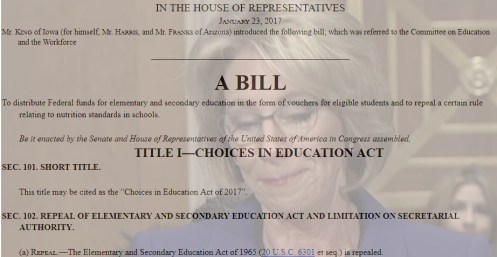
Amid the furor over RussiaGate and repeal of the Affordable Care Act, most of us had missed the introduction of House Resolution 610 (aka Choices in Education Act) which would radically change and limit federal government authority in American public education. The bill, sponsored by Republican representative Steve King of Iowa (and co-sponsored by 3 other Republicans) would do two things: a) repeal the Elementary and Secondary Education Act (ESEA) of 1965 and limit the authority of the Department of Education to bestowing block grants on states that comply with school voucher requirements, and b) eliminate the rule that established nutritional requirements for school lunch and breakfast programs. To read the summary and full text of the bill, click here.
Just to be clear how truly breathtaking this bill is, it would require states to create a system of school vouchers that could be used in any private elementary or secondary school in order to get any federal funds for education. And it would reduce the Department of Education to a dispenser of block grants to the states that complied. In the words of the bill: “The Secretary shall not impose any further requirements on States with respect to elementary and secondary education beyond the requirements of this title.” In other words, no standards for educational achievement, diversity, equality, special needs, etc. And it would let the states put junk food back in school lunches!
To put it another way, it would take the federal government completely out of the business of education except for providing a monetary incentive for states to issue vouchers for use in private schools. Basically, the bill combines a blunt instrument for diverting federal education funds into private (including religious or for-profit) schools with the dissolution of the Department of Education. Everybody wins, right?
Well, not exactly. Let’s start by looking at what would be lost by repealing the ESEA, which was passed to address the vast disparities in American public education in terms of race and geography by redirecting resources to poorly served areas and minority groups. Obviously, those disparities have not disappeared, but there has been progress, and the subsequent iterations of ESEA (which has to be re-authorized every five years) have dealt with other issues by instituting programs for struggling learners, AP classes, ESL classes, classes for minorities such as Native Americans, Rural Education, Education for the Homeless, School Safety (Gun-Free schools), Monitoring and Compliance and Federal Accountability Programs, special needs education, bullying, etc. The current version of the ESEA is the Every Student Succeeds Act, which was passed in 2015 to replace its predecessor, the No Child Left Behind Act passed in 2001 under the Bush administration. The latest version places less emphasis on standardized testing as a measure of school performance.
Repealing ESEA would mean that programs and standards would be left to state and local administrations without federal oversight, and state and local school boards tend to be more susceptible to political manipulation. In fact, educational achievement varies enormously among the states with Massachusetts and Vermont typically scoring at the top and Mississippi and Alabama at the bottom. Scores in some low-performing localities like DC have improved markedly in recent years. For an interactive comparison, click here.
But the primary focus of HR 610 is obviously to promote the privatization of public education. This, of course, is what Betsy DeVos is all about, so you could easily say that this is exactly why she is the Secretary of Education. Perhaps even more fervently than even the rest of the Republican party, she has tirelessly spent her time and, more importantly, her money promoting the idea that public funds should be used for sending kids to private and religious schools.
There are two reasons to oppose this. One is philosophical and the other is practical. I personally believe that having good public schools is a large part of what made the US the great country that it became, and that it is a basic element of social justice to do everything possible to insure that kids from disadvantaged circumstances have an opportunity to get a quality public education just as my own middle-class children did. I also believe that it is wrong and unconstitutional to use public funds to support schools that promote any particular religious agenda.
But let’s talk about the practical aspect of this, and by that I mean results. It is easy enough to find individual students who have benefitted from voucher programs that enabled them to attend private schools. But policy needs to be based on aggregate results, not cherry-picked cases.
The problem is that the evidence available from many years of school voucher programs in various locations is ambiguous at best. A recently-released Stanford University study of programs in Milwaukee, New York City, Washington DC, Indiana, and Louisiana over 25 years found that there was “no evidence that voucher programs significantly increase test scores…At best, they have only a modest impact on high school graduation rates,…and the risks they pose outweigh any advances.” Other serious attempts to measure the impact of such programs have come to much the same conclusion–some schools do a little better, some do a little worse, but vouchers are not the magic cure for what ails our public schools.
The Stanford study concluded that there are “policy changes that are likely to have much higher payoffs than privatization,…including teacher training, early childhood education, after-school and summer programs, student health programs and heightened standards in math, reading and science curricula.” All of these things are jeopardized by HR 610.
What voucher programs unquestionably do, however, is to transfer public resources to religious organizations and for-profit corporations. Indeed, the majority of the voucher-based school programs that DeVos promoted in Michigan involved for-profit corporations. Moreover, unless states establish strict accountability standards, private schools may not be subject to the same scrutiny that public schools are. At her hearing, DeVos steadfastly refused to say if she would require equal accountability for private schools benefitting from a voucher program.
Other types of programs, such as Florida’s “tax credit scholarship” program (which Trump has touted) enable corporations to get dollar-for-dollar tax credits for their contributions to nonprofit scholarship organizations. Parents can get up to $5,886 per student (about $2,000 less than the average cost of Florida private schools) and apply that money toward tuition at a set list of private K-12 schools. About 85 percent of the schools in the program are religious schools. The program essentially distorts the tax revenue stream by diverting corporate tax dollars directly into private schools.
There are now 17 states with tax credit scholarship programs, but HR 610 would force all states to set up a voucher program of some sort to get their block grants of federal educations funds. So much for letting the states and localities decide.
Fortunately, the fate of this bill is questionable at this point, but it clearly indicates the direction that the Trump administration wants to go. It needs to be firmly put down before it gets any further. The problem is that with everything else going on, few people may be paying attention.
Carter Page, PhD, was vaulted suddenly from obscurity into the limelight in March of last year, when Donald Trump named him along with four others as a member of his foreign policy team in an interview with the Washington Post editorial board. By late September, Page had become a non-person to the Trump team. In mid-January, Sean Spicer stated that, “Carter Page is an individual whom the President-elect does not know and was put on notice months ago by the campaign.” So what happened between March and September to cause his meteoric rise and precipitous fall? This is a long post, but it’s pretty interesting, so stick with me.
Trump’s statement a year ago sent the media scurrying to find out who this guy was. There was general puzzlement at all of the choices, as none were very prominent in the foreign policy world. It turned out that Page was founder and managing partner of a company called Global Energy Capital, and had graduated from the US Naval Academy. He had worked in the energy sector at Merrill, Lynch in London and Moscow, and had had a fellowship from the Council on Foreign Relations in the late 90s. Oddly, his bio on the Global Energy Capital website does not mention the PhD that Trump attached to his name. (Page told BloombergPolitics that the PhD came from the School of Oriental and African Studies at the University of London, but didn’t say when.) The website bio states that “he spent 3 years in Moscow where he was responsible for the opening of the Merrill office and was an advisor on key transactions for Gazprom, RAO UES and others.” Page is the only person listed on the management tab of the GEC website, which seems remarkably short on detail about the enterprise.
In the Bloomberg interview, Page said that while at Merrill Lynch in Moscow from 2004 to 2007, “he advised Gazprom [the huge Russian gas company] on its largest deals during this period, such as buying of a stake in the Sakhalin oil and gas field in the Sea of Okhotsk. He also helped the company court Western investors, assisting in setting up the first regular meetings with shareholders in New York and London.”
It’s not clear whether Page’s role in Moscow was quite as prominent as he has suggested. The Bloomberg piece cites a former top executive from the Merrill Lynch Moscow office, who described him as a junior banker with little understanding of the country. “I could not imagine Carter as an adviser on foreign policy…It’s really surprising.” In September, Julia Ioffe, a writer for Politico , started digging further and found a number of respondents who said that Page’s role in Moscow was much more junior and mundane than the rainmaker he was presenting himself as. She found that the Madison Avenue address for his company was actually a shared work site. This is a fascinating article, which presents Page as a kind of Zelig figure who kept popping up in important places, but who had no great influence on what was going on there. Well, he wouldn’t be the first guy to inflate a resume.
According to the Bloomberg article, Page took a buyout from Merrill Lynch in 2008 and started his company, but then the Great Recession hit and since then he had mostly done low-profile advisory assignments, such as counseling foreign investors on buying assets in Russia.
So how did he come to Trump’s attention? That, too, is a murky question. Ioffe tried to find out, but by that time none of the obvious suspects would admit to having recruited him. In his bizarre interview with MSNBC’s Chris Hayes last week, Page refused to answer a direct question on this point. (Speculation now seems to hover around Sam Clovis, the former co-chair of the Trump campaign.)
In recent years, Page has published a series of essays in an online journal called Global Policy (sponsored by Durham University in England). The articles are a mystifying series of non-sequiturs and jarring juxtapositions. An example is The Secret and the Surge: ISIS Response Self-help Principles for Would-be Warriors of the West, which seeks to apply the principles of Rhonda Byrnes’ self-help book “The Secret” to Middle East policy.
In another article from 2015 (New Slaves, Global Edition: Russia, Iran, and the Segregation of the World Economy), Page writes: In the landmark Brown v. Board of Education case of 1954, the U.S. Supreme Court ruled that it was unconstitutional to create separate public schools for black and white students. In February of that same year, the Soviet Union completed an internal transfer of the Crimean peninsula from the Russian Soviet Federative Socialist Republic to the Ukrainian SSR…. Despite the long-standing close cultural ties between Russia and Crimea, the administrative reshuffle of 1954 was based on the false assumption that no Western official could ever be foolish enough to lead a revolution in Ukraine that promotes pro-U.S. radicals to power in Kiev. Even more unthinkable is that such hand-selected rebels would be hostile to Russia’s interests. In the wake of such careless decisions, the March 2014 democratic referendum which followed in Crimea thus led to a predictable result.
You may, like me, find that paragraph difficult to parse, but it does contain a frequent theme in Page’s writing, which is that the US should be nicer to Russia and let Moscow do whatever it feels it has to do in Ukraine. It seems likely that ideas like this were what attracted the Trump team’s attention.
It’s unclear what role Carter Page played in the Trump team. (He was very cagey about this in the Chris Hayes interview.) But the press reported that he turned up in Moscow again in July two weeks before the Republican convention in Cleveland and again publicly criticized US policy. According to Yahoo News, Page made a commencement address for the New Economic School, an institution funded in part by major Russian oligarchs close to Putin, where he asserted that “Washington and other West capitals” had impeded progress in Russia “through their often hypocritical focus on ideas such as democratization, inequality, corruption and regime change.”
Whether he met with other Russian officials then, either on his own or representing the Trump campaign, is still unclear. John Podesta, whose emails were published by WikiLeaks perhaps after being obtained by Russian hackers, stated in December that “Carter Page, one of Trump’s foreign policy advisers, went to Russia before the Republican convention and met with a person in the Russian hierarchy who was responsible for collecting intelligence.” According to Politifact, in an interview with the state-run news agency, Interfax, Russian deputy foreign minister Sergei A. Ryabkov said “there were contacts” with Trump’s “entourage” throughout the election, according to multiple translations of the interview. “I cannot say that all of them, but quite a few have been staying in touch with Russian representatives.” The Trump campaign denied this, and the Russian foreign ministry later clarified that Ryabkov meant Russian officials had met with Trump’s political allies and supporters, not his campaign staff directly.
Page attended the Republican convention in Cleveland later in July, where he met with Russian ambassador Sergey Kislyak. Chris Hayes got him to confirm that this meeting took place after a great deal of hemming and hawing on Page’s part, though he maintains that this was just an anodyne and totally legitimate general conversation. It is interesting to note that Kislyak apparently did not go to the Democratic national convention.
On August 27, Senate Minority Leader Harry Reid sent a letter to FBI Director Comey asking for an investigation into reports that Russian was trying to tamper with the US election. In his letter, Reid referred indirectly to a speech given in Russia by one Trump adviser, Carter Page, who criticized American sanctions policy toward Russia–apparently referring to the July commencement speech at the New Economic School.
Then on September 23, the Yahoo News story appeared with the following lede: “U.S. intelligence officials are seeking to determine whether an American businessman identified by Donald Trump as one of his foreign policy advisers has opened up private communications with senior Russian officials — including talks about the possible lifting of economic sanctions if the Republican nominee becomes president, according to multiple sources who have been briefed on the issue. The activities of Trump adviser Carter Page, who has extensive business interests in Russia, have been discussed with senior members of Congress during recent briefings about suspected efforts by Moscow to influence the presidential election, the sources said.”
And suddenly, the Trump campaign team couldn’t quite recall if they knew who Carter Page was. On September 24, Steven Cheung, the campaign’s director of rapid response, told ABC News when asked about the report: “He has no role. We are not aware of any of his activities, past or present.” On the following day, when CNN’s Jake Tapper asked Kellyanne Conway about the Yahoo reports, she said, “Well, I have not spoken with him at all, in fact, meaning he’s not part of our national security or foreign policy briefings that we do now at all, certainly not since I have become campaign manager.” Carter who??!!
Page publicly denied the reports, calling them “complete garbage”, and then largely dropped out of sight for a while. Then in January, Buzzfeed published the “dossier” compiled by British investigator Christopher Steele, which among other sensational allegations claimed that Igor Sechin, the CEO of Russia’s state oil company, offered Carter Page and his associates the brokerage of a 19% stake in the company in exchange for the lifting of US sanctions on Russia. This was sourced to “a trusted compatriot and close associate” of Sechin. The report claimed that the offer was made in July when Page was in Moscow for the commencement speech. According to the dossier, “Page had expressed interest and confirmed that were Trump elected US president, then sanctions on Russia would be lifted.”
In February, the website The Intercept published a bizarre letter apparently written by Page to the Civil Rights Division of the Department of Justice demanding an investigation into “the severe election fraud in the form of disinformation, suppression of dissent, hate crimes and other extensive abuses led by members of Mrs. Hillary Clinton’s campaign and their political allies last year.” The letter went on to claim that “the actions by the Clinton regime and their associates may be among the most extreme examples of human rights violations observed during any election in U.S. history since Dr. Martin Luther King, Jr. was similarly targeted for his anti-war views in the 1960’s.” According to The Intercept, Page appended three documents to the letter: a July 2016 speech he delivered at the New Economic School in Moscow; a response to the director of national intelligence’s report claiming that Vladimir Putin ordered the Russian government to intervene in the 2016 election to help Trump; and a September 15 letter to FBI Director James Comey asking him to close any inquiry into Page.
This took place in the context of Trump’s unsubstantiated allegations of widespread voter fraud in favor of Hillary Clinton. So was this an attempt by Page to get back into Trump’s good graces? If so, it doesn’t appear to have worked, and Page evidently remains in the Siberia of TrumpWorld.
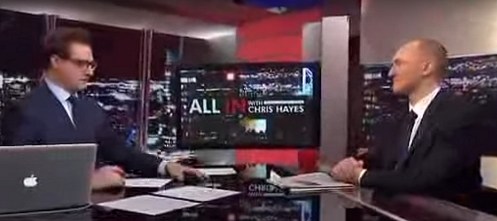
Which bring us to Carter Page’s cringeworthy interview on March 2 with Chris Hayes on MSNBC. I would charitably describe Page’s performance as evasive, and less charitably as weaselly. If you haven’t seen the video yet, watch it and judge for yourself.This was followed the following day by an even more detailed and excruciating grilling by Anderson Cooper in which Page seems to be trying simultaneously to downplay his role and still claim some importance and status. At some point in the interview, Cooper exclaimed “Weird!”, which pretty much sums it up. I would judge that the objective of his appearance on the interviews was to play down his role in the Trump team and place all discussions that he “might or might not have had” with Russian officials in the context of normal exchanges with foreign emissaries.
So what does all this add up to? Obviously, no smoking gun, but there sure is a lot of smoke. The fact that the Trump team dropped him like a flaming turd after the Yahoo story, suggests that they were worried that he could provide information validating the allegations of collusion with the Russian government and oligarchy. At this point, both Page and the Trump team clearly share an interest in minimizing his importance. But if he was such a nobody, why would the Russians have invited him to make his July speech? The fact that they did that implies that at least they thought he had some influence on the Trump team.
We still don’t really know if he was just a clever, fast-talking hustler on the make or something much more.

The continuing uproar over RussiaGate has not distracted the Trump administration from its aim of “deconstructing the administrative state.” The practical implications became startlingly real when Trump’s budget proposal was released on Monday calling for a major increase in spending for defense and correspondingly sharp cuts for programs relating to education, the environment, science, and the social safety net.
No agency is under greater attack than the Environmental Protection Agency, which is now anticipating having to cut staff by 20 percent and eliminate dozens of programs. An avowed foe of the EPA, Scott Pruitt, was confirmed last week as the agency’s director, and he appears determined to cripple the EPA’s enforcement and monitoring capabilities as quickly as possible. Grants to states, as well as EPA air and water programs, would be cut by 30 percent. The massive Chesapeake Bay cleanup project would receive only $5 million in the next fiscal year, down from its current $73 million.
The New York Times reported that Trump will likely sign executive orders next week aimed at destroying the major pillars of Mr. Obama’s environmental legacy. One of these is the 2015 rule known as the Waters of the United States, which gives the federal government broad authority to limit pollution in major bodies of water, as well as in streams and wetlands that drain into those larger waters. Another would begin the process of withdrawing and revising Mr. Obama’s signature 2015 climate-change regulation, aimed at curbing emissions of planet-warming greenhouse gases from coal-fired power plants.
According to the Washington Post, the EPA will pull back on strict fuel-efficiency standards for future cars and light trucks, dating from a 2009 deal struck with the Obama administration. Two associations representing the world’s biggest automakers last week asked EPA Administrator Scott Pruitt to reconsider the standards for model years 2022 to 2025, which would require the nation’s car and light-truck fleet to average 54.5 miles per gallon by the end of that period. The Trump administration reportedly wants to issue an executive order that would revoke California’s ability to set its own, tighter targets for those model years. California is the only state allowed to do so under the Clean Air Act, but other states can adopt its regulations as their own.
The NYT also reports that the Trump administration intends to relax restrictions on tailpipe emissions of carbon dioxide, a change that will not require action by Congress. Of course, all of these measures are key elements of the US commitment under the 2014 Paris Agreement to cut greenhouse gas pollution that is producing global climate change.
Speaking of climate change, the Washington Post reported that the administration is planning a 17 percent cut in the budget of the National Oceanic and Atmospheric Administration, the nation’s premier climate science agency. This would impose big cuts on research funding and satellite programs which produce much of the data on which climate science depends.The OMB outline for the Commerce Department (of which NOAA is a part) for fiscal 2018 proposed sharp reductions in specific areas within NOAA such as spending on education, grants and research. For an administration that denies the reality of climate change, that is probably exactly the goal.
The Post notes further that the proposed cuts would also eliminate funding for a variety of smaller programs, including external research, coastal management, estuary reserves and “coastal resilience,” which seeks to bolster the ability of coastal areas to withstand major storms and rising seas.
Trump’s budget would also slash funding for the already-struggling Internal Revenue Service by some 14.1 percent, according to the New York Times. The IRS has already been weakened severely by previous budget cuts imposed by the Republican-controlled Congress. The Times notes that individual tax return audits fell last year to its lowest level since 2004, and enforcement staffing levels were down by nearly 30 percent from 2010, to just below 16,000. Criminal investigations related to tax-related identity theft, money laundering, public corruption, cybercrime and terrorist financing also are on the decline as well. Maybe Trump thinks that’s a good thing. Crippling the IRS is one way of realizing the conservative dream of “starving the beast.”
On Thursday, the newly-confirmed Secretary of the Interior (Ryan Zinke, a former congressman from Montana) rode to work like Marlboro Man astride a horse borrowed from the Park Police. Among his first official acts was to overturn the U.S. Fish and Wildlife Service’s guidance to agency managers to phase out the use of lead ammunition and fishing tackle on national wildlife refuges by 2022. Residual lead fragments are estimated to kill between 10 and 20 million birds each year, along with other species. But it’s an intolerable burden to ask hunters and anglers to spend a few extra cents for non-toxic substitutes.
The WaPo has also noted that this week Trump signed some executive orders without the fanfare of reporters and photographers being present. These would be the ones that the White House has apparently decided maybe wouldn’t look so good to the public. One such recent signing was to rescind the Obama regulation to tighten gun background checks by requiring the Social Security Administration ro release the names of people who receive government checks for being mentally disabled and others who have been deemed unable to handle their own financial affairs to the FBI office that runs the national background check database. The NRA thinks it’s fine for mental incompetents to have guns and evidently the Trump administration does too. They’d just rather that everybody didn’t know about it.
It’s really happening, people!
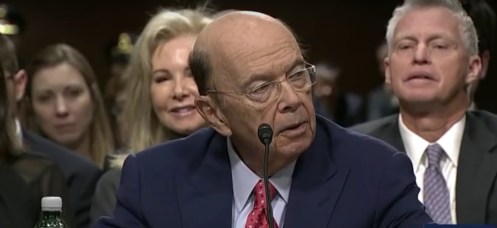
Given everything else going on, nobody paid much attention to the nomination of Wilbur Ross, who was confirmed as Secretary of Commerce on February 27 by a vote of 72-27. But it appears that Ross is yet another Trump associate who has significant financial ties to the Russian oligarchy and, by logical extension, the Russian government.
This is a very complicated story, but it was explicated well by Rachel Maddow on her broadcast earlier this week. Watch the segment here. It’s long, but it’s better than anything else you’ll see on television this weekend. As I said, this involves a very complex web of connections with lots of fascinating tangents, but reduced to its most basic essence, the relevant part of the story is as follows:
Since 2014, Ross has been a business partner of Viktor Vekselberg, one of Russia’s richest men and a close associate of Vladimir Putin, in the Bank of Cyprus. According to an investigation by Mother Jones (and other press accounts),the island of Cyprus (which is an EU member country) and this bank in particular had become a haven where rich Russians could expatriate their money to avoid Russian taxes and, likely in many cases, launder funds acquired by, um, unorthodox means. In 2013, the bank was on the verge of collapse, leading to a rescue in which billions in Russians’ deposits were converted to a majority of the bank’s shares, which worried European financial authorities. Enter Wilbur Ross, who in 2014 led a takeover of the bank in which Russian shareholders were offered a buyout. Ross then became the bank’s largest individual shareholder.
Soon thereafter, the bank announced that Vekselberg’s conglomerate, the Renova Group, had become the bank’s second-largest shareholder. Vekselberg and the Renova Group have a history of close ties to the Kremlin. In October 2014, a new board of directors was unveiled, which included Ross as vice-chairman. According to the Mother Jones story, also on the board would be Maksim Goldman, a Renova executive representing Vekselberg’s interests, and Vladimir Strzhalkovskiy, a previous board member whom Russia Today a year earlier had identified as a Putin associate and former KGB official. Ross and Vekselberg also recruited Josef Ackermann, a former head of Deutsche Bank, to come in as chairman. This was another Russian connection. As Bloomberg reported, “Ackermann, a regular visitor to the Putin-hosted St. Petersburg International Economic Forum while head of Deutsche Bank, is a director of Renova Management AG, an industrial holding company controlled by Vekselberg.” (Ackermann left Deutsche Bank after a scandal involving banking irregularities and $10 billion in Russian funds and for which the bank eventually paid a punitive fine of $630 million.) For a thorough look at the Bank of Cyprus, click here.
According to a report in the Miami Herald, Ross was involved with Russia during the 1990s when President Clinton appointed him to serve on the U.S-Russia Investment Fund, an investment fund set up in 1995 to help push the new Russian nation toward a free-market economy after the Soviet Union collapsed. The fund was converted to a nonprofit corporation in 2008 and many of its assets sold off. The banking investments were purchased by a subsidiary of German financial giant Deutsche Bank, led at the time by Josef Ackermann.
There is another curious tangent to this story. Another Russian oligarch named Dmitry Ryvoloviev (sometimes spelled Ryboloblev)–aka “the fertilizer king”–in 2010 acquired a 10 percent share of the Bank of Cyprus. A few years earlier, Ryvoloviev was involved in a spectacularly expensive divorce battle–reportedly involving a settlement of $4.5 billion–and was looking for places to buy in order to shelter his monetary assets. Among various real estate purchases he made around the world was an enormous “white elephant” property in Palm Beach, which he bought in 2008 for a reported $95 million from Donald Trump. The purchase price raised eyebrows at the time, because Trump had purchased the property at auction only four years earlier for $41 million, and the real estate market–especially in Florida–had softened as the mortgage crisis began to plunge the country into a deep recession. Apparently, Ryvoloviev didn’t care–he just needed some place to stash his money. At the time, Trump’s organization reportedly really needed the money to service loans from–wait for it–Deutsche Bank, Trump’s largest known lender.
It sort of looks like a form of money laundering, but you know, in a legal kind of way, right? FYI, last year the new owner announced plans to tear down the house and divide the property into three parcels, each to sell for $35-40 million.
All of this was known to the senators who held the hearings for Ross’s confirmation. In fact, six senators led by Florida’s Bill Nelson asked written questions about Ross’s relationship to other Russian stakeholders in the Bank of Cyprus. Ross also received a second letter on the Friday before his confirmation from Senator Cory Booker with more detailed questions about possible Russia links. Both Ross and the White House stonewalled and failed to respond.
Nonetheless, he was confirmed. Nelson even voted for him. Go figure!
If you want to see how your senator voted, click here. You might be surprised.
Update: Tonight (3/3) on the Rachel Maddow show, she closed with an intriguing segment about Ryvoloviev’s plane being at the same airport at the same time as Trump’s plane on several occasions during the past year in Concord (NC), Charlotte, Las Vegas, and Miami. Doesn’t prove anything, of course, but it’s an awfully interesting series of coincidences.
Democrats in the House forced a roll-call vote on a resolution calling for the release of 10 years of Donald Trump’s tax returns on February 27. The move failed on a straight party line vote (225-189), with all Republicans voting against the measure (two voted “present”). After the vote, Minority Leader Nancy Pelosi declared, “Tonight, House Republicans made themselves accomplices to hiding President Trump’s tax returns from the American people.”
FYI, all the South Florida Republican representatives (Carlos Curbelo, Ileana Ros-Lehtinen, and Mario Diaz-Balart) voted against the resolution, even though Curbelo had previously said that Trump should release his tax returns.
This was the latest in a series of Democratic attempts to use congressional powers to compel their release. An earlier attempt introduced by Texas Democrat Lloyd Doggett failed in the House Ways and Means Committee on February 14, again on a straight party-line vote.
Meanwhile, the Washington Post reported that a Democratic attempt to force the Justice Department to produce records relating to its probe of Trump’s alleged ties with Russia was killed in the House Judiciary Committee, once again on a straight party-line vote. (Do we see a pattern here?) This measure seems to have been prompted by Democrats’ suspicions that the Justice Department’s investigation was just a sham–a belief made more credible by Attorney General Sessions’s refusal to recuse himself from participation.
Now Sessions himself is in hot water, with the revelation last night in the Washington Post that during his confirmation hearings he failed to disclose meetings with the Russian ambassador prior to the election. This has led Democrats to call for Sessions to resign, and even a few prominent Republicans are now saying that he must recuse himself from the Justice investigation. House Oversight and Government Reform Committee Chairman Jason Chaffetz (who himself has stifled any inquiries into RussiaGate in his committee) tweeted early Thursday that “AG Sessions should clarify his testimony and recuse himself.” However, House Speaker Paul Ryan continues to defend Sessions and pretend that there is nothing amiss, while Majority Leader Kevin McCarthy has waffled on this issue.
Now the Wall Street Journal is reporting that “U.S. investigators have examined contacts Attorney General Jeff Sessions had with Russian officials during the time he was advising Donald Trump’s presidential campaign.”
Then there is the story that the New York Times broke last night, that Obama administration officials had “scrambled to spread information about Russian efforts to undermine the presidential election — and about possible contacts between associates of President-elect Donald J. Trump and Russians — across the government. Former American officials say they had two aims: to ensure that such meddling isn’t duplicated in future American or European elections, and to leave a clear trail of intelligence for government investigators.” Significantly, the Times story adds: “American allies, including the British and the Dutch, had provided information describing meetings in European cities between Russian officials — and others close to Russia’s president, Vladimir V. Putin — and associates of President-elect Trump.” And, “American intelligence agencies had intercepted communications of Russian officials, some of them within the Kremlin, discussing contacts with Trump associates.”
The good news here is that the press, especially the New York Times and the Washington Post, are doing a great job of investigative journalism. Without their work, Congress would be utterly inert and unreactive. Clearly, the Republicans are doing everything possible to delay and obstruct any real investigation and will be moved only by a massive public outcry. We need to have a special independent investigation.
Meanwhile, Trump and his minions are doing everything they can to destroy the credibility of a free and independent press. That’s what would-be dictators do. Our democracy absolutely depends on these independent institutions. Social media are nice, but they do not and cannot do the in-depth investigative reporting that these great journalistic organizations do. They need our help to survive. Subscribe to them!
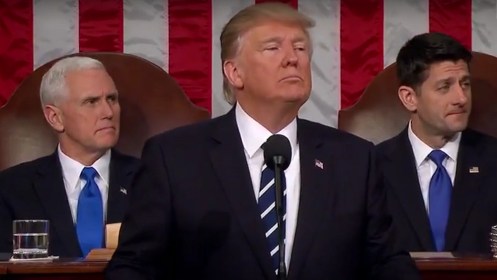
For me, the low point of Trump’s falsehood-laden speech to Congress last night came in his shameless exploitation of the widow of Navy Seal William “Ryan” Owens, who was killed on a botched anti-terrorist raid in Yemen on January 27. [Video here]
The problem here is not his recognition of Owens’ service and sacrifice or his widow’s loss, but rather the fact that Trump himself refuses to take any responsibility for approving the raid or for the circumstances in which it took place. In fact, only the day before his speech, Trump appeared on Fox News to repeat his false claim that the raid had been approved by the Obama administration and to pass the blame for losing Owens onto “the generals.” Moreover, Owens’ father refused to meet with Trump when the latter showed up at Dover Air Force Base when the body was returned and has called for an investigation of how the raid was authorized.
According to the New York Times, Trump rather casually gave the operation the green light five days after he took office, while having dinner with Steve Bannon, Jared Kushner, Defense Secretary Mattis, VP Mike Pence, and then-national security adviser Mike Flynn. And, of course, there has been no call in the Republican-controlled Congress for any Benghazi-like investigation of what went wrong.
Obama administration officials who were involved in the planning process for such operations have said that the Pentagon had worked up a general proposal that asked for the authorities to do raids in Yemen, but that this mission was not specifically a part of that. Nor did then-President Obama make any decisions because he thought it represented an expansion of the war in Yemen and believed the Trump administration should assess how to proceed.
Trump notoriously refuses to acknowledge his mistakes and failures, while eagerly claiming credit for accomplishments he had nothing to do with. The hypocrisy of Trump’s exploitation of what has been widely assessed (including by John McCain) as a failure and turning Owens’ death into the emotional climax of his speech is as mind-blowingly cynical as anything he has done thus far. Now miraculously, according to Trump, the operation has become “a highly successful raid”.
The hypocritical apogee occurred after a very long ovation for Owens and his widow when Trump declared that “Ryan is looking down–you know that–and I think he’s very happy, because I think he just broke a record.” (You know, like he had gotten really good ratings.) Amazingly, that line got laughs!
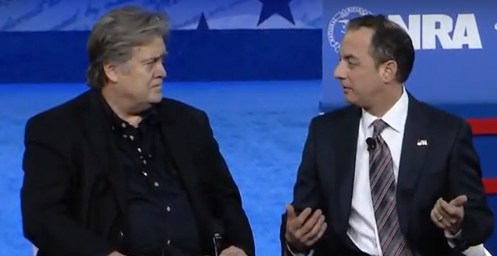
If you thought that the Trump administration’s goal is to dismantle the non-military functions of the federal government, Steve Bannon confirmed that yesterday. If you were wondering if the Republican party is fully in step, Reince Priebus just confirmed that too.
At the annual Conservative Political Action Conference (CPAC), Bannon declared that the Trump administration is in a battle for the “deconstruction of the administrative state.” And White House chief of staff Reince Priebus, who supposedly represents the Republican establishment, was right next to him to say “amen.”
Of course, anyone who paid even slight attention to Trump’s cabinet choices wouldn’t have needed Bannon’s statement to understand this. Virtually every cabinet nominee for the civil departments of the federal governments has been specifically selected to subvert the administrative and regulatory functions of the agency they are supposed to lead.
Consider Scott Pruitt at EPA, Betsy DeVos at Education, Puzder at Labor (at least that one got shot down, no replacement named yet), Mnuchin at Treasury, Mulvaney at OMB, Price at HHS, the list goes on and on. And then there’s Jeff Sessions at Justice to make sure that the government’s judicial machinery doesn’t interfere with the program. Bannon actually said that nominees “were selected for a reason, and that is deconstruction.”
So if you like having clean air and water, support public schools, believe in paying workers a living wage, think Wall Street and Big Banking need to be regulated to avoid another crash, believe the government needs to have fiscal and monetary tools to mitigate the next recession, want more people to have access to affordable medical care, etc., you now have a government that wants all of these functions delivered into the hands of unconstrained corporate interests. What could possibly go wrong?
The message from Bannon and Priebus at CPAC–which the irrepressible Kellyanne Conway said should really be called “TPAC” (you know, Trump Political…)–is that there really is no daylight between the Trump/Bannon team and the Republican party. After all, even supposedly principled Republican senators like McCain and Graham voted for every last one of Trump’s cabinet nominees.
The best, and perhaps only effective, weapon against this program of destruction is massive, unrelenting, and loud resistance by ordinary Americans who are letting their elected representatives know what they think at town halls across the country, whether their representatives show up or not. This may actually be having some effect, because so far the only prominent Republican member of congress to show up at CPAC has been the reptilian Ted Cruz.

To hear Trump talk about it, you might think that the country is having an unprecedented crime wave. During the campaign, he vowed that his administration would “liberate our citizens from the crime and terrorism and lawlessness that threatens their communities” and that “the crime and violence that today afflicts our nation will soon, and I mean very soon, come to an end.” He has claimed that the national murder rate is at its highest in 45 or 47 years. He has singled out Chicago (threatening to “send in the Feds”) as being the worst example of crime being out of control in America’s major cities, which he says are “facing a public safety crisis.” The trouble is that most of this narrative is false.
For complicated reasons, the US has long had much more crime that other developed countries, but national crime rates have dropped sharply since the early 90s and remain at levels not seen since the mid-1960s, despite an uptick since 2014.
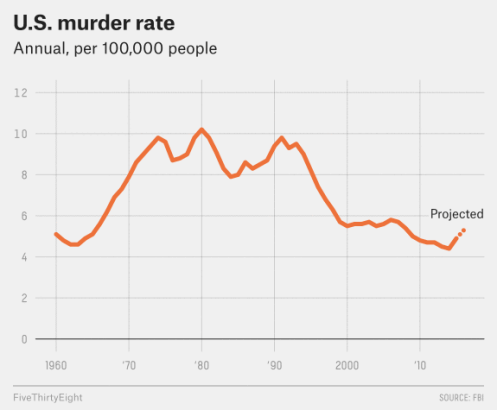
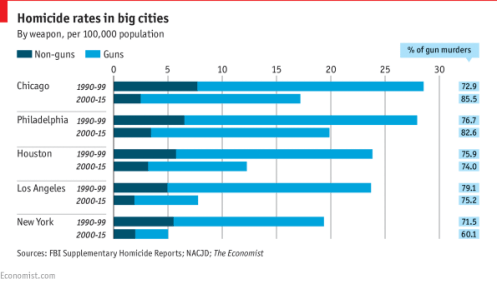
Chicago has a very serious crime problem and has suffered from increased gun violence in the last two years, but it isn’t even close to having the highest crime rate among the country’s major cities. In fact, St. Louis has the dubious distinction of having the highest murder rate among big cities in the US (more than twice that of Chicago, which ranked 8th in 2016). The other top ten cities in 2016 were (in descending order) Baltimore, Detroit, New Orleans, Cleveland, Newark, Memphis, Kansas City, and Atlanta. Moreover, San Antonio topped Chicago in percentage increase in the murder rate in 2016, followed closely by Memphis. A five-year average of murder rates 2015-2015 in major cities, shows Chicago ranked 18th, with about a third the rate of St. Louis, New Orleans, and Detroit. Many smaller cities throughout the country have much higher murder rates than these.
Take a look at this interactive graphic published by The Economist. Virtually all cities share the general trend of decline in murder rates since the early 90s, but if you look at them individually you see that there are spikes and dips that have no obvious correlation to the larger crime trends. Indeed, criminologists have not been able to come up with any compelling explanation for the spike in violent crime in some cities–certainly not the one that Trump has been peddling which is that it’s because of violent gangs of illegal immigrants, something for which there is no evidence. In Chicago, the violent crime is concentrated in a few areas on the West- and Southside, and the rest of the city is as safe as any city in the country.
So why is Trump continuing to hold up Chicago as the poster town for violent crime? I think one fairly obvious reason is that Chicago is Obama’s adopted home town, and Trump likes nothing better than to denigrate anything associated with Obama. Then there’s the mayor, Rahm Emanuel, who was Obama’s chief of staff during his first term, which makes it a twofer. Emanuel, by the way, has met with Trump and other key members of his administration but has not received any pledges of increased federal assistance, despite Trump’s blustering about “sending in the feds.”
More generally, Trump has interwoven the false narrative of skyrocketing crime with the even greater false narrative of out-of-control illegal immigration. Hyping “inner city” (Whitespeak for “black”) crime plays to the racial fears and prejudices of his base of white suburban and rural supporters, convincing them–again falsely–that they’re in greater danger than ever of becoming a crime victim, and they better arm themselves.
Indeed, the most glaring omission in all this discussion is any mention of the proliferation of guns. The Economist points out that: “Crunching numbers on 280,000 murder records from 1980 to 2015 shows that among our 50 cities gun use has increased from 65% to 80% of all murders. But that number varies dramatically by city. Guns were responsible for 60% of murders in New York and 85% in Chicago between 2010 and 2015. Although both places have made progress in reducing non-gun-related homicides, Chicago’s gun murder rate is five times New York’s.”
Good luck these days having any conversation about reducing the number of guns.
 TrumpWorld for Beginners