
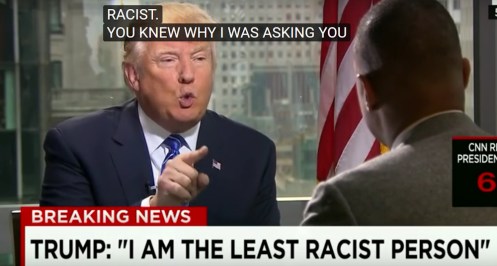
“I am the least racist person that you have ever met.” Donald Trump, interviewed by CNN’s Dan Lemon, 12/9/2015. “Number one, I am the least anti-Semitic person that you’ve ever seen in your entire life. Number two, racism, the least racist person.” Trump press conference, 2/16/2017
Usually when someone insists “I’m not a racist” it’s because he really is racist, or is about to do or say something racist.
The second quotation above, occurred after a Jewish journalist (wearing a yarmulke) asked Trump about the recent rise of anti-Semitic hate crimes in the US. Trump took umbrage at the question, and after rudely telling the reporter to sit down, said that it was “not a fair question” and “a very insulting question”, all the while failing to actually answer it.
Only a few minutes later, Trump recognized veteran African-American journalist April Ryan (saying “this is going to be a bad question”), who asked about his campaign pledge to help inner cities and an anticipated executive order on historically black colleges and universities (HBCUs).
Regarding the order, Trump said only that it would be coming out soon. [As of this writing, it has not been made public. Omarosa Manigault reportedly is involved in the project, and it may turn out to be a vehicle to cast Trump in a favorable light relative to Obama, who had a somewhat strained relationship with HBCUs.]
Trump then launched into an extended boast about how well he had done with black voters. [Factual note: He received an estimated 8 percent of the black vote versus Romney’s 6 percent in 2012 running against an incumbent African-American president.] And Latino voters. And women voters. This then segued into the familiar trope about what “hell” America’s inner cities are. He said nothing about any plans except “great people” are “working very hard” on inner cities.
Ryan followed up by asking if Trump planned to involve the Congressional Black Caucus, at which point Trump turned strangely hostile and confrontational, asking her if she “wanted to set up the meeting” and if the CBC were friends of hers. When she pointed out that she was just a reporter, he challenged her to “set up the meeting” as if that were her role. He then claimed that Rep. Elijah Cummings had pulled out of a meeting, probably at the instigation of Senator Schumer “or some other lightweight”. [Note: The transcript of this portion of the press conference is appended at the bottom of this post.]
Reportedly, no meeting had been officially scheduled, and Rep. Cummings stated that he had “no idea why President Trump would make up a story about me like he did today,” adding that “of course, Schumer never told me to skip a meeting with the president.”
All of this followed Trump’s excruciating February 1 remarks on Black History month. [Full transcript here.] Flanked by Omarosa and Ben Carson (maybe the only black people Trump actually knows?), he began his remarks by bragging about the election, and then said, “Well this is Black History Month, so this is our little breakfast, our little get-together.” In the midst of talking mostly about himself, he managed to mention a few iconic black historical figures (Dr. King, Rosa Parks, Harriet Tubman) and then said, “Frederick Douglass is an example of somebody who’s done an amazing job and is being recognized more and more, I noticed.” [Pause for embarrassed laughter.] Perhaps someone had told him something about Douglass, but failed to mention that he has been deceased for over a century.
Several things stand out here. One is Trump’s disdain for “our little breakfast”, for which he clearly did utterly no preparation. Obviously, his staffers didn’t bother to set him up for this either, which says a lot about the level of White House interest in black voters in general. Another is his failure to acknowledge anything about the outstanding achievements of African-Americans or the vital role of ordinary black citizens in contemporary society or the continuing discrimination that black people encounter in our country. His only reference to present-day challenges was to harp again on the “terrible” state of the “inner city,” without any idea of what he might propose to address problems, except to have Carson “work very hard.”
Then there was Trump’s pre-inauguration Twitter attack on civil rights hero Rep. John Lewis, after Lewis stated that he didn’t see Trump as “legitimate president” because of Russian meddling in the election. Trump angrily tweeted: “Congressman John Lewis should spend more time on fixing and helping his district, which is in horrible shape and falling apart (not to mention crime infested) rather than falsely complaining about the election results. All talk, talk, talk – no action or results. Sad! Congressman John Lewis should finally focus on the burning and crime infested inner-cities of the U.S. I can use all the help I can get!”
Aside from the sheer effrontery of saying that Lewis, who was savagely beaten by white segregationist Southerners during civil rights protests, was “all talk”, it turns out that Lewis’s district is actually doing quite well, thank you, and is far from the “burning and crime-infested” ghetto of Trump’s uninformed imagination.
All of this has occurred against the backdrop of the most blatantly racist campaign since George Wallace’s. Here is what Shaun King, of the New York Daily News recently had to say about that:
You were given a resounding endorsement by the KKK. Current and former Klan leaders have sung your praises for years now. Neo-Nazis literally give the Nazi salute to you and your presidency. Bigots, be they young ones or old ones, commit hate crimes against Jews, immigrants, Muslims and people of color, and frequently say they are doing so in your name. In other instances, they chant your name and your name alone as a form of ethnic intimidation. When graffiti is left on buildings to intimidate people, right alongside racial slurs and swastikas, your name is tagged on buildings and playgrounds and cars across America. Have you ever wondered why white supremacists and neo-Nazis didn’t use George Bush’s name like this? Or Bill Clinton’s? Or Barack Obama’s? It’s because they were not seen as white supremacist superheroes and you are.
I don’t know if Trump is personally a racist or not–maybe he just feels entitled to act like an asshole to anyone. But there is no doubt in my mind that many of his ideas are racist, and that he has consciously courted racists and white nationalists as supporters. The fact that his words and actions are denounced as racist probably just solidifies his base support.
He obviously finds it uncomfortable to be accused of racism, but in the final analysis, he just doesn’t really care.
TRUMP: Yes, oh, this is going to be a bad question, but that’s OK.
QUESTION: It doesn’t(ph) have(ph) to be a bad question.
TRUMP: Good, because I enjoy watching you on television. Go ahead.
QUESTION: Well, thank you so much. Mr. President, I need to find out from you, you said something as it relates to inner cities. That was one of your platforms during your campaign. Now you’re —
TRUMP: Fix the inner cities.
QUESTION: — president. Fixing the inner cities.
TRUMP: Yep.
QUESTION: What will be that fix and your urban agenda as well as your HBCU Executive Order that’s coming out this afternoon? See, it wasn’t bad, was it?
TRUMP: That was very professional and very good.
QUESTION: I’m very professional.
TRUMP: We’ll be announcing the order in a little while and I’d rather let the order speak for itself. But it could be something that I think that will be very good for everybody concerned. But we’ll talk to you about that after we do the announcement. As far as the inner cities, as you know, I was very strong on the inner cities during the campaign.
I think it’s probably what got me a much higher percentage of the African American vote than a lot of people thought I was going to get. We did, you know, much higher than people thought I was going to get. And I was honored by that, including the Hispanic vote, which was also much higher.
And by the way, if I might add, including the women’s vote, which was much higher than people thought I was going to get. So, we are going to be working very hard on the inner cities, having to do with education, having to do with crime. We’re going to try and fix as quickly as possible — you know, it takes a long time.
It’s taken more a hundred years and more for some of these places to evolve and they evolved, many of them, very badly. But we’re going to be working very hard on health and healthcare, very, very hard on education, and also we’re going to be working in a stringent way, in a very good way, on crime.
You go to some of these inner city places and it’s so sad when you look at the crime. You have people — and I’ve seen this, and I’ve sort of witnessed it — in fact, in two cases I have actually witnessed it. They lock themselves into apartments, petrified to even leave, in the middle of the day.
They’re living in hell. We can’t let that happen. So, we’re going to be very, very strong. That’s a great question and — and it’s a — it’s a very difficult situation because it’s been many, many years. It’s been festering for many, many years. But we have places in this country that we have to fix.
We have to help African American people that, for the most part, are stuck there. Hispanic American people. We have Hispanic American people that are in the inner cities and their living in hell. I mean, you look at the numbers in Chicago. There are two Chicagos, as you know.
There’s one Chicago that’s incredible, luxurious and all — and safe. There’s another Chicago that’s worse than almost any of the places in the Middle East that we talk, and that you talk about, every night on the newscasts. So, we’re going to do a lot of work on the inner cities.
I have great people lined up to help with the inner cities. OK?
QUESTION: Are you going to include the Congressional Black Caucus and the Congressional —
TRUMP: Well, I would. I tell you what, do you want to set up the meeting?
QUESTION: — Hispanic Caucus —
TRUMP: Do you want to set up the meeting?
QUESTION: No — no — no. I’m not —
TRUMP: Are they friends of yours?
QUESTION: I’m just a reporter.
TRUMP: Well, then(ph) set up the meeting.
QUESTION: I know some of them, but I’m sure they’re watching right now.
TRUMP: Let’s go set up a meeting. I would love to meet with the Black Caucus. I think it’s great, the Congressional Black Caucus. I think it’s great. I actually thought I had a meeting with Congressman Cummings and he was all excited. And then he said, well, I can’t move, it might be bad for me politically. I can’t have that meeting.
I was all set to have the meeting. You know, we called him and called him. And he was all set. I spoke to him on the phone, very nice guy.
QUESTION: I hear he wanted that meeting with you as well.
TRUMP: He wanted it, but we called, called, called and can’t make a meeting with him. Every day I walk and say I would like to meet with him because I do want to solve the problem. But he probably was told by Schumer or somebody like that, some other lightweight. He was probably told — he was probably told “don’t meet with Trump. It’s bad politics.”
And that’s part of the problem in this country.
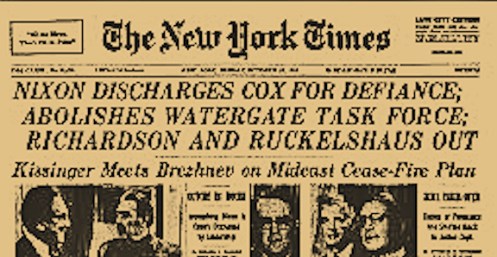
Let’s say it plainly: The Republican Party has decided to be complicit in covering up what may well be the greatest political scandal in American history.
As the New York Times stated today, the only way RussiaGate is going to get a genuine investigation is with an independent Special Prosecutor, which the congressional Republicans continue to block. The Republicans are simply too focused on implementing their legislative agenda now that there is nothing to stop them to allow a little thing like having a president compromised by ties to Russia get in the way.
Mitch McConnell, the most cynical and self-serving senate majority leader in recent memory, continues oppose even the appointment of a select congressional committee, and most Republican leaders are acting as if Flynn’s resignation has taken care of the problem. Paul Ryan makes occasional clucking sounds, but has been silent about the larger scandal and called Flynn’s conversations with the Russian ambassador “entirely appropriate.”
As economist Paul Krugman points out, the Republican chairs of the relevant congressional committees are simply ignoring what is in front of their noses. Devin Nunes, chair of the House Intelligence Committee, dismissed calls for a select committee saying, “There is absolutely not going to be one.” Jason Chaffetz, chair of the House oversight committee — who hounded Hillary Clinton endlessly over Benghazi — declared that the “situation has taken care of itself.” (However, Chaffetz isn’t too busy to investigate a pre-school cartoon character on PBS!) Rand Paul explained: “We’ll never even get started with doing the things we need to do, like repealing Obamacare, if we’re spending our whole time having Republicans investigate Republicans.”
Most tellingly, this week the House Ways and Means Committee, which has the power to demand individual tax returns, rejected a Democratic push to get the IRS to release Trump’s returns, on a straight party-line vote.
The handful of senate Republicans with any remaining vestiges of moral integrity continue to prevaricate. Curmudgeonly John McCain makes occasional harrumphing noises, but has backed off from calling for a select committee. Tinkerbell-like Lindsay Graham flits around making vaguely disapproving statements once in a while, but has not called for an independent investigation either. As they showed during the election campaign, when the chips are down, they will go with Trump.
Meanwhile, the Democrats simply don’t have the votes in Congress to force anything and will have to make what they can out of the Republican-controlled inquiries in the various committees, which are likely to focus on Flynn rather than aggressively go after the bigger scandal.
Trump’s appalling ability to dissemble, dodge, distract, and misdirect were on full display at yesterday’s mind-boggling press conference. His responses were completely incoherent even regarding Flynn, while he claimed incredibly to have absolutely no dealings with Russia. There has to be a pony somewhere in this pile of horseshit.
At this point, the only hope really is that the press will uncover further evidence regarding RussiaGate and that the American public will forcefully demand a full and independent investigation.
Otherwise, it’s the end of the world as we know it, and the Republicans feel just fine.
.
[*Apologies to W. B. Yeats]
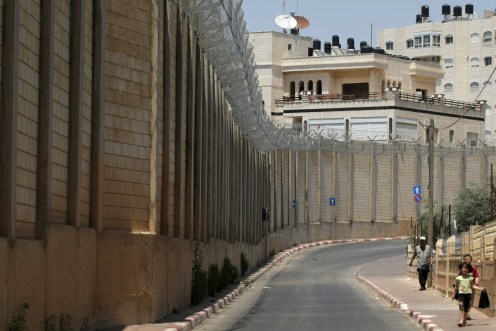
Israeli Security Barrier in Jerusalem’s Beit Hanina neighborhood, 2009. Source: The Times of Israel
The Israeli news media was filled with speculation on Sunday that the Trump administration would immediately announce the [American] embassy move [to Jerusalem] — as a de facto recognition of Israel’s annexation of predominantly Arab East Jerusalem, which it captured from Jordan during the 1967 war. The New York Times, 1/23/2017
Israeli Prime Minister Netanyahu is meeting with Trump in the White House today. In the last couple of weeks, the Trump administration has seemed to ease off from the campaign pledge to move the embassy immediately, but has not disavowed this intention.
Why is it such a big deal to move the US Embassy from Tel Aviv to Jerusalem? The answer both simple and extremely complicated.
The simple answer is that no other country has its embassy located in Jerusalem because the UN and (at least until now, the US) considers the status of Jerusalem to be subject to negotiation as part of an overall peace settlement on the status of Israeli-occupied territories. If the US embassy were to move there, it would inflame anger against both the US and Israel in the Muslim world, because it would inevitably be seen as de facto recognition of Israel’s claim to Greater Jerusalem and, by implication, support for Israeli settlements in the West Bank and continued effective control over the West Bank. A violent reaction seems highly likely.
The complicated part is understanding how all this happened and what it means for the future of people who live in the West Bank and Israel itself. To begin to comprehend all of this requires a lesson in both geography and history of the place. The following is an extremely abridged version:
Start by realizing that we’re talking about a very small place. Israel is about the size of New Jersey, and the West Bank is about the size of Delaware. The city of Tel Aviv on the Mediterranean Sea is less than 10 miles from the official border between Israel and the West Bank.
When Israel was carved out of the former British mandate of Palestine in 1947, a war with neighboring Arab countries broke out which expanded the area inside Israel. The 1949 armistice established a border–generally called “the Green Line”–between Israel and the area west of the Jordan River and Dead Sea (hence the name West Bank) still controlled by Jordan. But most important, the Old City of Jerusalem containing the sites sacred to Jews, Christians, and Muslims remained in what was then still Jordanian territory.
All this was changed by the 1967 war, which left Israel in control of the entire West Bank. . Almost immediately, Israel annexed about 100 square miles of territory including all of East Jerusalem–something which has never been recognized by the US or the UN.
Flash forward to 1993, when the Oslo accords established a Palestinian Authority (PA) and divided the West Bank into three areas. Area A, in which the PA had both civil and security control, contained most of the major towns in geographically separated pockets of land and comprised only 18% of the land in the West Bank. Area B, where Israel has security control and the PA civil control comprises 21% of the land area. The remainder, Area C, is fully under the control of Israel and is 61% of the West Bank. To travel from one A or B area to another, residents must pass through Area C and are subject to rigorous security searches by the Israeli military.
Meanwhile, starting soon after the 1967 war, Jewish Israelis began building settlements in East Jerusalem and scattered throughout the West Bank on land acquired by means ranging from purchase to legal seizure to outright squatting. Some of the settlements are considered “illegal”, but most have been authorized and indeed subsidized by the Israeli government. The settlements are distributed widely and have further split up the physical integrity of the West Bank, and they have been a cause of anger and violence by Palestinians. The settlers tend to be very conservative politically and religiously, and many believe in their right to control Greater Israel based on a Biblical mandate. They receive significant financial and political support from private US donors, including Jewish and conservative Christian groups. As of December 2015, there were 406,302 Israeli settlers on the West Bank (according to official figures) plus another 360,000 in the annexed area of East Jerusalem.

Map of West Bank settlements and closures in January 2006: Yellow = Palestinian urban centers. Light pink = closed military areas or settlement boundary areas or areas isolated by the Israeli West Bank barrier; dark pink = settlements, outposts or military bases. The black line = route of the Barrier
The settlements, which have continued to proliferate to this day, have become a major impediment to the so-called “two-state solution”, which envisions an independent Palestinian state alongside Israel and has been the cornerstone of US policy for decades. Their existence has established “facts on the ground” in the form of Israeli villages, towns, and small cities on the territory of what presumptively would be the Palestinian state, and they would be extremely difficult to remove. Moreover, their location effectively splits up the remainder of the West Bank into non-contiguous chunks of land, which would seriously hinder the viability of a Palestinian state. This has led to charges that the settlements realize an official Israeli strategy of making any Palestinian state a kind of “Bantustan” like those set up by apartheid-era South Africa–nominally independent, but under the de facto control of Israel. Netanyahu has recently floated a “two-state-minus” idea, which is basically the Bantustan approach.
The situation has been further complicated by Israel’s construction of a 450 mile long “security barrier” (in response to the 2000-2005 infitada uprising) which is now largely complete. The barrier, which consists of walls, fences, and electronic fences, mostly follows the Green Line (always on the Palestinian side), but in several areas makes major incursions into the West Bank to encompass many of the largest settlement blocs. In all, some 8.5% of the land area of the West Bank is now on the Israeli side of the barrier, resulting in a kind of de facto annexation and further reducing the territory that could conceivably become part of a Palestinian state. The wall now cuts off all of East Jerusalem from the West Bank, making it effectively impossible for Jerusalem to be capital of a future Palestinian state, which has been a basic demand of the PA from the outset. (See detailed map here.)
US policy has generally been disapproving of the Israeli settlements and became sharply more negative during the Obama administration. Nevertheless, the US continues to give massive aid to Israel, much more than to any other country. For FY 2017, the US is providing $3.1 billion in security assistance to Israel, which is more than twice the amount of total assistance to the next largest recipient, Egypt. (Netanyahu actually asked for $4-5 billion!)
Trump’s nominee for US ambassador to Israel, David Friedman, will be having confirmation hearings soon, possibly this week. Most recent US ambassadors have been seasoned professional diplomats. Trump has nominated his bankruptcy lawyer, who is aligned with the extreme political right in Israel, has accused Obama of “blatant anti-Semitism”, and called liberal Jewish organizations worse than the kapos who collaborated with the Nazis during the Holocaust. Friedman is to the right of Netanyahu and the Likud party. He has insisted that as ambassador he would work out of the US consulate in Jerusalem (which is officially not accredited to Israel). What could possibly go wrong?
Now Netanyahu comes to Washington in the midst of a huge and growing domestic crisis for Trump. Both the new secretaries of State and Defense will be out of town. This probably means that Trump’s son-in-law Jared Kushner will be guiding the discussions that take place.
Most commentators think that there will be little substance to the visit. We can only hope so. The last thing anyone needs at this point is to do something aggressively stupid like moving the US embassy to Jerusalem and thereby setting off another crisis in the Middle East.
UPDATE: At the White House today, Trump managed to cast doubt on his commitment to the “two-state solution.” His remarks were basically (I’m paraphrasing here): Two-state, one-state, whatever. Unbelievable!
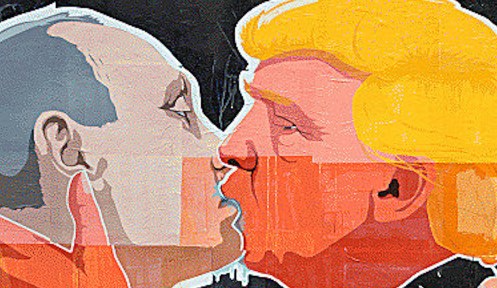
Tonight the New York Times published a story providing details of contacts between the Trump campaign and Russian intelligence and government officials prior to the election, going considerably further than anything previously made public. Taken against the background of Michael Flynn’s stunning firing/resignation over his conversations with Russian officials, precipitated by the Washington Post’s reporting, it suggests that we are on the verge of an avalanche of revelations that could potentially imperil the Trump presidency. Commentators and prominent present and former US officials are calling this perhaps bigger than Watergate.
Citing phone records and actual calls intercepted around the time that US intelligence and law enforcement agencies were discovering evidence that Russia was attempting to meddle in the US election against Hillary Clinton, the Times story says that “members of Donald J. Trump’s 2016 presidential campaign and other Trump associates had repeated contacts with senior Russian intelligence officials in the year before the election.” Specifically mentioned is Paul Manafort, Trump’s former campaign manager, whose ties within Russia and employment by a Russian-supported Ukrainian political figure had created controversy last summer.
The story notes that so far there has been no direct evidence of collusion. But the circumstantial evidence is certainly beginning to accumulate.
Democratic leaders are pushing hard for an independent investigatory commission, but until now, Republican congressional leaders have been dismissive about the revelations and resisting any comprehensive investigation. But maintaining that stance is quickly becoming untenable.
The Republicans are trying to keep the scandal confined to Flynn. Representative Jason Chaffetz, the Chair of the House Oversight Committee, has refused to initiate an investigation, saying that the Flynn scandal “had taken care of itself.” It is highly questionable how newly-confirmed Attorney General Jeff Sessions will play this, because he was at least a de facto member of the Trump campaign himself.
The Flynn scandal is just the sideshow, and the real question is whether the Trump campaign did more than passively benefit from Russian covert operations to fix the election in Trump’s favor. Until tonight, mainstream media were exercising great caution in talking about this Über-scandal, but that no longer seems to be the case. There will be growing pressure from the public and the media to look into Trump’s business and personal ties with Russia that he has managed to keep concealed until now, and this developing story promises to overwhelm everything else.
I remember vividly being riveted as the Watergate hearings played out on television in the summer of 1973. The scope of this scandal would seem to make Watergate look laughably quaint by comparison. Potentially, RussiaGate could involve nothing less than a hostile foreign power co-opting a candidate for president of the United States and then using covert means to put him in office.
If we have a Republican party that is so determined to seize and hold power that we can’t have a genuine and thorough investigation of this enormous scandal, then we are well and truly fucked.
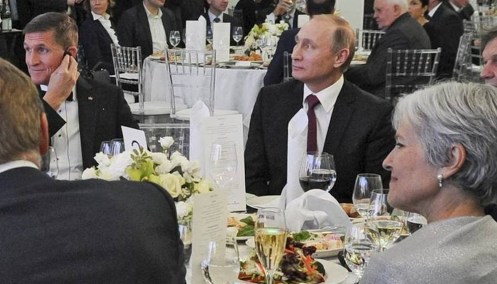
At RT dinner in Moscow, December 2015: Michael Flynn, Vladimir Putin, and Jill Stein [source: DailyKos]
On February 9, the Washington Post published an extraordinary (and exceptionally well-sourced) story providing previously unknown details about contacts between Trump’s National Security Advisor, Michael Flynn, and Russian officials–particularly Russia’s ambassador to the US, Sergey Kislyak.
Most of the commentary since the story appeared has focused on reported conversations between Flynn and Kislyak on December 28, after the Obama administration had imposed sanctions on Russia’s diplomatic mission in the US for Moscow’s interference in the 2016 election to help Donald Trump. Then on December 29, Putin surprisingly announced that Russia would not retaliate for the US sanctions–something they would normally do. This left many analysts wondering why.
Flynn and other senior Trump administration officials, including Mike Pence, had flatly denied that Flynn discussed the sanctions with the Russians. Then last week, Flynn backed off on his denials, saying he didn’t remember and couldn’t be sure.
According to the Post, Flynn did indeed talk with Kislyak about the sanctions. The story cites information from nine current and former officials, who were in senior positions at multiple intelligence and law enforcement agencies at the time of the calls, all of whom “said Flynn’s references to the election-related sanctions were explicit. Two of those officials went further, saying that Flynn urged Russia not to overreact to the penalties being imposed by President Barack Obama, making clear that the two sides would be in position to review the matter after Trump was sworn in as president.”
Obviously, the implication was that Moscow shouldn’t retaliate because Trump would fix all that after the inauguration. It also seems highly unlikely–even in the midst of Trump’s chaotic transition–that Flynn would tell the Russians this entirely on his own without authorization.
The other part of the Post story which has received less attention, but may be even more damaging, is that the “talks were part of a series of contacts between Flynn and Kislyak that began before the Nov. 8 election and continued during the transition.” In an interview this month, Kislyak said that he had been in contact with Flynn since before the election, but declined to answer questions about the subjects they discussed or to say anything about the origin of his relationship with Flynn.
All of this raises disturbing questions about whether the Trump team (of which Flynn was a key member) had any knowledge of the covert Russian campaign to tilt the election to Trump or might even have been colluding in it. And it should provide further incentive to investigate the nature of the Trump administration’s extensive ties with Russia and the reasons for Trump’s astounding admiration for and deference to Putin. This is only the outer layer of this rotten onion.
At a minimum, Flynn should be fired. He had no business being on the National Security Council in the first place, much less being in charge of it. He now appears to have been caught lying about arguably colluding with a hostile major power. The extent of his Russian connections are unknown, but the intelligence and law enforcement agencies clearly don’t trust him or they wouldn’t be leaking such derogatory information. Now one of his top aides has reportedly been denied a security clearance by the CIA. Flynn has lobbied for the Turkish government and has been paid to appear at an RT event. He has a record of erratic and irresponsible behavior, having been dumped as director of the Defense Intelligence Agency in 2014 reportedly for his chaotic leadership style. He is prone to conspiracy theories and reckless tweeting or retweeting, most famously one just before the election alleging links between Hillary Clinton’s emails and money laundering and sex crimes with children. At the Republican convention, he led chants of “Lock her up”. He shares Bannon’s believe that the West is in a war against Islam.
Flynn may now be seen as a liability even by Trump and his inner circle. But the Democrats can’t allow ditching Flynn to be the end of the inquiry into RussiaGate. There is clearly much more to this than we yet know.
Now, about Jill Stein. According to The Daily Beast, Stein has refused to answer questions about who paid for her 2015 Moscow trip and appearance on an RT panel in which she denounced “disastrous militarism” by the US. During her stay in Moscow, she also parroted Russian talking points on incursions into Ukraine and the shoot-down of a Malaysian airliner. RT even hosted the Green Party’s May 2016 presidential debate. (Russian environmental activists opposed to Putin in August 2016 posted an open letter blasting Stein’s support for him.) All of which leads one to wonder what else the Russians might have paid for.
Why, you might ask, would Russia bother with a bit player like Jill Stein? Of course, the Soviets had a long history of subsidizing starry-eyed leftist American naifs of her ilk. But actually in the 2016 election, Stein might not have had such a minor part after all. The votes Stein got in Pennsylvania, Michigan, and Wisconsin were more than Trump’s margin over Clinton in each of those crucial states. Had those votes gone to Clinton, she would have won the electoral college and therefore the presidency.
So it’s not at all inconceivable that helping Stein might have been a little part of the Russian effort to tilt the election to Donald Trump.
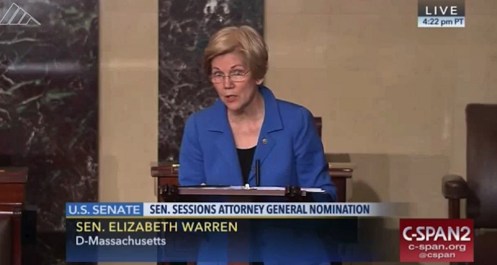
Tonight on the Senate floor, Senator Elizabeth Warren was silenced while reading a letter of Coretta Scott King written in 1986 regarding Jeff Sessions, Trump’s nominee for Attorney General. Senate Majority Leader Mitch McConnell stopped Warren stating that she was violating a senate rule and that she had “impugned the conduct and motives of” Sessions, who is still a senator from Alabama.
Warren was speaking against Sessions’s record on civil rights and voting rights, which had resulted in his rejection as a nominee for a federal judgeship in 1986. The letter by Mrs. King had been submitted at that time in opposition to his appointment.
Warren had read the following passage from the letter when she was stopped: “Mr. Sessions has used the awesome powers of his office in a shabby attempt to intimidate and frighten elderly black voters. For this reprehensible conduct, he should not be rewarded with a federal judgeship.”
Warren later stated that she had been “red-carded” and by senate rules would not be allowed to speak further on the Sessions nomination at all.
The full text of the letter from Mrs. King is here.
If McConnell wanted to ratchet up the rancor over this nomination, he could hardly have chosen a more explosive way to do it than by trying to censor a letter written by Dr. Martin Luther King, Jr.’s widow. It appears that as far as McConnell and the Republican congressional leadership is concerned, the historical record regarding Sessions is off limits.

Donald Trump has vowed to push for deregulation at the Food and Drug Administration, the country’s watchdog for protecting the safety of the food we eat and the medicines we take. There now, don’t you feel better already?
According to the New York Times, a leading contender as Trump’s pick to head the FDA is Jim O’Neill, a former HHS official during the Bush II administration. O’Neill is a libertarian and associate of billionaire Trump supporter Peter Thiel (who, incidentally, has reportedly bought a big property in New Zealand and acquired kiwi citizenship just in case things don’t go well here). O’Neill is a managing director of an investment firm founded by Thiel and former director of the Thiel Foundation. He is not a doctor, unlike previous FDA directors. (Two other names being floated are Dr. Scott Gottlieb, a former FDA official with strong ties to pharmaceutical and biotech companies, and Dr. Joseph Gulfo, a former biotech and medical device executive.)
More to the point, according to the Times, O’Neill has advocated what he calls “progressive approval”, meaning that drugs shown to be safe could be FDA-approved for use before they were proven to be effective for whatever they’re being prescribed for. He proposes to prove their efficacy after they’ve been legalized. This would be a major reversal of decades of FDA policy which has usually required large clinical trials on humans to prove that they actually work.
Advocates for this kind of deregulation claim that this would make drugs available to patients much quicker. But even a layman can see that the major benefit would accrue to the drug manufacturers who could transfer most of the risk and cost of clinical testing to patients taking the drugs and sell a lot of them before the drugs had been proven to actually cure anything.
In fact, the FDA already moves faster than similar regulatory agencies in any other developed country. In 2015, two-thirds of new drugs were approved first in the US. Moreover, the “21st Century Cures Act”, passed by large bi-partisan majorities and signed by President Obama in December, sped up the approval process for some drugs by easing requirements for the level of evidence when approving a drug that has already been authorized for other diseases.
Studies have shown that although expedited paths to approval are being used more frequently, there is little evidence that most of the drugs being approved in this manner are actually innovative, rather than slight variations on previously approved medicines. According to a number of studies, since the mid-1990s about 85 to 90 percent of new drugs don’t offer any clinical advantages for users. However, they are usually much more expensive than older medicines that do virtually the same thing.
You may have noticed that there are a lot of prescription drug commercials on TV. In fact, the amount spent by Big Pharma on promotion increased from an average of $3.6 billion in 2011-13 to $5.2 billion in 2015. (The US, by the way, is the only country except New Zealand that allows ads for drugs aimed directly at consumers.)
Big Pharma always cites the high cost of research and development for new drugs to justify the high cost to patients of newer drugs still under patent, but the Washington Post reported in 2015 that 9 out of 10 of the largest drug manufacturers actually spent more on sales and marketing than for R&D. (The exception, Roche, spent roughly equal amounts for each.) Even the American Medical Association has called for a ban on drug advertising directly to consumers. For information about how much gets spent on what, click here.
You might have also seen TV ads for certain drugs and a few minutes later ads soliciting participation in class action suits against exactly the same drugs. Weird, right? Well, it turns out that Big Pharma firms have made enormous payouts to settle lawsuits for complications from well-advertised drugs, but still made big profits from the sale of the same drugs. It’s just a cost of doing business.
A few Democratic members of Congress have tried to address some of these issues noting that the FDA and Big Pharma are already too cozy. Elizabeth Warren, for example, denounced the “Cures Act” for providing “tiny fig leaf of funding” for NIH and opioid abuse as “political cover for huge giveaways to giant drug companies.” The measure authorized only $1.8 billion for the so-called “cancer moonshot”. But these are voices crying out in the wilderness.
Research, development, and approval for prescription drugs is a highly complicated business. But placing the FDA in the hands of a tool of Big Pharma is certainly not the best way to go, even if it is totally in keeping with the rest of Trump’s nominations.
One final observation: Jim O’Neill has served on the board of the Seasteading Institute, an endeavor supported by Peter Thiel aimed at establishing new nations on interlocked floating vessels in international waters. Think an endless Carnival cruise, or maybe “Waterworld.” Or watch this video, and ask yourself if you want this guy in charge of our food and medicine.
[Source: arcadiapower.com]
- The House of Representatives voted 228-194 to rescind a regulation intended to prevent coal mining companies from dumping waste into nearby streams. The Republican House leadership invoked the Congressional Review Act of 1996 (previously used only once) which permits a simple majority to revoke any regulations imposed during the prior 60 legislative days. The rule would have protected 6,000 miles of streams and 52,000 acres of forests, by maintaining a long-established 100-foot buffer zone that blocks coal mining near streams, and imposing stricter guidelines for exceptions to the 100-foot rule.
- Using the same measure, congressional Republicans also nullified a regulation intended to curb the venting of gas wells on federal lands. The measure would have prevented the release of gas via flaring or leaks, eliminating an estimated 180,000 tons a year of methane gas, a potent greenhouse gas leading to climate change, while also increasing federal revenue by as much as $10 million a year, by forcing energy companies pay royalties only on fuel they contain and then sell. Both of these regulations were on a list of targeted rules in a document prepared by a group backed by the Koch brothers.
- A plan to revoke the “resource extraction disclosure rule” was revealed by two senior congressional Republicans (Congressman Huizenga of Michigan and Senator Imhofe of Oklahoma), which would remove the requirement under the 2010 Dodd-Frank financial reform law for publicly-traded mining, oil and gas companies to disclose payments they make to foreign governments. Recently confirmed Secretary of State Rex Tillerson lobbied against this rule when he was CEO of Exxon, and as has been pointed out, the regulation would identify oil companies with financial ties to countries such as Russia.
- Trump signed an executive order to review regulations under Dodd-Frank, which are still not fully implemented. Trump said, “We expect to be cutting a lot out of Dodd-Frank, because frankly, I have so many people, friends of mine, that had nice businesses, they just can’t borrow money . . . because the banks just won’t let them borrow because of the rules and regulations in Dodd-Frank.” Dodd-Frank forces banks to do yearly “stress tests” to prove they could withstand economic downturns and to draw up “living wills” that lay out how the banks could be dismantled without harming the rest of the financial system. The “Volcker rule” bars banks from trading in high-risk securities using their own capital and makes it harder to hide exotic risky securities off the banks’ balance sheets, concealing the extent of the banks’ debts.
- Trump also signed a memorandum that could delay a Labor Department rule that would require financial professionals such as stock brokers to put their clients’ interests ahead of their own. This “fiduciary rule” was scheduled to go into effect in April.
- Congressional Republicans also announced plans to target a rule enacted by the Obama administration that could close dozens of coal burning power plants, and another that would extend overtime pay eligibility to an estimated four million Americans.
- Trump dropped his campaign pledge to aggressively negotiate lower drug prices with pharmaceutical companies. After meeting on Tuesday with executives from those drug companies, Trump did a 180 and emerged from the sit-down parroting the industry talking points. FYI, Americans pay on average twice what patients in other countries do for drugs still under patent.
And that’s just in one week!! And maybe you thought corporations were already running the country? Just wait, because you ain’t seen nothing yet!
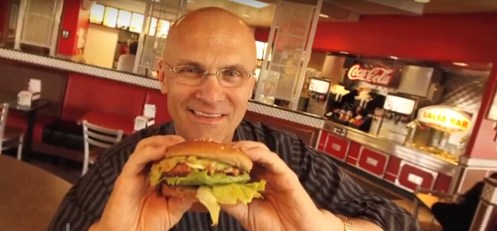
Which is the most cynical nomination? Scott Pruitt for EPA? DeVos for Education? Price for HHS? Ben Carson for HUD? Sessions for Justice? Rick Perry for Energy? So hard to choose!
But naming Andrew Puzder for Secretary of Labor has to be right up there. Here’s a man who has opposed increases in the minimum wage and expanding eligibility for overtime. He has criticized paid sick leave policies for workers, and claimed that the Affordable Care Act had created a “government-mandated restaurant recession”, something visible to virtually no one else. He thinks further automation is a great thing because machines are “always polite, they always upsell, they never take a vacation, they never show up late, there’s never a slip-and-fall or an age, sex or race discrimination case.”
The president of the AFL-CIO says Puzder’s “business record is defined by fighting against working people.” As secretary of labor, he would be responsible for investigating violations of minimum wage, overtime and worker safety laws and regulations. Puzder’s company owns Hardee’s and Carl’s Jr. fastfood restaurants, many of which have been investigated over the past 15 years for just such violations. According to the Washington Post, his companies have been hit with more federal discrimination lawsuits than any of their domestic competitors.
According to the New York Times, Puzder has been doing battle with labor regulators since 1983 when he worked for “a law firm owned by a famous mob lawyer and casino owner whom the Labor Department accused of squandering $25 million from his union workers’ pension funds on sham investments.” It’s a long and complicated story, but you can read it all here.
You might also want to watch this video.
In sum, it’s really hard to see how Puzder could possibly serve as an advocate for the rights and interests of American workers. His vision for them is dead-end, minimum wage, minimum benefit, fastfood jobs that boost corporate profits and CEO packages while leaving workers unable to afford a middle-class life.
If anyone deserves to be rejected in the confirmation hearings, he does.
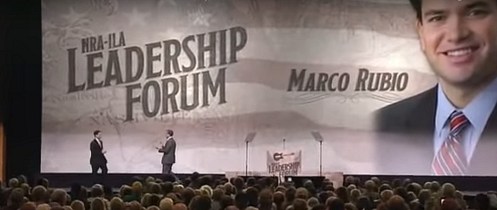
“Sen. Marco Rubio has a well-deserved reputation for being a windbag who huffs and puffs but never quite blows anything down.” Colbert King, Pulitzer Prize-winning columnist for the Washington Post.
Senator Marco Rubio (R – Florida) didn’t have the cojones to act on his own “reservations” and vote against confirming Rex Tillerson for Secretary of State, but he has no problem foisting his own agenda on the unwilling residents of the District of Columbia who can’t fight back.
In mid-January, Rubio re-introduced the NRA-backed (and probably NRA-drafted) “Second Amendment Enforcement Act” which would gut DC’s tough gun control laws and strip the DC council of the authority to pass any future gun legislation. The bill would also make it easy to get a concealed weapon permit and recognize such permits granted by other states. In other words, the residents of Washington, DC would have no voice in determining the laws governing guns in their own community. With Trump now in the White House, Rubio’s pet project has a much better chance to succeed.
Bringing more guns into the Nation’s Capital has been a peculiar hobby horse for Rubio ever since he arrived in the Senate in 2010. He has used the issue to raise his political profile and get the NRA’s backing for his presidential ambitions. The NRA raised his rating from B+ to A after he first introduced the bill in 2015. Back in 2013, Rubio claimed that gun violence “skyrocketed” after DC passed some of the nation’s strictest gun laws in 1976–an assertion that is misleading at best. (Gun violence in DC has declined greatly after peaking in the early 90s during the crack epidemic that devastated DC and other cities, and it ignores other factors such as the easy availability of guns with almost no questions asked just by crossing the Potomac into Virginia.)
For those who dozed through high school civics classes (do they still have civics classes?), the 680,000 residents of Washington, DC have no voting representation in Congress, even though the city has a greater population than the states of Wyoming or Vermont. Moreover, Congress has the power to overturn DC laws that it doesn’t like. When Democrats control the committees that control DC affairs, Congress generally leaves the city alone, but when Republicans are in charge they love to meddle out of spite just because they can. Local DC politics are very liberal and progressive and overwhelmingly Democratic. (Trump got 4 percent of the vote in DC.) The Republican love of states’ rights simply doesn’t apply to the District of Columbia.
DC voters have approved recreational use of marijuana, use of local tax money to help pay for abortions for low-income women, and a Death With Dignity law similar to the one that Oregon has. All of these are now threatened by Congressional disapproval. There is a formal (and rarely used) process by which Congress can override DC laws by passing a disapproval resolution within 30 days. That also requires a presidential signature, which wasn’t going to happen under Obama, but almost certainly would under Trump. But there is also another much easier and more common way to kill local DC laws, which is to attach riders dictating DC law to must-pass legislation.
But it is the Republican insistence on allowing unregulated gun possession that is most dangerous and galling to the people who actually live in Washington, DC. Colbert King and others have highlighted the hypocrisy of people like Rubio who are quite happy to ban guns of any kind from the Capitol for their own safety, while working to give them free run in the capital city regardless of the hazard they pose for the people of DC.
As King wrote: “If the presence of a gun-toting public is good enough for the streets of our nation’s capital, shouldn’t the same be good enough on congressional grounds?”
[Disclosure: I lived and worked in Washington, DC for four decades, and still have strong ties there as well as a deep love for the city itself.]
 TrumpWorld for Beginners