
Do the Democrats have any money for political ads on South Florida TV stations? The question occurred to me as my attention ebbed and flowed while watching the endless—largely fluff-filled—television coverage of Tropical Storm Isaac, which reinforced my earlier impression that the Republicans utterly dominate the airwaves when it comes to political advertising.
Of course, I don’t normally watch TV all the time, and I can’t provide firm statistics, but my unscientific impression is that there are probably ten Romney ads for every Obama one. The ad that appears with nauseating frequency is this one from the pro-Romney “Restore Our Future.”
In the ad, Restore Our Future—whose very name is semantic nonsense—cobbles together a stew of non-sequiturs, misleading claims, and outright falsehoods, but the message is that Romney comes from the private sector and is therefore a “job creator” while Obama is a bumbling amateur who wasted taxpayer money on the stimulus while sending the economy down the drain.
I have seen only one Obama ad which addresses the Republicans’ crusade against Planned Parenthood and Roe v. Wade, and it airs very infrequently. There is nothing that counters the economic claims in the Restore Our Future ad.
But the one that really caught my eye was this one from Karl Rove’s “Crossroads Grassroots Policy Strategies” which is directed against incumbent Senator Bill Nelson. It seems to be on constantly now.
The ad is total bullshit in which virtually every element is misleading or a bald-faced lie. It ostensibly calls on the senator to vote to repeal the Affordable Care Act (aka Obamacare), which Nelson supported, because it is “hurting seniors”, but of course it’s really calling on seniors to vote against Bill Nelson. You don’t expect truth or fairness from Karl Rove, but my main point here is that I haven’t seen one single ad in support of Bill Nelson.
I don’t know if these ads are effective or not, but I think they must have some impact, particularly among “low information voters” who don’t bother or don’t care to find out the facts. The simple repetition of lies or half-truths eventually makes them part of the atmosphere, particularly when they are constantly pounded into your head by Fox News and conservative radio bloviators. This helps explain the stubbornly persistent belief among an astonishingly large number of Americans that Obama is a Muslim and was born outside the US.
As a side note, when my power went out as Isaac approached South Florida, I tried to tune in a news station on my ancient transistor AM radio. But all I found were Spanish-language religious programming and the virulent anti-Obama radio talk shows that my mother keeps on as a kind of aural wallpaper.
I think seniors are particularly susceptible to this kind of propaganda, which is especially pernicious because it basically turns the facts upside down. If my mother is any example, once you get seniors believing that the Republicans are trying to save Medicare, no appeal to reality has a chance. The ads cleverly address a Republican weakness by, essentially, lying about their actual agenda and claiming to be the savior of institutions they really want to destroy.
Both Restore Our Future and Crossroads GPS are super PACs, which means that corporate and individual contributions to them have no limits because they can’t legally contribute directly to candidates’ campaigns or political parties and are supposedly “independently-expenditure only committees”. There is supposed to be a firewall between the campaigns and the super PACs, but that’s transparent hogwash. They are creatures of the Roberts Supreme Court’s 5-4 Citizen’s United decision that released a tsunami of money from corporations and the super-rich into the US political system. And as the saying goes, “Money is the mother’s milk of politics”.
I’m not privy to DNC election strategy, but it seems very dangerous for the Democrats to cede the airwaves in South Florida to the GOP, which according to everything I’ve been reading lately, has a huge advantage in fundraising. Maybe the DNC has a barrage of new ads they’re preparing to unleash, but if they have any hope for winning the Florida electoral votes, the Democrats need to win big in South Florida. If the Democrats don’t have the money to spend, and can’t win—or at least fight—the propaganda battle in the media, their chances of winning in ballot box are not good.
Money will have talked—with forked tongue.
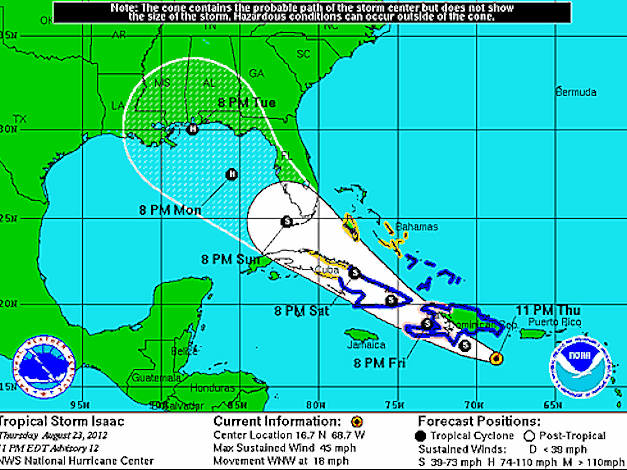
With Tropical Storm (and possibly Hurricane) Isaac heading toward the Florida Keys and Gulf Coast, perhaps it’s time to revisit one of my least favorite topics—namely Citizens’ Insurance.
BTW, if you need hurricane coverage or want to increase yours, it’s probably too late now–at least until Isaac blows by. According to the Citizens’ website: No application for new coverage or endorsement for increased coverage may be bound, written or issued, or monies received, regardless of effective date, when a Tropical Storm or Hurricane Watch or Warning has been issued by the National Weather Service for any part of the State of Florida.
In previous posts, I’ve chronicled my own unhappy experience dealing with the state-run “insurer of last [i.e., only] resort”, but it’s clear that I’m far from alone and that others’ stories are much worse than mine. [I can report that after a couple of months of wrangling and submitting reams of redundant documentation, my mitigation credits were finally restored.]
In a nutshell, the Citizens’ board, appointed by Gov. Rick Scott, has mandated the company to aggressively reduce the number of homeowner’s policies that it underwrites—a program known as “depopulation”. (Sounds sinister, doesn’t it?) As part of this effort, Citizens has dispatched an army of inspectors to find reasons to remove credits for wind mitigation measures or even cancel coverage. It’s a transparent way of circumventing the state law that limits rate hikes for existing policy holders to no more than 10 percent a year.
The objective, apparently, is to push homeowners out of Citizens and into the private insurance market, which in hurricane-prone areas like South Florida does not exist. The Miami Herald published a series recently documenting what is going on and the growing storm of protests. It has also reported that increasing numbers of seniors who own their homes outright are deciding to go without insurance because they can no longer afford it. As risky as that is, most homeowners carry mortgages and don’t have that as an option because lenders require that the properties they finance have insurance. Naturally, the enormous cost of insurance is a drag on the recovery of Florida’s fragile real estate market, as the Herald has also reported.
In response to a growing uproar, Citizens’ has denied directing its inspectors to disqualify as many homeowners as possible. Last week, a spokesman announced that policyholders who had their credits removed could get a free second inspection, though it was unclear if that would apply to those who had already lost their credits. (Three-fourths of homes inspected have lost their credits.) I think a lot of people will find the charm offensive unconvincing.
Despite the flurry of media coverage, it’s still surprising to me that this isn’t a bigger political issue. Property insurance reform was conspicuously absent from Scott’s legislative priorities, and the current Republican-dominated legislature has done nothing to address the issue. Instead, Scott has directed his hand-picked board to deal with the problem administratively, which has resulted in the situation we now face.
Citizens’ Insurance was created by the state government to fill a need that the private sector would not take on. Basically, Scott and the Republican legislature have changed its primary mission from one of helping millions of Florida homeowners stay in their homes to one of minimizing risk and maximizing revenue—as the first step to getting rid of Citizens’ entirely.
It’s as if Medicare were directed to get rid of as many people as possible by finding any conceivable reason to deny coverage and forcing them into the private insurance market, which wouldn’t accept them because they are old and likely to need medical care. Actually, it’s not hard to see in the Citizens’ story the overarching Republican strategy toward Medicare and Social Security, i.e., to weaken, mismanage, and discredit a government-run institution so that the public loses confidence in it and becomes willing to accept its demise.
Or, a beginner’s guide to the political geography of the Sunshine State.
If you live in South Florida, it’s easy to get a false impression of the state as a whole, because this area is so different from other parts of the state that, at least politically, it could be in another part of the country entirely.
Let’s start with these two maps. The first shows the results of the 2008 presidential election (by county) and the second shows the results of the 2010 election for governor. It’s obvious at a glance that there is a lot of consistency between these two quite different elections.
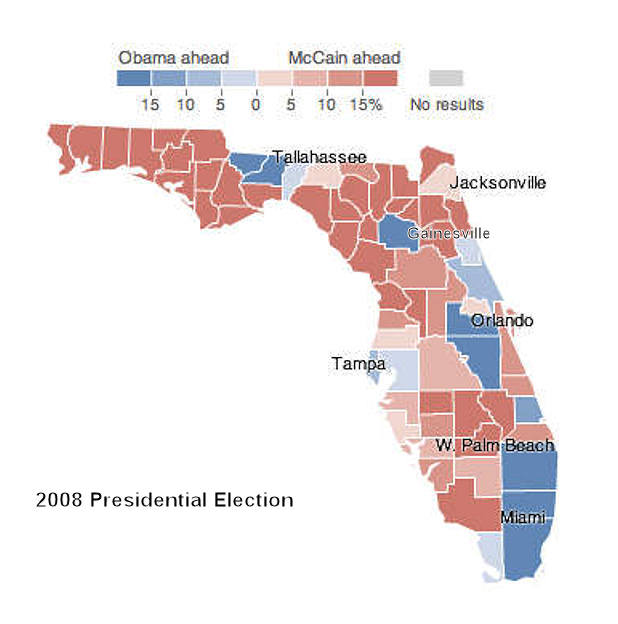
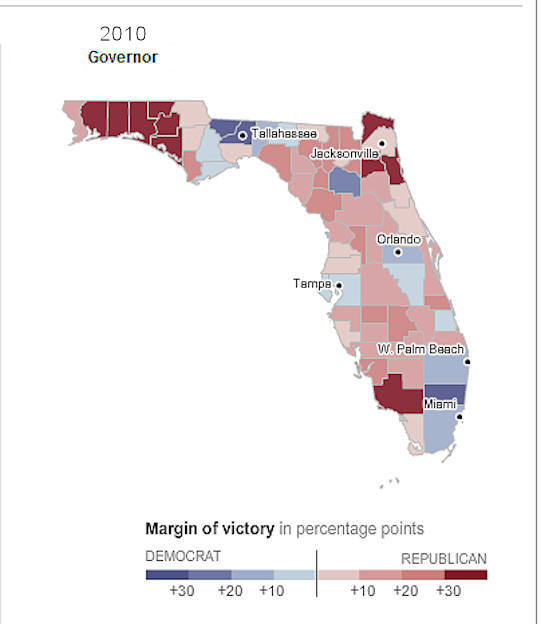
In broad terms, you can easily come up with at least half a dozen different political regions within the state of Florida depending on how you slice it up. Let’s try these just for grins:
- The Panhandle, or South Alabama. A Republican stronghold. They don’t call this the Redneck Riviera for nothing.
- Northern Florida, or South Georgia. This includes the Jacksonville metro area and is another Republican bastion.
- The Farm Belt. These are the largely agricultural counties in the inland parts of the state stretching from around Gainesville south to around Lake Okeechobee—also strongly Republican.
- The I-4 Corridor running from Tampa/St. Pete through Orlando to Daytona. This is a swing area which has recently been trending towards the Democrats, at least in the metropolitan counties.
- The Southwest Coast, or Midwest Snowbird Land. These are the Gulf coast counties south of Tampa. Demographically, they are overwhelmingly Anglo white, with only small numbers of blacks or Hispanics, and they reliably vote Republican.
- The Liberal Islands. (Only metaphorically.) These are the odd counties like Leon (Tallahassee) and Alachua (Gainesville) that have big universities and Gadsden (up on the Georgia border) that is the only county in Florida with a black majority. All vote strongly Democratic. (No wonder conservatives mistrust higher education and minorities!)
- The Space Coast, from Brevard County (S of Daytona) down to Martin County (N of Palm Beach). Recently has been more up for grabs, but generally votes conservative.
- And finally, South Florida, the state’s most populous region including Miami-Dade, Broward, and Palm Beach counties. It—overall—tends to vote strongly Democratic.
In many ways, Florida is like a microcosm of the country. As is apparent, there are more Republican regions than Democratic ones, but the latter have more people and more votes. The regions that are culturally more “Southern” vote Republican—if the voters are white, which most of them are. Even within these regions, the urban core tends to vote Democrat, but the further out into the suburbs and exurbs you go, the more Republican—and Tea Partyish—they become, a pattern familiar throughout the country. I have always attributed this largely to conservative whites’ fear of blacks and other non-Anglo minorities and to their unshakable belief that these minorities are getting undeserved benefits at taxpayers’ (i.e., their) expense.
For the GOP, the real pay dirt is in the Tampa and Orlando regions, where almost half of all registered Republicans live. Check out this interesting article by the brilliant poll analyst Nate Silver. By the same token, the Democrats need to do at least as well in the I-4 corridor as they have done in the past two elections. Of course, it’s not exactly coincidental that the Republican national convention is in Tampa.
To win Florida, the minority vote—particularly the Hispanics—has become crucial. For a long time, the Florida Hispanic vote was thought to be synonymous with the Cuban vote and therefore mostly Republican, but neither assumption holds true any more. Take a look at this graphic that appeared in a post from the Immigration Policy Center published by Daily Kos.
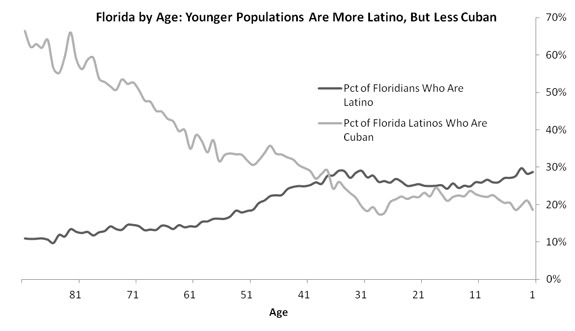
As the piece points out, Cubans are now a minority among Florida Hispanics except among those over 70—only 29 percent of the Florida Latino population is now Cuban in origin.
And Hispanics are an important factor in other parts of the state—not just in South Florida. The Tampa Bay Times recently published a story on the changing demographics of Osceola County (just south of Orlando), where almost half of the population is now Hispanic and mostly of Puerto Rican origin.
The hostility of the national Republican party toward Latino immigrants has become a real problem for the party in Florida, in part because the Cubans who are now the Latino face of the Florida GOP received a much more welcoming embrace from the US government than did immigrants from elsewhere in the hemisphere. Just ask any Haitian or Mexican. That’s why politicos like Marco Rubio have tried to come up with their own “Dream Act Lite”, but it’s hard to sell that when fellow Republicans like Arizona Governor Jan Brewer are pulling a George Wallace-style defiance of President Obama’s measure to allow children of illegal immigrants to remain in the US legally under certain conditions.
In Florida, as in most of the country, black voters go overwhelmingly for the Democrats. This explains why Rick Scott and his minions in the state legislature as well as other Republican officials in other states have worked so strenuously to enact measures that will almost certainly suppress black votes. We shouldn’t forget that in the infamous 2000 election, more than 22,000 votes were reportedly nullified in Republican-dominated Duval County (Jacksonville), most of which were from a few predominately African-American precincts that went heavily for Al Gore. (In case you were on Mars or less than two years old at the time, George W. Bush won Florida—and therefore the election—by 537 votes). If you’re skeptical about whether the vote suppression is really GOP policy, read the article here where former Florida state Republican chairman (now under indictment, but not for that) spills the beans.
It would be ironic, wouldn’t it, if the votes of blacks and Hispanics this year wound up saving the country from the disastrous consequences of the radical Republican agenda and white people from their own stupidity.
Well, the primary election is over and the question in Miami-Dade is not who won, but rather whether all those absentee ballots were really legit. A lot of people don’t think they were, and there’s increasing evidence to back up that suspicion. Eye on Miami has been doggedly pursuing this issue for quite some time, and now the mainstream press is finally starting to pay attention.
First of all, there’s just the sheer number of absentee ballots in the count. According to the Miami Herald, there were some 92,000 absentee ballots counted in the August 14 primary elections (both Republican and Democrat), which amounts to some 37 percent of the total number of votes.
I find that a truly astonishing figure. I wondered how that might compare with other places, so I took a look at the returns for this year’s primary in my former hometown, Washington, DC, where the Democratic primary is the real election. Turns out that there were only 3,300 absentee ballots sent out (presumably fewer than that were actually returned), which amounts to only 5.6% of the 58,210 votes cast. Now, DC local politics isn’t exactly squeaky clean, but that is a huge difference.
Most of the attention is focused on the Miami-Dade mayoral race, where some 38 percent of the ballots were absentee. Winner Carlos Gimenez got 54% of the total vote, but 62 percent of the absentee votes in this race, and slightly under 50 percent of the early and election day votes, which has led losing opponent Joe Martinez to threaten to challenge the outcome.
The odd thing is that the percentage of absentee votes within the Miami-Dade Democratic primary varies a great deal from one race to another. (I have not looked at the Republican primary results at all.) To take another hotly-contested county-wide race, for State Attorney, the percentage of absentee ballots was considerably less—only about 28 percent. Here again, the absentee votes increased the winner’s margin of victory, though not quite as much as in the mayoral race.
The one that really caught my eye was State Senate District 39, which was essentially a 3-man race. The winner, Dwight Bullard, got 49.4 percent of the early and election day vote, but only 33 percent of the absentee vote. [Note: These numbers refer to the Miami-Dade vote only and don’t include votes in other counties in the district.] His opponent, James Bush III, got almost exactly the reverse proportion: 32.6 percent of the early and election day vote and 47 percent of the absentee vote. The third man in the race, Ron Saunders, got a consistent 11 percent of both. Now that’s weird. And, to my eye, a big red flag.
If I were doing an investigation of absentee ballot fraud, I would certainly start with a statistical analysis to look for these sort of anomalies. On the face of it, one would assume that almost everyone in local politics is using absentee ballots to pump up their vote totals, probably fearing that if they don’t then their opponent will. Which probably means that there will never be a meaningful investigation into this mess by state or local authorities because almost everyone’s hands are dirty to one degree or another.
But this also tells me that it’s way too easy to get an absentee ballot here—and to manipulate the system for massive fraud. There’s something seriously wrong with a system where more than a third of the voters don’t actually cast their ballots in person. I certainly don’t understand all the rules governing absentee voting, but it’s hard for me to understand why boleteros (the absentee vote bundlers) should ever be allowed to handle someone else’s vote.
What’s really scary, though, is the thought that this could affect the outcome of the presidential election in November. I remain psychically scarred by the 2000 election debacle and have never quite forgiven Florida for saddling us with George W. Bush. Maybe the only saving grace is that both parties have people capable of abusing the absentee votes—but it’s hard to know who’s better at doing it.
UPDATE: ELECTION RESULTS CAN BE VIEWED HERE
It’s less than two days to the August 14 primary, and I’m still trying to learn enough about the candidates to make an informed choice. I’m talking here about the Democratic primary (and mostly Miami-Dade). The Republicans are all basically hopeless—it’ll be a cold day in hell before one of them gets my vote.
The choice gets harder as you go down the ballot because generally you know less about the candidates for the more obscure local offices—especially as a newcomer to the area. You can find some help in the endorsements by the newspapers. The Miami Herald’s are here and here. The Sun-Sentinel is still working on it at this writing. Update: The Sun-Sentinel’s endorsements for local offices in Broward are now available here.
Gay voters can find guidance here.
Here’s a list of the top 5 local candidates to avoid at all cost. And if you want to know where some of the mysterious PAC money for the campaign is coming from, check out this article in the Miami New Times blog.
Daily Kos has a great article on all races for all the Florida districts in the US House of Representatives, explaining which are potentially in play in the November election.
For the US House of Representatives, District 23 and 27 are uncontested in the primary. In 23 Debbie Wasserman Schultz is the incumbent as well as Chair of the DNC. In 27 Manny Yevancey will be going up against Republican Ileana Ros-Lehtinen in the general election. In District 25 there is no Democratic candidate, so Republican Mario Diaz-Balart will have a free ride—which is a real shame.
In District 24, which is my district, incumbent Frederica Wilson faces challenger Rudolph Moise, a Haitian-American osteopath. Wilson is noted more for her hats than her legislative accomplishments, but she has a good voting record on important issues and it’s hard to see a good reason for replacing her.
The more important race is for District 26 where Joe Garcia and Gloria Romero Roses are vying to challenge the loathsome Republican incumbent David Rivera in November. The district has become more competitive for Democrats due to redistricting, so the key question may be who can run the best race. The Herald has endorsed Romero Roses.
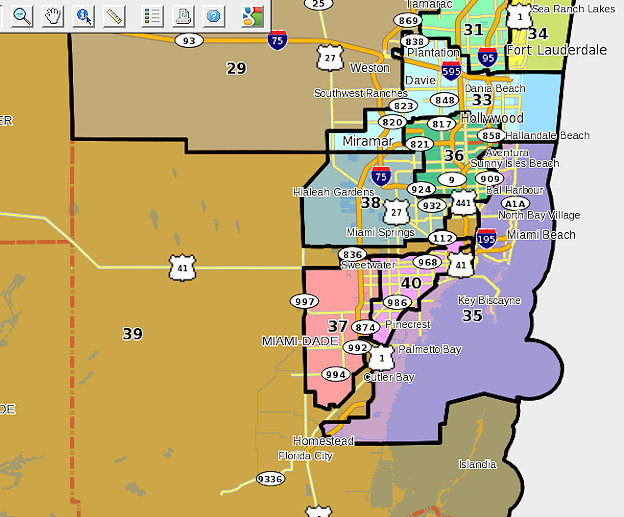
State Senate District Map
For the State Senate, the only real primary race is in District 39, which includes the Keys and most of the Everglades as well as the Homestead area and a weird finger of territory that snakes through Little Havana into Midtown Miami. (Wonder how that one passed the redistricting rules.) The nomination race there is really between Dwight Bullard and Ron Saunders, both incumbent state representatives. The Herald has endorsed Saunders, but both seem to be viable candidates.
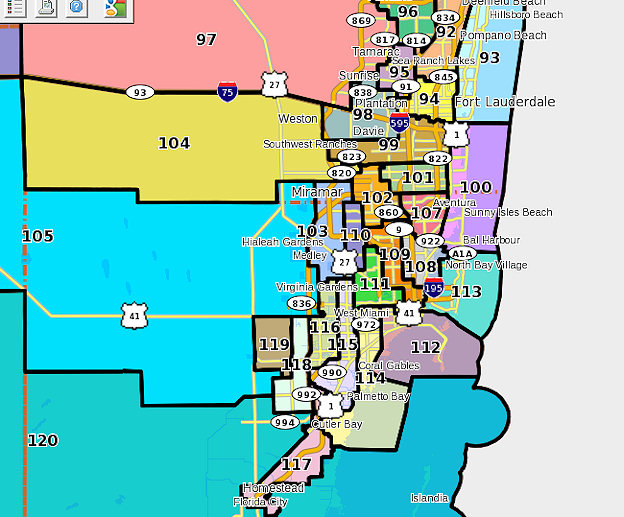
State Representative District Map
When you get to the State Representative districts, it gets more complicated. To make it simple, here are the Herald’s endorsements for the districts with more than one candidate: District 100, Joseph Gibbons; District 102, Sharon Pritchett; District 107, Barbara Watson; District 108, Alix Desulme; District 109, Cynthia Stafford; District 112 , Jose Javier Rodriguez; District 113, Mark Weithorn; District 117, Carmen Morris.
For the County Commision, there’s an interesting race for District 1, where Miami Gardens Mayor Shirley Gibson is running against incumbent Barbara Jordan, who has proven to be pretty much a disaster. It should be a no-brainer, except for Gibson’s acceptance of the endorsement of the Christian Family Coalition, a hateful anti-gay group. I don’t live in the district, but if I did, that would make it a difficult choice.
Finally, there’s the race for the State Attorney between incumbent Katherine Fernandez Rundle and defense attorney Roderick Vereen. The Herald has endorsed Fernandez Rundle, and she seems to have done a good job.
Whew, that’s enough to give me a headache! And the really important stuff will happen in November!
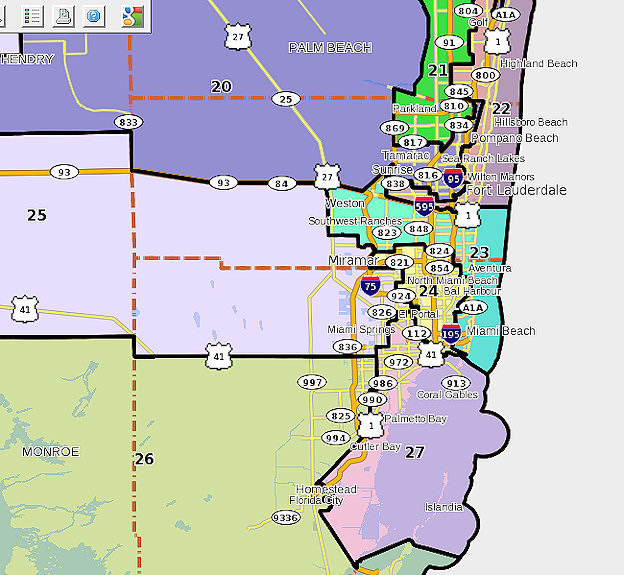
South Florida US Congressional Districts
I’m back from a trip to Texas to close up my mother’s house (hence my posting hiatus), and since getting back I have been trying to understand the peculiarities of Florida elections and decide who to vote for in the August 14 primary election
When you move to a new place, you have to make an effort to learn things about local politics that long-time residents have absorbed by osmosis over the years. The candidates are largely unfamiliar and you don’t know the backstory—or the dirt.
Update: If you want to know the dirt, start with this piece from the Herald‘s political blog.
Florida went through a thorough a court-ordered redistricting process this year, which resulted in new district maps for US congress members as well for Florida state senators and representatives. The new maps were supposed to eliminate the blatantly gerrymandered districts that had been designed to select the voters to suit the candidate, instead of the other way around.
The new maps sort of did that by making the districts more geographically compact and coherent than the bizarrely contorted districts they replaced. They also were supposed to meet certain standards regarding racial/ethnic demographics. Of course, this being Florida, the revised maps somehow managed to insure that virtually all of the incumbents were still resident in their new districts. You can find the approved district maps here.
Florida has early voting, where you can cast a ballot before the election date at certain locations. (Though the Republican-dominated state government has reduced the period for early voting, apparently believing (probably correctly) that this would hurt the Democrats.
Then there is absentee voting, which is the real voting scandal in the state. In past elections, suspiciously lopsided absentee ballot counts have resulted in election victories by candidates who lost in the election-day ballot count. Eye on Miami has been pursuing this scandal well before the mainstream press started paying attention to it. Recently a few ballot collectors were arrested in Miami-Dade after being caught with bags full of ballots gleaned from retirement and nursing homes. But these are just little fish, and no one seems particularly interested in going after the people they work for. Instead, the state government has focused on eliminating supposedly ineligible voters from the voting lists, even though they have had great difficulty finding any and managed to impugn the voting rights of some legitimate voters.
The August vote is a primary election to select the Democratic and Republican party candidates for the general election in November, and only voters registered as a Democrat or Republican can vote in that party’s primary. But there is also something called a “Universal Primary”. As I understand it, this happens when one party does not contest a given elected office so that the primary election de facto determines the winner of the general election. In that case, a 1998 state constitutional amendment mandates that all voters of whatever party will be able to vote for that office. There are a couple of examples of this in local state representative districts.
Again, there are ways of getting around this provision, namely by having a write-in candidate enter the race, which voids the requirement of a “universal” primary. The write-ins are often simply stalking horses for one of the candidates on the ballot, and are exempt from paying filing fees or election assessments, so the bar for entry is extremely low. And it effectively excludes large numbers of voters from having any voice in selecting a holder of public office. Several races in Broward and Palm Beach counties have been closed by this ruse.
The other feature of the primary elections that I find peculiar is the inclusion of judicial offices—for county and circuit judges. I know this happens in other states too, but it’s difficult to make an informed choice on these races. It’s not at all easy to find out anything about most of the candidates–I doubt if many people even try—and the press gives these races scant attention. I found one article here. You’re pretty much left with taking the Herald’s endorsement into to the voting booth when the time comes to mark the ballot.
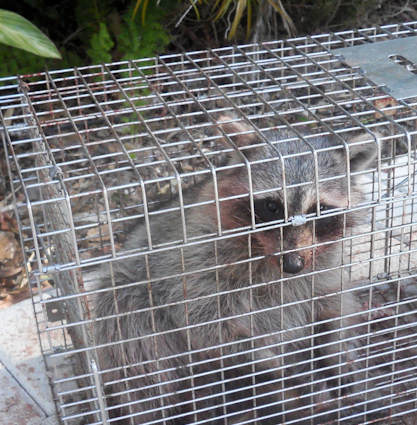
Busted
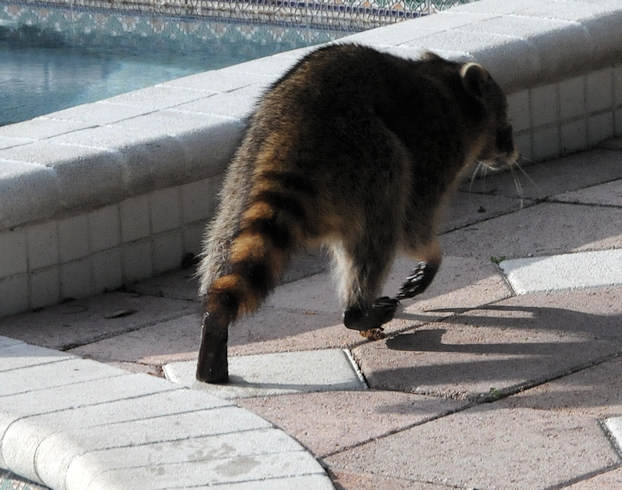
Escaping in broad daylight
Florida is a great environment for all manner of animal life from insects to giant reptiles—some native and others introduced from elsewhere. Most of them you will never or rarely encounter, but there are others that you may well find yourself getting up close and personal with. If you move here, trust me, you’ll soon be on a first-name basis with your friendly exterminator.
Let’s start with the termite, for which Florida’s warm, moist climate is the Promised Land. Now, termites are not exactly unknown in other parts of the country, but here they are practically unavoidable. When I first came to Florida, I noticed houses that were totally encased in blue plastic. I soon learned that they were being “tented” for termites.
This is a process in which the occupants of the house move out temporarily after removing or bagging up any food and other vulnerable items and then the house is covered by a gas-impermeable tent into which poisonous gas is pumped to kill the termites and any other living creatures left inside. With a little luck, the treatment is good for about six or seven years, and then it has to be done over again. If you don’t have your house inspected and treated regularly, you are quite likely to find that it has become lunch for a thriving termite colony.
But it’s not just termites. I was sitting at home one night this spring when I noticed that there seemed to be things crawling across my TV screen, and then they were on my computer screen, and then they were everywhere there was a light on. I swatted some and looked closely at them, and they looked like winged ants. I had never seen any of these the first year in the house, and my initial fear was that they were termites. However, when the exterminator got here, I learned that they were carpenter ants, which while noxious and undesirable, were a rung or two lower on the destructive insect scale. Still, it took multiple visits from the exterminator to get rid of them, and meanwhile I couldn’t even read in bed because the lamplight soon had them crawling over me like a low-grade horror movie.
Then there were the “ghost ants”—tiny, almost microscopic light-colored ants that would appear in astonishing numbers as if by magic whenever sugar or anything sweet was left on the kitchen counter. I quickly discovered that Windex would kill them instantly, but new ones just kept coming. And they were so small that they could get into anything, which had me resorting to keeping the sugar in the freezer. Again, it took my trusty exterminator to get rid of them.
But my personal nemesis has been the raccoon. I have a pool, and raccoons are attracted to water, and my verdant village on the north side of Miami turns out to be home to large numbers of what the French-Canadians call the raton laveur (washer rat). People think raccoons are cute, but get close to one and you will find that they are nasty-tempered and aggressive critters—the gangsta thugs of the suburban jungle. They are also particularly susceptible to rabies.
Now, I would be happy to live and let live, but raccoons have a disgusting habit of shitting on the pool deck when they go to wash whatever it is they wash in the pool, and that is where I draw the line. I would find fresh raccoon poop calling cards when I got up in the morning. I went online to see if there might be something that would repel them, but the experts say nothing really works. (My pool man told me that if I peed around the pool, that could keep them away. I’m not saying if I tried it, but apparently the results are inconclusive.)
So off I went to Home Depot and bought a Havahart trap. (Note to the tenderhearted: These are traps designed to cage, but not harm, the animal.) I set it, and bingo! A very unhappy raccoon—big as a large cat–was waiting there the next morning. Then I took him (or her) over to a state park and released it into the wild, thinking my problem was solved. Alas, it was only the beginning.
Let’s just say that since then I have trapped six or seven raccoons (I’ve lost count) and released them into the wild. I know there will be more, but it helps for a while. I think of it as something like the English transporting pickpockets to Australia—they may not like it at first, but they’ll be happy there in the long run.
Raccoons are cunning creatures and sometimes manage to eat the bait and get away without dropping the trapdoor, but if you’re persistent, like other criminals they will eventually slip up. I’ve also caught two feral cats and a ‘possum in the trap. I just let them go, figuring they weren’t doing any harm, although the damn ‘possum just lay there playing, well, possum and refused to budge until I propped open the door and went away. He eventually got up and slunk off into the bushes.
There are also some critters that I really love, and these include the lizards that scamper around my yard. I don’t know exactly what they are called, but there are at least four species that I have seen. One is pretty certainly a chameleon—normally a brilliant chartreuse green, but capable of changing colors at an amazing rate. Another one has a bright red wattle that he displays at certain times. For a while, I was concerned that their numbers were decreasing and suspected that one of the wandering cats was eating them, but they seem to be back in numbers. They are harmless, fascinating, and they eat insects. What more could you want?
Apparently Citizens’ Insurance just fucks with its customers in hopes that they will leave and go somewhere else. Which is kind of ridiculous, because there is nowhere else to go.
Actually, I did not come to that conclusion all by myself; my insurance broker told me that in so many words. But my latest experience with the “insurer of last only resort” could be Exhibit A.
Here is my cautionary tale:
When last I visited this topic on this blog, I was trying to figure out how my premium had jumped by about 35 percent when, by law, Citizens’ can’t raise premiums of existing customers more than 10 percent per year. Turned out that Citizens’ revised my coverage without telling me. So I asked my insurance broker again if there wasn’t some other option.
After some checking around, he came up with an alternative, which was to split my coverage: I’d stick with Citizens’ for the wind/hurricane coverage (duh! since you can’t get it anywhere else) and get coverage for “all other perils” from another carrier. The projected savings were substantial—well over $1000. It sounded good—or at least better—so I said “let’s do it.”
The first sign that it wasn’t working as expected was when I got three bills for the new Citizens’ policy (all for different amounts) even though I had paid 40 percent of the stated annual premium at the outset. I couldn’t understand why they said I owed them money, particularly when they actually owed me a substantial refund for payments I had already made for the previous policy, which was supposed to have been cancelled.
When I went online to check out my account, I discovered that the annual premium shown for the new wind-only policy was TWICE what I had been quoted and almost as much as the full coverage policy I had before.
I called my broker in a panic, and after checking it out, he told me that 1) my previous policy hadn’t been cancelled so I was still paying for it, and 2) Citizens’ had removed all of my previous credits for wind mitigation (like new hurricane impact windows) even though it was the exact same house that was being insured and they already had all the documentation. He told me that I would have to resubmit the documentation for mitigation credits. He also said I would have to AGAIN cancel the old policy and request that the refund due on the old policy be applied to the new one.
So now I have done all that, and I’m told that my premium will be reduced to what it was supposed to be and the credits applied, and within eight business days all will be well. But why does it have to be so fucking hard?
It is indeed the stated policy of Citizens’ Insurance to shed as many customers as possible, even though it is all but impossible to get wind/hurricane coverage anywhere else unless you’re willing to pay prohibitively exorbitant rates. It also seems to be the unstated policy of the current administration in Tallahassee to make the state-run insurance company as incompetent and customer-hostile as possible. This is, of course, in keeping with the Republican dogma that government-run programs are always bad. Government-run programs are not necessarily inefficient and incompetent, but if they are purposely ill-managed, then the dogma becomes self-proving.
Florida has a high hurricane damage risk, and this is never going to change. If people are going to live here, they need to have homeowners’ insurance. Private insurance companies have left the state and probably won’t come back. Therefore, why don’t we all accept the fact that we need a state-supported agency to fill this need and make it work instead of trying to kill it?
But I guess that would be radical socialism.
I came across a couple of things on the web that I had missed when they first appeared. These were the reports from the Property Appraiser’s office in Broward and Miami-Dade that indicate that on average property values for 2012 in both counties showed an increase—albeit slight—over the previous year for the first time since 2007.
The first item was this article in the Sun-Sentinel, which reported that county-wide Broward real estate values had increased by 1.2%.
That got me looking for a similar report for Miami-Dade, and I found it here. The increase for Miami-Dade was 1.48%. The table showing the breakdown by municipality can be found here.
Of course, it still remains to be seen if this is really the harbinger of an upswing in property values and the end of the disastrous slump that began with the Great Recession in 2007. But the figures are good news for governments whose revenues depend on taxable values and for people who have seen the value of the homes plummet to frightening levels.
As always, the gains are not distributed evenly and some municipalities in both counties show continued losses. In general, the increases show up in more affluent areas. Some actually show astounding increases, but these are basically statistical flukes because the entities are so small that a large new development or a few high-ticket sales can skew the data. Both the cities of Miami and Fort Lauderdale showed modest gains.
The locations showing continued losses are areas that have been particularly hard-hit by foreclosures such as Homestead, Opa-Locka, and Florida City in Miami-Dade and Lazy Lakes, North Lauderdale, Lauderdale Lakes, and Tamarac in Broward. The inventory of distressed properties makes a upturn in these markets a more distant prospect.
In any case, this represents a glimmer of hope the real estate market has finally turned the corner.
Before moving to Florida, I had never paid much attention to the state’s politics, except for the few cases when it was unavoidable like the 2000 election clusterf**k. Now that I’m here, the more I learn, the more it looks like organized crime.
The object of the game is to divert public funds into the pockets of private supporters, to privatize as many government functions as possible and award the contracts to perform those functions to wealthy contributors, and to cripple what’s left of the state government’s oversight and policing agencies.
The former old-school capo di tutti capi, Jeb Bush, has semi-retired and can’t quite hide his disdain for the barbaric youngsters that replaced him, led by Governor Rick Scott. But he’s willing to swallow his distaste for their style and tactics because, basically, they further the same interests that the old regime had supported. The only problem is if the new guys’ slash-and-burn tactics might create a public backlash. That wouldn’t be good for business, capisce?
My first thought when I saw Rick Scott’s photograph soon after he took office on January 4, 2011 was that he looked like he had been separated at birth from the Tucson shooter Jared Loughner who went on a rampage about the same time. They both have that weird glint in their eyes that says “this dude is crazy!”
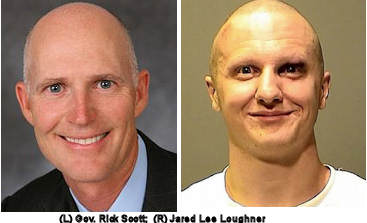
I’m pretty sure that Rick Scott has never actually shot anyone, but in the year and a half he’s been governor, he has been able to do an awful lot of damage.
The astounding thing is that Scott managed to be elected at all. Prior to running for governor, his major credential was building a huge Texas-based private for-profit health care company called Columbia/HCA which in 1997 was brought up on federal charges of massive Medicare fraud, and eventually admitted to 14 felonies. Scott resigned as CEO, under pressure from the company’s board, and decamped to Naples, Florida with a nice settlement and his fortune intact, and—best of all—no personal criminal charges. When questioned, Scott seemed almost unable to remember that he had anything to do with the company. Isn’t it amazing how CEOs never know anything about what’s happening in their companies despite the astronomical salaries they pull down?
One other detail: Scott was once a partner of George W. Bush in ownership of the Texas Rangers baseball franchise.
Scott was deeply involved in opposing the Obama health care legislation, and then launched his bid for the Florida governorship, spending a reported $78 million of his own money on the primary and general election. He managed to catch the wave of the Tea Party movement, which apparently regards defrauding the government as a good thing, and won the election by a margin of less than 62,000 votes (out of 5.3 million cast) over Democrat Alex Sink.
Since the election, many Floridians are apparently experiencing voters’ remorse, and Scott’s polling numbers have gone from bad to worse. Within a year of taking office, Scott had become the country’s least popular governor with an approval rating of only 29 percent. According to Public Policy Polling, even Republicans now barely support Scott, and he would now lose to little-known Democratic State Senator Nan Rich of Broward County (who recently announced her intention to run) by a double digit margin. Unfortunately, 2014 is still a long time away.
So, what has he done while in office? The Miami New Times recently published a handy list (read the whole thing with details here) of the dirty dozen:
- He privatized almost all of the state prisons in 18 counties (including Broward and Palm Beach) opening the door to private prison companies that supported his election to win the contracts.
- Began a systematic suppression of voters by undoing reforms under Jeb Bush and Charlie Crist that had made it easier for non-violent offenders to have their voting rights restored. Now they must wait 5 years after completion of their sentences. Those most affected: African-Americans. Their most common crime: drug possession. Then he made drives for signing up new voters practically impossible (see earlier post).
- Mandated drug testing for state workers (but not state legislators) and welfare recipients. The welfare thing had been tried in the 90s, but was a total failure with few recipients showing up positive and was abandoned. Then it turned out that one of the companies that would be paid for doing the tests was Solantic which was founded by Scott and his wife.
- Sought to repeal the law creating a prescription drug database which had been designed to help control the rampant trafficking of prescription drugs in the state. Ultimately, he had to backtrack on this.
- Proposed privatizing Medicaid statewide despite less-than-successful results of a pilot program in Broward County.
- Failed to acknowledge an apparent conflict of interest between health-related proposals and his reported $62 million investment (technically in his wife’s name) in Solantic until it became a media issue.
- Cut funding for persons with disabilities.
- Gave new tax breaks to business, while cutting unemployment benefits. Now the length of time someone can receive unemployment is indexed to the unemployment rate—the lower the latter, the shorter the former.
- Has avoided the press whenever possible and evaded sunshine laws.
- Returned federal funds for building a high-speed rail line between Tampa and Orlando, and then misstated the numbers that supposedly were the reason for the decision.
- Gutted state agencies charged with environmental protection and acquisition of land of ecological importance.
- Slashed funding for public schools, while approving privately-run, but publicly-funded virtual charter schools.
Scott’s latest fiasco also involves vote suppression and was launched with great fanfare last month with the “news” that untold thousands of non-US citizens were on Florida’s voter rolls. The campaign to purge the lists has attracted national attention, but turned up relatively few actual fraudulent registrations. In fact, a number of names on the supposed fraudulent list turned out to be perfectly legitimate, and most of Florida’s counties have now suspended a systematic search because the data they were given to work with turned out to be faulty. But Scott is still sticking to his guns.
And yes, he supports the “Stand Your Ground” gun law and appointed known supporters to the panel that was supposed to review the controversial law.
All of which makes me wonder why there hasn’t been a recall movement started. After all, Miami-Dade County got rid of Mayor Carlos Alvarez last year for what seem to me to be lesser offenses. But nothing of that nature seems to be brewing, and Rick Scott still has a lot of money for a re-election effort.
Maybe his slogan could be: “Crazy, but not as dumb as Rick Perry.”
 TrumpWorld for Beginners