
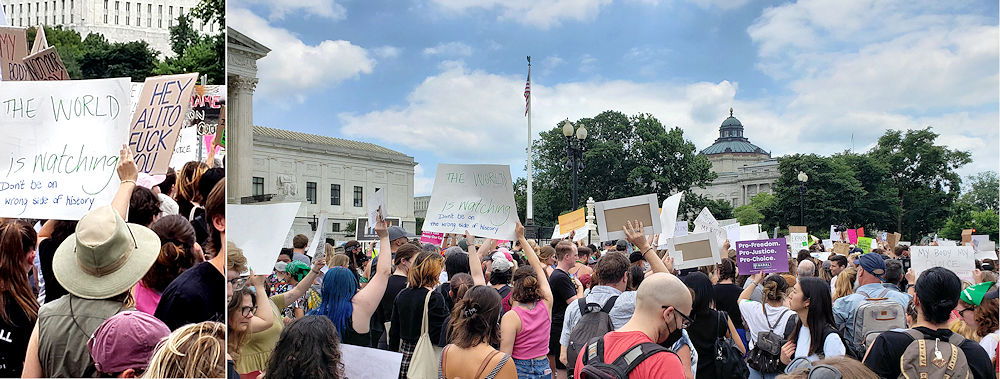
Reading the entire 213 pages of the Supreme Court decision on Dobbs v Jackson Women’s Center (the case that killed abortion rights by reversing the 1973 Roe v Wade) may seem like masochism for a non-lawyer like me, but for a case as momentous as this one, it seemed worth the effort. If nothing else, it shows clearly that on truly critical cases like this it’s not really about the law, but rather about political philosophy and power. The justices know where they’re going to come down, their opinions are merely the window-dressing–bits of argument and citations of precedents carefully selected to buttress the decision they’re already made. When you read the text, you realize that constitutional law is definitely not rocket science. You can understand it perfectly well. This is a long post, but stick with me. It’s important.
At least in this case, the opinions also reveal a lot about the inner dynamics of the Court and how each justice wants to present him- or herself to the American public, or at least that segment of it that cares about such things. More revealing than the majority opinion or even the dissents, are the concurrences where justices add further thoughts about the matter in question. This case has all of that in spades.
Boiling it all down isn’t easy, but here goes:
The Majority. The ruling opinion written by Samuel Alito closely follows the draft that was leaked weeks ago, and is an extreme example of the “originalist” judicial philosophy championed by the late Justice Anton Scalia. This line of argument maintains that legal opinions must adhere to the thinking of the men (and they are almost always men) who wrote the Constitution and its amendments at the time they were written. It rejects the idea that our understanding or interpretations of the meaning of such documents can evolve over time to accommodate changing circumstances and knowledge. This school of thought is analogous to religious fundamentalism, which it frequently overlaps, and ascribes a virtually divine origin to the Constitution. Thus, unless something isn’t present in the actual language of the Constitution, it probably isn’t constitutional.
Alito and his cohort baldly assert that Roe was “egregiously wrong” from the outset (even though five of the justices on the Court who voted for it in 1973 were Republican appointees) and that “Roe was on a collision course with the Constitution from the day it was decided.” The argument is essentially that abortion isn’t in the constitution and has been illegal throughout most of American history, that is, until Roe. Therefore it cannot be a right protected by the Constitution because it is not mentioned in that document or “deeply rooted” in tradition. There are pages of citations regarding the illegality of abortion in 1868, when the 14th Amendment was passed. This is important, he argues, because Roe held that that the Due Process Clause of the Fourteenth Amendment to the United States Constitution provides a fundamental “right to privacy”, which protects a pregnant woman’s right to an abortion. Alito insists that this is nonsense because the 14th Amendment doesn’t mention any “right to privacy” and anyway abortion was illegal in 1868. Therefore, the supposed right to have an abortion is simply made up and has no constitutional basis.
He follows this with an extended discussion of the question of fetal viability, which Roe used to determine at what stage of pregnancy an abortion would be legally permissible. Basically, Roe divided a pregnancy into three trimesters. During the first trimester (weeks 1 -12), abortion was unrestricted by government intervention. During the second trimester, the state could regulate abortion regulate abortion if the regulations were reasonably related to the health of the pregnant woman. During the third trimester, the state could prohibit abortions unless an abortion was necessary to save the life or health of the woman. Thus the key point was that at which a fetus became “viable” or capable of surviving outside the womb. That question had been revised somewhat in 1992 in Planned Parenthood v Casey, in which the Supreme Court created a general standard based on fetal viability (understood to be around 28th week of pregnancy but not rigidly defined) while upholding the constitutionality of Roe. [Note: Dobbs also overturns Casey.] Alito attacks the very idea of such an “arbitrary line”, arguing that viability has changed with medical advances, and questions whether a State can even make such a judgment. This suggests that a state could set the dividing line at virtually any point in a pregnancy or not have one at all.
Alito notes that viability also depends on the quality of available medical facilities and then asks rhetorically, “On what ground could the constitutional status of a fetus depend on the pregnant woman’s location?” [Ironically, this is precisely the situation that the elimination of Roe has produced, i.e., without a national standard, states can and will apply different standards for when an abortion can be obtained or prohibit abortion at any stage.]
Next, Alito attacks the concept of “undue burden” which obstacles imposed by states would place on a woman seeking an abortion, claiming this is too ambiguous and therefore all but impossible to adjudicate.
Then he devotes a few paragraphs to the practical effects of overturning Roe (“reliance interests”), but airily concludes that those are impossible to determine “in any practical sense” and thus the whole question of abortion should be left to state legislatures. And besides, women have the right to vote and “are not without political or electoral power”.
Then, on page 74, Alito dismisses any concerns that this case could also impact other rights based on the Due Process Clause of the 14th Amendment–like contraception, gay sex, or gay marriage. Abortion is different, he declares, because it terminates a life or potential life, and thus is “inherently different from marital intimacy,” “marriage,” or “procreation”. “And to ensure that our decision is not misunderstood or mischaracterized, we emphasize that our decision concerns the constitutional right to abortion and no other right. Nothing in this opinion should be understood to cast doubt on precedents that do not concern abortion.” Trust us.
Finally, Alito gets around to the sticky question of “stare decisis“, the legal doctrine that established laws should remain in effect absent some compelling reason to get rid of them. He notes that neither Roe nor Casey ended controversy over abortion. He doesn’t identify any cogent reason to overturn Roe other than the alleged deficiencies in its constitutional basis and that ” 26 States expressly ask us to overrule Roe and Casey and to return the issue of abortion to the people and their elected representatives.” After all, he asks piously, what if Plessy v Ferguson hadn’t been overturned by Brown v Board of Education? “We can only do our job, which is to interpret the law, apply longstanding principles of stare decisis, and decide this case accordingly. We therefore hold that the Constitution does not confer a right to abortion. Roe and Casey must be overruled, and the authority to regulate abortion must be returned to the people and their elected representatives.”
But wait, there’s more. Alito goes back yet again to the impact on Griswold, Eisenstadt, Lawrence, and Obergefell, i.e., those cases based on the Due Process Clause dealing with contraception, sex, and same-sex marriage. We already explained how those are different, he says, “and it is hard to see how we could be clearer.” But, he warns that can’t be turned around, because “a right to abortion cannot be justified by a purported analogy to the rights recognized in those other cases or by ‘appeals to a broader right to autonomy’.” Obviously, a sore point here (more on this below).
Finally, he turns to the concurrences by the other justices, or more precisely one of the concurrences, that of Chief Justice Roberts. I’ll discuss that below, but here I just want to comment on the tone of Alito’s dismissal of Roberts’ argument, which is dripping with contempt. Alito writes, “The concurrence’s most fundamental defect is its failure to offer any principled basis for its approach” and “would do exactly what
it criticizes Roe for doing: pulling ‘out of thin air’ a test that ‘[n]o party or amicus asked the Court to adopt’.” He ends: “In sum, the concurrence’s quest for a middle way would only put off the day when we would be forced to confront the question we now decide. The turmoil wrought by Roe and Casey would be prolonged. It is far better—for this Court and the country—to face up to the real issue without further delay.” In other words, the Court will end the controversy over abortion by making it a political issue in every state of the Union. The absurdity of this argument is stunning.
Roberts may still be Chief Justice, but the radicals clearly have no respect for him. It’s not the Roberts Court any more.
Clarence Thomas. The concurrence written by Thomas goes straight for the jugular. Yes, he writes, the Due Process Clause does not secure the right to abortion, because it does not secure any substantive right. The Dobbs decision doesn’t affect decisions like Griswold, Lawrence, and Obergefell, but that’s only because “no party has asked us to decide whether our entire Fourteenth Amendment jurisprudence must be preserved or revised”. He goes on: “For that reason, in future cases, we should reconsider all of this Court’s substantive due process precedents, including Griswold, Lawrence, and Obergefell. Because any substantive due process decision is “demonstrably erroneous,” …, we have a duty to ‘correct the error’ established in those precedents.” He continues: “After overruling [emphasis added] these demonstrably erroneous decisions, the question would remain whether other constitutional provisions guarantee the myriad rights that our substantive due process cases have generated. For example, we could consider whether any of the rights announced in this Court’s substantive due process cases are “privileges or immunities of citizens of the United States” protected by the Fourteenth Amendment.”
This is truly chilling. Thomas is saying that all of those cases should be overruled–he’s already decided that–and here he is openly soliciting cases that deal with those decisions so that can happen. There are a number of states that will be happy to oblige by generating cases to send forward to SCOTUS.
So, according to Thomas, those assurances in Alito’s opinion are nonsense and mean nothing. In previous concurrences and dissents, Thomas has openly stated his hostility to gay rights and same-sex marriage in particular. Now he seems to think he has a court that will let him take those away. He may well be right.
Kavanaugh. Brett Kavanaugh’s rather odd concurrence takes the Pontius Pilate approach, essentially washing his hands of the issue. According to him, the Constitution is completely neutral on the question of abortion, neither for nor against. Therefore it’s up to “the people and their elected representatives to resolve through the democratic process in the States or Congress—like the numerous other difficult questions of American social and economic policy that the Constitution does not address.” Roe was wrong because it took a side in favor of abortion, but he emphasizes that “the Court’s decision today does not outlaw abortion throughout the United States.” It’s up to Congress or the states to decide.
He then goes into the stare decisis issue. “This Court establishes that a constitutional precedent may be overruled only when (i) the prior decision is not just wrong, but is egregiously wrong, (ii) the prior decision has caused significant negative jurisprudential or real-world consequences, and (iii) overruling the prior decision would not unduly upset legitimate reliance interests.” Based on that, he agrees that Roe should be overruled, but supplies nothing regarding meeting the second or third criteria–presumably he just accepts the “egregious” part. Then there’s a dutiful reference to the wrongness of Plessy v Ferguson, etc, etc....
On the Due Process issue, Kavanaugh simply repeats what Alito said: “I emphasize what the Court today states: Overruling Roe does not mean the overruling of those precedents, and does not threaten or cast doubt on those precedents.” Perhaps the justice doth protest too much.
So what’s the point of Kavanaugh’s concurrence? To me, it looks like image repair. The message is: See, we’re not vindictive meanies! It’s simply not up to us, so go sort it out for yourselves. And don’t worry, we’re not going after the gays. Yet.
Roberts. The concurrence by Chief Justice Roberts is more interesting, but ultimately looks like wanting to have it both ways or, better yet, put off making any comprehensive ruling. Its point of departure is essentially a procedural question: Did the Court go way beyond what the case initially asked it to do?
Roberts tries to find some middle course that straddles the gap between the anti-abortion zealots and abortion rights defenders. “The Court’s opinion is thoughtful and thorough, but those virtues cannot compensate for the fact that its dramatic and consequential ruling is unnecessary to decide the case before us.”
Ultimately, however, he goes along with the Alito majority opinion. Robert’s says the “viability test” should be discarded entirely as unworkable, but doesn’t say what should replace it. He argues that the Court didn’t have to completely eliminate the right to abortion afforded by Roe. Interestingly, he notes that Mississippi initially only asked the Court to “clarify whether abortion prohibitions before viability are always unconstitutional” and added that “the State made a number of strong arguments that the answer is no” which Roberts found “persuasive”. It was only after the Court agreec to review that case, that Mississippi “changed course” and in its principal brief argued for overturning Roe and Casey. Roberts then implicitly rebukes the Court for “rewarding that gambit” by accepting the revised basis for review when it didn’t have to. Instead, it should have adhered to the principle of “judicial restraint” rather than “overruling Roe all the way down to the studs: recognize that the viability line must be discarded, as the majority rightly does, and leave for another day whether to reject any right to an abortion at all.”
He goes on that the Court could have overruled a “subsidiary rule” (about viability) and allow “abortions up through fifteen weeks, providing an adequate opportunity to exercise the right Roe protects. By the time a pregnant woman has reached that point, her pregnancy is well into the second trimester. Pregnancy tests are now inexpensive and accurate, and a woman ordinarily discovers she is pregnant by six weeks of gestation.”
Roberts states that “The Court’s decision to overrule Roe and Casey is a serious jolt to the legal system—regardless of how you view those cases. A narrower decision rejecting the misguided viability line would be markedly less unsettling, and nothing more is needed to decide this case.” He then continues in that vein at some length.
But regardless of all that, Roberts concurs in the ruling anyway.
So what are we to make of this? The one thing that seems obvious is that the right-wing majority has the bit in its teeth and is no longer accepting guidance from Roberts, at least on core issues important to the Republican base. The radicals aren’t interested in compromise. Roberts now looks increasingly like an impotent figurehead, trying desperately to bridge an unbridgeable gap. But in the end, he goes along with the Jacobins.
The Dissent by Breyer, Sotomayor, and Kagan. To read the vitriolic language in the Alito opinion, one might think that the defenders of Roe and Casey were helpless to produce any coherent rationale for either. However, the robust 65-page dissent proves otherwise. I would urge everyone to read it for yourself.
Reading the majority opinion, I was struck by the utter lack of any consideration of the impact of this decision In Real Life–the “reliance interests” so cavalierly dismissed by Alito. (Indeed, this is a common aspect of virtually all the major decisions by the conservative majority in recent decades from Citizens United to the recent decision banning restrictions on carrying guns in public.) Their decisions reject such concerns as either unknowable or inconsequential, when in fact they are neither. The discussion is framed in terms of abstract principles and citations of precedents and other “authorities”, not the enormous and very predictable Real World implications. The logical conclusion is that their willful ignorance of such consequences means that the drafters of these rulings actually welcome the IRL consequences of their decisions. Indeed, those consequences are usually precisely what the Republican party wants.
The dissent in this case addresses at length the foreseeable damage and chaos that the decision will cause and its impact on currently and potentially pregnant women across the country. “Above all others, women lacking financial resources will suffer from today’s decision. In any event, interstate restrictions will also soon be in the offing. After this decision, some States may block women from traveling out of State to obtain abortions, or even from receiving abortion medications from out of State. Some may criminalize efforts, including the provision of information or funding, to help women gain access to other States’ abortion services.” Of course, this is already happening. It continues: “Most threatening of all, no language in today’s decision stops the Federal Government from prohibiting abortions nationwide, once again from the moment of conception and without exceptions for rape or incest. If that happens, “the
views of [an individual State’s] citizens” will not matter…Whatever the exact scope of the coming laws, one result of today’s decision is certain: the curtailment of women’s rights, and of their status as free and equal citizens.”
The dissent then addresses the exact threat raised by Thomas’ concurrence: “And no one should be confident that this majority is done with its work. The right Roe and Casey recognized does not stand alone. To the contrary, the Court has linked it for decades to other settled freedoms involving bodily integrity, familial relationships, and procreation. Most obviously, the right to terminate a pregnancy arose straight out of the right to purchase and use contraception… In turn, those rights led, more recently, to rights of same-sex intimacy and marriage…They are all part of the same constitutional fabric, protecting autonomous decision-making over the most personal of life decisions.” In other words, the remaining liberals on the Court are agreeing with Thomas that cases like Griswold, Lawrence, and Obergefell are based on the same legal foundations as Roe. If Roe is invalid, why wouldn’t the others be threatened as well? As for the assurance that it’s only Roe that is affected, the dissent later points out the fragility of that claim, calling it “Scout’s honor”.
The dissent points out that “The lone rationale for what the majority does today is that the right to elect an abortion is not ‘deeply rooted in history’…[but] The same could be said…of most of the rights the majority claims it is not tampering with…So one of two things must be true. Either the majority does not really believe in its own reasoning. Or if it does, all rights that have no history stretching back to the mid-19th century are insecure. Either the mass of the majority’s opinion is hypocrisy, or additional constitutional rights are under threat. It is one or the other.”
It then addresses stare decisis: “The legal framework Roe and Casey developed to balance the competing interests in this sphere has proved workable in courts across the country. No recent developments, in either law or fact, have eroded or cast doubt on those precedents. Nothing, in short, has changed. Indeed, the Court in Casey already found all of that to be true. Casey is a precedent about precedent. It reviewed the same arguments made here in support of overruling Roe, and it found that doing so was not warranted. The Court reverses course today for one reason and one reason only: because the composition of this Court has changed.” The dissent returns to this point later, after a long and detailed discussion of the Constitutional basis of Roe and other rights deriving from the Due Process Clause, observing: “The majority has overruled Roe and Casey for one and only one reason: because it has always despised them, and now it has the votes to discard them. The majority thereby substitutes a rule by judges for the rule of law.”
The rest of the dissent is a point-by-point rebuttal to the majority’s arguments, including casting ridicule on Kavanaugh’s blithe declaration that the Court is neutral on abortion. I won’t go into more detail here, but I find the dissenters’ argument compelling.
Finally, the dissent returns to the impact of the ruling IRL, which is indeed the crux of the matter. “The majority claims that the reliance interests women have in Roe and Casey are too ‘intangible’ for the Court to consider, even if it were inclined to do so…This is to ignore as judges what we know as men and women. The interests women have in Roe and Casey are perfectly, viscerally concrete. Countless women will now make different decisions about careers, education, relationships, and whether to try to become pregnant than they would have when Roe served as a backstop. Other women will carry pregnancies to term, with all the costs and risk of harm that involves, when they would previously have chosen to obtain
an abortion. For millions of women, Roe and Casey have been critical in giving them control of their bodies and their lives. Closing our eyes to the suffering today’s decision will impose will not make that suffering disappear. The majority cannot escape its obligation to ‘count[] the cost[s]’ of its decision by invoking the ‘conflicting arguments’ of ‘contending sides’…The majority’s refusal even to consider the life-altering consequences of reversing Roe and Casey is a stunning indictment of its decision.” There’s a fundamental principle at stake here as well: “Rescinding an individual right in its entirety and conferring it on the State, an action the Court takes today for the first time in history, affects all who have relied on our constitutional system of government and its structure of individual liberties protected from state oversight.”
Finally, the dissent addresses the impact of this decision on the Court itself and respect for the legal system in general: “We fear that today’s decision, departing from stare decisis for no legitimate reason, is its own loaded weapon. Weakening stare decisis threatens to upend bedrock legal doctrines, far beyond any single decision. Weakening stare decisis creates profound legal instability. And as Casey recognized, weakening stare decisis in a hotly contested case like this one calls into question this Court’s commitment to legal principle. It makes the Court appear not restrained but aggressive, not modest but grasping. In all those ways, today’s decision takes aim, we fear, at the rule of law.” Take a second and consider the gravity of that statement.
The dissent ends with a bitter indictment of the majority who endorsed this decision: “Now a new and bare majority of this Court—acting at practically the first moment possible—overrules Roe and Casey. It converts a series of dissenting opinions expressing antipathy toward Roe and Casey into a decision greenlighting even total abortion bans…It eliminates a 50-year-old constitutional right that safeguards women’s freedom and equal station. It breaches a core rule-of-law principle, designed to promote constancy in the law. In doing all of that, it places in jeopardy other rights, from contraception to same-sex intimacy and marriage. And finally, it undermines the Court’s legitimacy.”
It concludes: “In overruling Roe and Casey, this Court betrays its guiding principles. With sorrow—for this Court, but more, for the many millions of American women who have today lost a fundamental constitutional protection—we dissent.”
One more thing–The elephant in the room. There is a fundamental dishonesty in this entire discussion, and that involves the total absence of any acknowledgement of the centrality of religion in this entire Court decision. The opposition to abortion is mostly based on religious belief–specifically Roman Catholic dogma and that of certain fundamentalist Christian sects. The five Justices–Alito, Kavanaugh, Barrett, Gorsuch, and Thomas–who are the driving force behind the majority decision constitute a group that should rightfully be called the Court’s Religious Majority. All of them are Catholics, except Gorsuch (who was raised Catholic and whose mother Ann Gorsuch, who headed the EPA under Reagan, was Catholic and a staunch foe of abortion). They consistently write and endorse decisions that have thoroughly eroded the separation of Church (Christian, specifically) and State. This decision is no different. It amounts to the imposition of a specific religious belief on the entirety of American society.
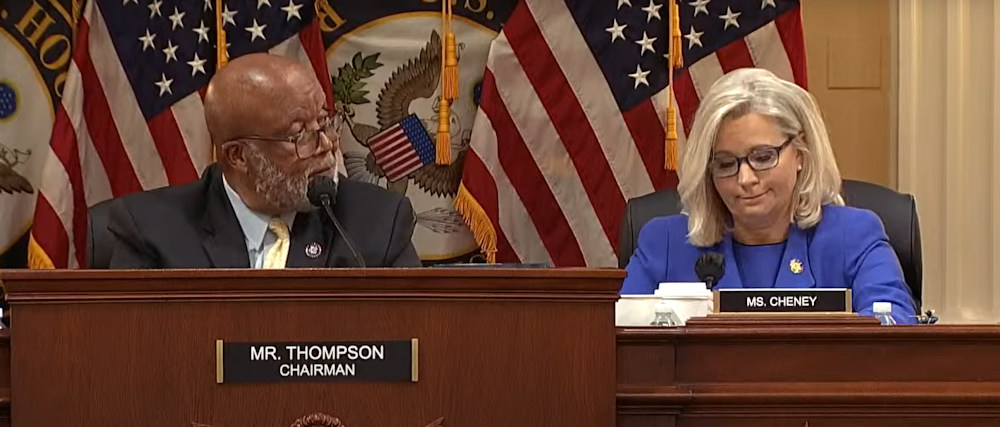
Will the January 6 hearings make any difference? I hope they will, but I am very doubtful. Last night’s opening provided compelling detail–some of it new–but what we saw was not all that different from what was presented during Trump’s second impeachment a year and a half ago, and we all know what happened then. Nothing.
The truth has been in full view for any who have eyes to see. On various occasions during the 2016 election campaign and during his presidency, Trump was asked repeatedly whether he would accept losing an election. His response was always evasive, which clearly signaled that the true answer was “No”.
When it actually happened, he did everything possible to overturn the election and stay in power illegally. A few Republican “leaders” like Mitch McConnell and Kevin McCarthy initially expressed shock and dismay calling Trump’s actions “unacceptable”. Simultaneously, however, eight Republican senators and 139 Republican representatives voted against certifying Biden’s election on January 6—AFTER THE INSURRECTION. When it counted–at the impeachment trial–every single Republican senator except Mitt Romney voted against impeachment, thus signifying that what had happened was, in fact, acceptable. And, indeed, something to be defended.
Since then, the Great Lie about the “stolen election” has had a year and a half to metastasize and become a battle cry in MAGA land. Cults are impervious to reason and facts. Faith doesn’t demand proof; the faithful just believe. The Republican Party’s position is absolutely clear. Whose mind is going to be changed now?
I vividly remember watching the Watergate hearings in the summer of 1973. It was a different country then. Americans might have been divided over Vietnam, but they still found Nixon’s actions shocking, even though what he did was utterly trivial compared to staging a coup in order to remain in power. The country paid attention, in part because there were only three networks and all of them broadcast the hearings live.
I don’t see that happening now. Where’s the outrage? Where’s the mobilization against the fascist direction that the Republican party is trying to take us? The mood of the country seems to me to be one of sullen, cowed resignation. There are too many distractions available. People don’t want to be bothered. Everyone expects the Democrats to lose the midterms. Biden is unpopular and has become a late-night punching bag. Gas costs too much! Nobody cares that every day isn’t a new scandal like it was when Trump was in the White House. Maybe we kind of miss it. At least it was entertaining, and entertainment is what we all want. Does anyone think Trump wouldn’t win in 2024? If not Trump, then there are plenty of Trump Mini-Me clones waiting in the wings.
We don’t believe that government can work for the people anymore, because it doesn’t. We can’t even raise the legal age to buy AR-15s to 21 following two horrific massacres—that would be too “radical”. The campaign waged by Republicans (with some Democrats’ assistance) for the last 50 years to discredit government has succeeded. The MAGA crowd has been convinced that the last election was rigged, and Republican-dominated legislatures across the country have been working diligently to insure that the next one WILL be rigged—in their favor. Then elections won’t even matter anymore.
I think we are living in an American version of the Weimar Republic, when our democratic institutions are perilously fragile and vulnerable and everyone is too distracted or exhausted or just trying to get by on crap wages to give a shit. We are getting dangerously close to the black hole of fascism and may already have passed the point of no return. I really hope I’m wrong.
This is a sick, sick country. The mass murder in Buffalo brings together two of the most virulent diseases infecting America: white supremacy and gun worship. I no longer have any hope that I will see anything constructive done about gun violence in my lifetime. Meanwhile, the Republican Party has made white supremacy the bedrock of its appeal to voters, and too many white people seem to be buying it. I think the two are tightly intertwined. Republicans traffic in racial fear, and fear fuels the proliferation of firearms.
There has been plenty of commentary about how the spread of propaganda on right-wing media about “white replacement” (and the linked hysteria about “critical race theory”) have fed into the fever dreams of infantile psychos like Dylann Roof, Kyle Rittenhouse, and now Peyton Gendron, who see themselves as heroes of White America–and who are indeed accepted as such within the MAGA crowd. There really isn’t any doubt that this is true. This pernicious nonsense is Republican dogma now–covertly for some, overtly for a growing number of others.
What I don’t see is any serious effort to do anything about guns. Democrats have basically given up on that. In state after state, the trend is to loosen, not tighten, access to firearms with new open- and concealed-carry laws that have increased the likelihood that the dude at the next table in a restaurant or at the next pump in a gas station is packing heat. Nothing makes any difference–not Sandy Hook, not Pulse nightclub, not Marjorie Stoneman Douglas High School, not Sutherland Springs, not Columbine, not the El Paso Walmart, not Las Vegas, and now not Buffalo. We are no longer surprised or even much shocked by mass shootings; indeed we hardly notice most of them. So far just this year, there have been almost two hundred shootings in the US involving at least four victims shot or killed, according to the Gun Violence Archive.
The US is an outlier in this regard among advanced countries. Racism exists to a greater or lesser degree everywhere, but only in the US do we see it manifested in lethal gun violence at anywhere close to the scale we experience in this country. Why? Because there are way more guns.
TV crime procedural dramas always talk about means, motive, and opportunity. Well, opportunity for an armed person to shoot people in a public place is everywhere and anywhere. Maybe we could do something about motive if the Republican Party and its enablers changed their tune, but we know they’re not going to as long as it’s working for them, which it is. We certainly could do something about means if there were enough political will to reduce the number of guns in private hands and eliminate access to firearms of mass destruction. But there is no such will, and it’s not going to happen. There will be other Buffalos, just like there have been other Sandy Hooks. It’s just maddening and infuriating, but we all know nothing is going to change because our government simply doesn’t work.
This country is in a sour, mean mood, for all sorts of different reasons. We are in our own Weimar Republic, and I fear that what comes next won’t be pretty.
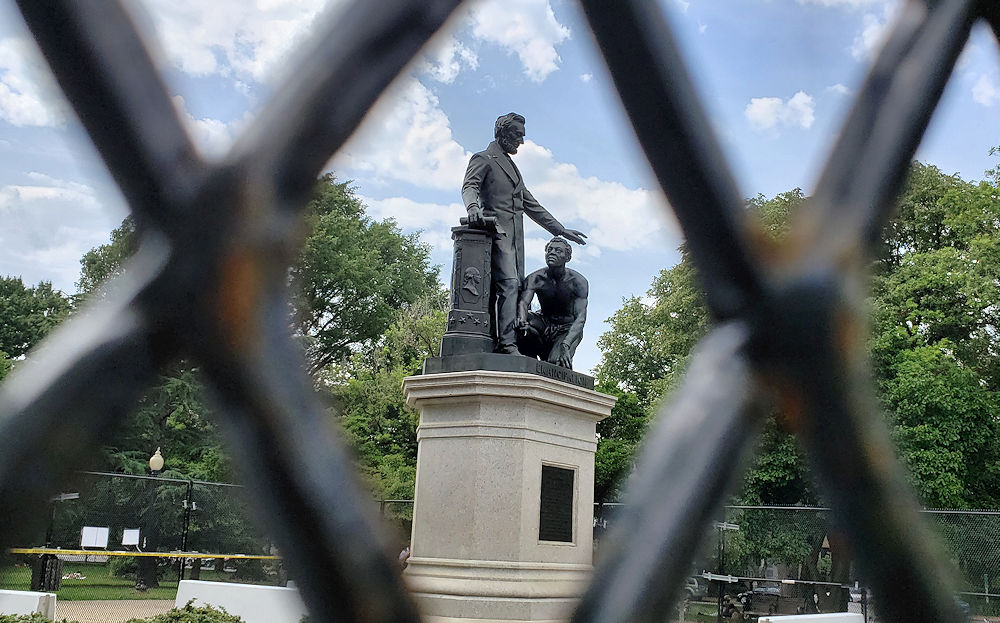
Don’t get me wrong, I’m very happy that June 19, or Juneteenth, has been made a federal holiday to commemorate the emancipation of America’s slaves.
What bothers me is the narrative that is being constructed around the Juneteenth holiday. Why is it that Republican lawmakers in Congress, who universally support their party’s unceasing and increasingly successful efforts to suppress the votes of Black and other minority Americans and who have made Critical Race Theory a conservative bogeyman to scare white people, should so eagerly embrace making Juneteenth a holiday? Could there possibly be another agenda here?
Of course there is. If we now have not one but TWO holidays that celebrate Black America, that means that racial discrimination is no longer a problem in this country, doesn’t it? It’s all fixed, right? Nothing to see here, folks, so let’s just move on. Look, we gave you another day off! America isn’t a racist country, and this proves it. After all, that was the rationale for the Supreme Court’s 2013 gutting of the Voting Rights Act: We don’t have a problem anymore, because all of that was in the past–now it’s all fine. Hey, Walmart is selling the t-shirt!
The critic Hilton Als, in a 1999 essay on the great comedic and dramatic talent Richard Pryor, observed: “People are quick to make monuments of anything they live long enough to control.” Kaitlyn Greenidge cited that aperçu in a New York Times op-ed, saying “I can’t help but think this is the impetus behind the rush to canonize Juneteenth as a national holiday. I worry the lessons of Juneteenth will become lost because we have seen the promising visions of Black freedom-dreaming co-opted before.” Just look at how Martin Luther King, Jr. and even Malcolm X are now piously–and very selectively–cited by politicians who would have regarded them with the same fear and loathing that most of white America did when they were alive and active.
Back in the segregated Texas of my childhood, Juneteenth was the one day out of the year when black folks could go to the public parks and zoos (not swimming pools, however), and of course, white people stayed strictly away. It’s facts like these that are in danger of being whitewashed away in the Disneyfied version now being promulgated.
Ironically, this is exactly why Critical Race Theory and initiatives like The 1619 Project are needed even more if we as a nation are ever to understand and come to terms with this country’s ugly racial history. Instead, what do we get? A concerted Republican effort to suppress study and teaching of America’s real racist culture as being “divisive” and “unpatriotic”. Teaching of Critical Race Theory has been banned from being taught in public schools in Texas, Florida, and at least 3 other Republican-governed states, and several other states have similar bans in the works. Texas Senator Ted Cruz proclaimed that “Critical race theory is bigoted, it is a lie, and it is every bit as racist as the klansmen in white sheets.” If Republicans can suppress the black vote, why not continue to suppress black history? After all, the holiday itself commemorates the suppression for two years of the news that slaves in Texas had been emancipated.
So yes, let’s make Juneteenth a holiday. But we can’t use another holiday to pretend that we’ve fixed the problem of structural racial injustice in our society.

On June 4, an overflow crowd jammed the Mana Convention Center in Miami’s trendy Wynwood district to attend Bitcoin2021, sponsored by the leading cryptocurrency and headlined by such Silicon Valley luminaries as Jack Dorsey, the founder and CEO of Twitter, there to make the case that the blockchain technology is world’s best tool for achieving financial freedom and fighting government censorship. “We don’t need the financial institutions that we have today,” Dorsey said. “We have one that is thriving … that is owned by the community.” Miami Mayor Francis Suarez opened the conference, declaring his goal was to make Miami the “Bitcoin, blockchain and mining capital of the world.”
The campaign seems to be working. Only the day before, Suarez announced that Blockchain.com, whose digital platform lets users buy, sell, and trade Bitcoin and other forms of digital payment, would be moving its headquarters from New York to Miami. Earlier in the week, Atlanta-based Borderless Capital announced the creation of the Borderless.Miami fund, which will use $25 million to “seed startups using the Algorand blockchain and Algo coin. It is also creating an Algorand Miami Accelerator in collaboration with Circle, another heavyweight in the crypto world.” Then on Bitcoin2021’s opening day, eToro, the world’s second-largest exchange by number of weekly visitors, announced it is seeking office space in Miami for a 50-person U.S. hub that will share duties with its current U.S. location in Hoboken, New Jersey.
To top it all off on that same day, the former American Airlines Arena–the home of the Miami Heat–was officially renamed the FTX Arena, part of a 19 year, $135 million renaming deal with FTX, a cryptocurrency exchange founded and headed by a little-known 29-year-old billionaire named Sam Bankman-Fried. It almost overshadowed news coverage of several mass shootings in Miami-Dade County during the same week.
If, like most Miamians, you had never heard of FTX and have only the vaguest idea of what a cryptocurrency is, you might well wonder what all of this is about. It sounds so cool and cutting-edge, but who are these people really? And what does this purported financial revolution mean for the city and the country?
There is remarkably little information readily available about FTX or its wunderkind founder, and there is no evident connection to Miami. The company, founded in 2019, is based in Hong Kong and incorporated in Antigua and Barbuda, a Caribbean island nation that sells its citizenship for as little as $100,000 (plus processing fees). Forbes did a fanboy interview with Bankman-Fried in May, that ticked off the basic (and oft-repeated) milestones in his bio–MIT, working for Jane Street Capital, founding Alameda (“a crypto quantum trading firm”), and then FTX. “I wanted to incorporate the buyer, the seller, and the exchange. So we launched FTX in spring of 2019 and built it from nothing to where it sits today as the fourth largest global crypto currency exchange based outside of China.” The Forbes interviewer showed no curiosity about the source of the capital that fueled this meteoric rise, focusing instead on Bankman-Fried’s self-proclaimed “effective altruism”, comparing him to Victorian utilitarian philosopher Jeremy Bentham.
According to one report, Bankman-Fried is now the second most wealthy “blockchain billionaire”–up from being nowhere on the list the previous year. The stunning rise of FTX seems to correlate to a large investment in December 2019 by Binance, the world’s largest cryptocurrency exchange, founded by CEO Changpeng “CZ” Zhao in China, but later moved offshore to a succession of locations reportedly including Malta, Seychelles, and the Cayman Islands. Zhao now reportedly claims that Binance has no headquarters. In May, Bloomberg News reported that Binance was under investigation by the IRS and Justice Department.
In the world of cryptocurrency, no one seems concerned by such things, but the Miami Herald editorial board expressed some serious qualms in an editorial entitled “Forgive us, but the heady prospect of Miami as a crypto hub makes us a little queasy“:
“It’s an exciting time. It’s scary, too. To those of us without a Bitcoin to our names, it feels kind of unreal. Don’t get us wrong. We hope cryptocurrency — and the flashing neon welcome mat we’ve set out for the tech industry — elevate this city to new prosperity. We’d love it if this heady new world has real staying power, especially if it can provide the fuel for the gritty, unglamorous things this city needs, like affordable housing, ways to combat sea level rise and better transportation. We hope virtual currency and the underlying blockchain technology provide scads of jobs in this community. Just don’t blame us for being a bit wary.
“Because Miami has history, folks. We’ve been a smugglers’ paradise, the epicenter of the cocaine trade, a mecca for money laundering, ground zero for mortgage fraud, home to the biggest Medicare black market in the United States. When the “frothy” housing bubble burst in 2007, Miami’s overheated market got hurt badly.”
Indeed. Back in the ’80s–the days of Miami Vice–the flood of unbelievable amounts of cocaine cash fueled the local economy and built the glittering skyscrapers that line Brickell Avenue, but it came at a great price in crime and corruption when Miami became the US epicenter of the cocaine wars. No one is suggesting that the influx of cryptocurrency money will bring 80s-style gun battles in the streets. But there are serious concerns about where all of the money bankrolling these companies is coming from and who is paying whom on these platforms. Not to mention questions about whether the entire cryptocurrency phenomenon is just another bubble that will pop and leave another financial disaster in its wake.
There are also serious concerns about adverse effects of unregulated cryptocurrency on society at large. The near-untraceability of cryptocurrency transactions makes it the ideal medium of exchange for organized crime, money laundering, terrorist activity, tax evasion, and cyber crime. To cite only the most recent big example, when cybercriminals shut down the Colonial Pipeline last month causing panic buying and fuel shortages throughout the eastern US, the company reportedly paid the $4.4 million ransom in Bitcoin.
Technically, cryptocurrency transactions are not absolutely anonymous, but rather pseudonymous, i.e. the identity of the parties involved is masked by a public key which is published on the bitcoin blockchain and a private key or “signature” known only to the user. It is therefore theoretically possible to identify parties to transactions through cluster analysis of patterns in the keys, but there are also ways of evading this scrutiny, e.g., by using a different key for each transaction. Some cryptocurrency exchanges and digital “wallets” require some minimal level of personal information in order to set up an account. But there are also a number of cryptocurrencies whose primary selling point is that they offer enhanced security features or options that help to keep users’ identities and activities concealed. The bottom line is that it remains extraordinarily difficult for law enforcement or national treasuries and central banks to identify the parties to any given transaction and the odds of detection are extremely small, especially if someone takes measures to conceal his identity. So for all practical purposes, almost all cryptocurrency transactions are indeed virtually anonymous.
If you look for the one thing that most distinguishes cryptocurrency from fiat currency like the dollar, euro, yen, or pound, it would be precisely its secrecy and absence of oversight by government agencies. Since there are no intermediaries like banks that are subject to scrutiny and regulation, there is no entity to police what happens on the cryptocurrency exchanges other than the exchanges themselves, which have little or no incentive to do so. That is exactly what makes it so attractive to individuals and organizations that don’t want their activities revealed. It takes little imagination to see applications in politics, like dark money payments to influence elections (already hard enough to trace) or bribery of public officials by opening up a cryptocurrency wallet invisible to prying eyes.
To be fair, advocates claim that cryptocurrencies can do some things that traditional currencies can’t and are intrinsically more democratic by being available to people who lack access to traditional banking. For example, they assert that cryptocurrencies offer a safe way to store monetary value in countries that lack a stable currency, like Venezuela. The problem is that upon closer examination, these arguments start to melt away and seem more a specious rationalization for a medium best suited for illicit activities. A desperate Venezuelan may indeed see a cryptocurrency as a way to get money out of his country’s abysmally failed economic system, but access to an exchange would be largely limited to the richer strata of society, not those who have seen their meager savings vanish and have to scramble daily for necessities. Moreover, the value of individual cryptocurrencies themselves is highly volatile and subject to abrupt swings. For example, Elon Musk’s remark on Saturday Night Live last month that dogecoin, a bitcoin rival that he had been pushing, was really “a hustle”, sent its value immediately plummeting by 40 percent.
Still, it’s easy to understand the allure of speculation in cryptocurrency when the overall trend in the market value of cryptocurrencies like bitcoin continues to rise, fueled by the speculation itself and the belief that this is The Next Big Thing. Many people have made a lot of money by betting on Bitcoin and its rivals. At this point, however, the market value is based on faith and faith alone, which is why things like naming rights to Miami’s biggest sports arena become important. If the Heat are playing in the FTX Arena, it must be real, right?
What could make it Not Real is if the US Government decides to impose regulations that would pull back the veil of anonymity in cryptocurrency transactions. This is why it is critical now to get political support for the free-wheeling status quo and project an aura of both inevitability and Too Big to Fail. It’s no accident that Sam Bankman-Fried gave $5 million to the Biden campaign–the second-largest individual donation after Mike Bloomberg’s. The party affiliation is unimportant, as long as politicians see the “industry” as legitimate and its survival to be in their interest. Any effective regulation is viewed as a threat that could bring the whole thing crashing down. The prevailing ideology in the cryptocurrency world is Libertarian where any regulation is a bad regulation.
Governments and central banks around the world have been slow to react to the cryptocurrency phenomenon or recognize its implications. As long as cryptocurrency represented only a tiny fraction of financial activity, it could be essentially ignored as insignificant. But if, say, a quarter or a third of financial transactions took place with cryptocurrency, that would represent an existential threat not only to the established banking industry but also to governments’ ability to impose effective monetary and fiscal policy because an enormous chunk of economic activity would be beyond their control. That may be Jack Dorsey’s Libertarian dream, but it would be Janet Yellen’s nightmare.
So far, the US government has not really tackled cryptocurrency-related issues. Back in February 2020, then-Treasury Secretary Mnuchin told Congress that regulations were being developed at Treasury for cryptocurrencies, which he cited as “a major threat”, but then nothing happened. The crypto industry has created its own lobbying force to try to insure that nothing does happen. There is even a bi-partisan “Blockchain Caucus” in the House of Representatives, whose website says “we believe in the future of blockchain technology” and “as a Caucus, we have decided on a hands-off regulatory approach, believing that this technology will best evolve the same way the internet did; on its own.” In May, Treasury announced that any crypto transfers greater that $10,000 would have to be reported to the IRS, adding that “cryptocurrency already poses a significant detection problem by facilitating illegal activity broadly including tax evasion.” It was unclear, however, how this could be enforced. China has also called for a crackdown on cryptocurrency trading and mining.
As if all this weren’t enough, it turns out that “mining”–the computer processes that create and manage the blockchains that are the essential element of cryptocurrency trading–is a huge environmental threat because of the enormous amounts of electrical power that it requires. According to one study, the energy expended on this worldwide already equals the entire energy consumption of Sweden or Argentina. Moreover, powerplants are being put online specifically to power mining, which increasingly is being done by largescale “mining rig” farms rather than the decentralized individual computers of crypto mythology. About 70 percent of mining takes place in China.
There is a TV series now trending on Netflix called “Start Up“, which coincidentally takes place in Miami and involves a bitcoin-like cryptocurrency created by a brilliant young Cuban-American woman and the efforts taken by her and her associates to find the capital to realize it as a successful business venture regardless of what it takes. Without being too much of a spoiler, let’s just say that it doesn’t end well. But, of course, that’s fiction. In real life, she’d have the backing of the Mayor, and her company’s name would be going up on the Miami Heat’s downtown arena. Right?

Amidst all of the commentary on the assault on the Capitol and American democracy, we should not lose sight of one important thing: This was an insurrection by white Americans to preserve white dominion in this country. White supremacy has always been the bedrock beneath Trump and Trumpism. Sometimes it lurks beneath the surface, sometimes it crops up in plain sight, but it is always there.
The Big Lie of white supremacy is implicit in Trump’s preposterous claim that he “won the election in a landslide”. What do the battle cries of “take back your country” or “stop the steal” really mean? Take it back from whom? Stop the steal by whom? Who is “stealing” the country and the election? Obviously, it’s the Democrats, but who are they but a mongrel coalition of black and brown people, immigrants, and their perfidious white liberal allies who want to trample all over the rights of Real Americans, i.e., white people.
The message was clearly on display during the Republican National Convention in August, where one after another, Trump’s acolytes took the podium to scream alarm that if Joe Biden won the election those people from the crime-ridden war zones of Democrat-run cities [i.e., black people] would be coming to destroy America’s idyllic [white] suburbs. There would be uncontrolled rioting in the streets, “mob rule”, and “no one will be safe in Biden’s America”, as Trump himself proclaimed. Rudy Giuliani could barely contain himself, calling–literally–for locking more people up and portraying New York City as a cartoonish Gotham City where criminals rule the streets and chaos reigns.
Trump’s claim that he would win by a landslide unless the election was rigged rests on the belief that the champion of white people can’t lose. And millions of Americans–overwhelmingly white people–have bought into that idea. No evidence can shake that belief. Trump and his minions traffic in fear, and their lies fall on ears primed to believe them. As columnist Leonard Potts, Jr. correctly observed:
But for all the other things that riot was, it was also an expression of fear — the panic of those who find themselves outnumbered. One cannot overemphasize a simple fact: In only one of the eight presidential elections since 1993 — Bush v. Kerry in 2004 — has the Republican Party won the popular vote. Seven times, the majority of voters have sided with the Democrats. GOP leaders — and the resentful white voters who are their core constituency — understand what this means. They know they’ve lost the debate over LGBTQ rights, immigration, race and all the other issues marking the line between left and right. They realize the nation’s population of angry white people is dwarfed by its rainbow coalition of white, Black, Asian, Hispanic, Islamic, Jewish, LGBTQ and others who demand, in the words of the pledge we learned as children, liberty and justice for all.
It certainly wasn’t lost on the virtually all-white mob that invaded the Capitol–or on Trump and the rest of those whipping them up–that they had just lost two senate seats in Georgia the previous day by a bigger margin than Trump’s own loss in that state. Or that Georgia had elected its first ever black senator, a man who holds the pulpit in Martin Luther King Jr.’s church. It’s also no coincidence that Trump’s first public appearance after cowering for five days in the White House will be to inspect The Wall he built on the Texas-Mexico border–his monument to white fear of Latino immigrants.
From its earliest days, America was built on the lie of White Supremacy. It justified displacement and genocide of Native Americans. Our Founding Fathers enshrined it in the Constitution. Our Civil War was fought because of it, and even the victors more or less believed it. The defeated South created an entire “Lost Cause” myth based on it, imbuing it with specious nobility and religious sanction. It rationalized legal apartheid and terrorism against black Americans to keep them from full citizenship, as well as the myriad more subtle instruments of institutional racism that still pervade American society. And that lie elected Donald Trump, who again in 2020 got a majority of the votes cast by white Americans–both male and female.
Reduced to its essence, the rationale for Trump’s absurd claim to have “won by a landslide” rests on the idea that the votes of black people are inherently illegitimate and shouldn’t count–a notion that until fairly recently in our history was reality in the United States. Without any evidence whatever, the legal challenges thrown out by court after court made unfounded allegations against specific urban counties with large black populations, not against the same entire states which were operating under identical rules. The Republican congress members who “objected” to counting the state-certified electoral votes on January 6 certainly knew that their arguments were lies and nonsense, but they are ready break the system if that’s the only way they can win.
As historian Timothy Snyder wrote in the New York Times Magazine, “Thanks to technological capacity and personal talent, Donald Trump lied at a pace perhaps unmatched by any other leader in history. For the most part these were small lies, and their main effect was cumulative. To believe in all of them was to accept the authority of a single man, because to believe in all of them was to disbelieve everything else. Once such personal authority was established, the president could treat everyone else as the liars; he even had the power to turn someone from a trusted adviser into a dishonest scoundrel with a single tweet.” Some of those lies were big enough to matter a great deal, however. And when he delivered the big one, millions were ready to believe it. “The claim that Trump was denied a win by fraud is a big lie not just because it mauls logic, misdescribes the present and demands belief in a conspiracy. It is a big lie, fundamentally, because it reverses the moral field of American politics and the basic structure of American history.”
I think I understand what Snyder is getting at here, i.e., that the “moral field” and “basic structure” of US history has been towards respect for rule of law and increasing inclusiveness for all Americans–the “moral arc” of Dr. King, if you will. Where I would take issue is that in fact Trump’s Big Lie is firmly embedded in the even bigger lie that runs counter to that “moral arc” throughout American history, namely the Great Lie of white supremacy.
What we saw at the Capitol on January 6 is just the latest manifestation of that Great Lie. It won’t be the last.

Democrats keep dreaming that Republicans are going to see the light and abandon Trump, but we need to wake up and realize that’s only a dream. Never mind that he incited an deadly insurrection that trashed the Capitol in order to stop the electoral vote count, or that he was recorded threatening Georgia election officials if they didn’t alter the vote count in Georgia. THEY DO NOT CARE! To quote the Rachel Maddow mantra: Watch what they do, not what they say.
Two days after the riot at the Capitol, Republican officials held a party conference at Amelia Island, FL. As the New York Times reported: “Party members, one after another, said in interviews that the president did not bear any blame for the violence at the Capitol and indicated that they wanted him to continue to play a leading role in the party.” The party chair Ronna McDaniel lamented the attack, but “neither she nor any other speaker so much as publicly hinted at Mr. Trump’s role in inciting a mob assault on America’s seat of government.”
Only hours after the attack on the Capitol, 147 Republican members of Congress persisted in “objecting” to the counting of electoral votes, in a quixotic attempt to stop the count and overturn the election results. This represented a majority of the Republican members in the House including Minority Leader Kevin McCarthy. (McCarthy is the guy who in 2016 was caught on tape opining to the congressional Republican leadership that Trump was controlled by Putin.) Florida senator Rick Scott (who has not been particularly closely tied to Trump) voted–in the middle of the night when no one was watching–to disqualify the Pennsylvania electoral votes.
Mitch McConnell got praise in the media for accepting the election results and not voting for disqualification of state electoral votes (a low bar indeed), but he continues to protect Trump from efforts to remove him from office. As Democrats move to re-impeach Trump, McConnell let it be known (in a memo obtained by The Washington Post) that the Senate would not take up impeachment until January 19, meaning that the Senate trial could not begin until after Trump leaves office on the following day (and, of course, McConnell is no longer Majority Leader).
VP Mike Pence, who has been personally attacked by Trump and his minions for doing his duty and presiding over the electoral vote count in Congress, refuses to invoke the 25th Amendment to remove Trump, despite a growing chorus of voices–including Rupert Murdock’s Wall Street Journal editorial page–that Trump is dangerous and must be removed. Meanwhile, cabinet members like Elaine Chao and Betsy DeVos have resigned their posts, insuring that they will never be forced into voting on removing Trump.
The official GOP line is becoming clear: What a shame that the Capitol was attacked, but Trump had nothing to do with it. No one even mentions that Trump was recorded blatantly suborning the Georgia Secretary of State to alter election results, and threatening him if he didn’t do it.
Off the record, individual Republicans may mumble into their sleeves that maybe Trump went too far and perhaps needs to be held accountable, but still they remain loyal. Republican office holders like Lisa Murkowski or Ben Sasse or Mitt Romney, who have publicly said Trump should go, can be counted on the fingers of one hand.
The reason for their cowardice is glaringly obvious: The Republican Party has become a cult of personality and Republican voters are not voting for the party, they are voting for Trump. Those 75 million votes that went to Trump in November were for him, not the party. If Republicans splinter to form another party or leave the party altogether, no one is going to follow. The calculus is simple. If Republican politicians want to keep getting elected, they must stick with Trump.
We keep reading about the demise of the Republican party, but it’s not dying, it’s just mutating. The so-called “moderate Republican” is all but extinct, and the traditional wing of the party knows which way the wind blows and is adjusting quite easily to the new reality. Just look at Ron Johnson! Marco Rubio does his usual thing of muttering gobbledygook to suggest that he has “reservations” about what just happened, but he always falls into line in the end. Lindsey Graham has shed his skin more times than a copperhead, but he’s still backing Trump. There are few, if any, significant differences on policy between the Trumpistas and the traditionalists, and the latter see that Bolshevik tactics work so they’re fine with it.
The lesson has been learned by the jackals who now set the tone for the party’s style and tactics: Ted Cruz, Josh Hawley, Jim Jordan, Tom Cotton, Ron DeSantis, Matt Gaetz, etc. They are smart, glib, slick, and utterly amoral, willing to utter any lie with a straight face if it advances their agenda. For now, they follow along in Trump’s wake, feeding on the carcasses. They are the future of the Republican Party, and it’s a frightening prospect.
For them, as for Mitch McConnell, it’s all about power. I think the tensions in the party that we see are purely about personal power, not direction or substance. The only real fundamental principle of the party is white privilege. As Miami Herald columnist Leonard Pitts Jr. wrote: ” It is being framed, and not without reason, as the ultimate statement of white privilege; a white mob allowed to ransack the Capitol — virtually none was arrested and some even took selfies with police — in the same city where peaceful protesters asserting that Black Lives Matter were met with military force. But for all the other things that riot was, it was also an expression of fear — the panic of those who find themselves outnumbered.”
So forget the pipe dreams about the Republican Party self-destructing. Instead, we need to see clearly what we and the country face: A Republican Party that is mutating into neo-fascism and willing to use any means necessary to keep itself in power.
I would love to be proved wrong.
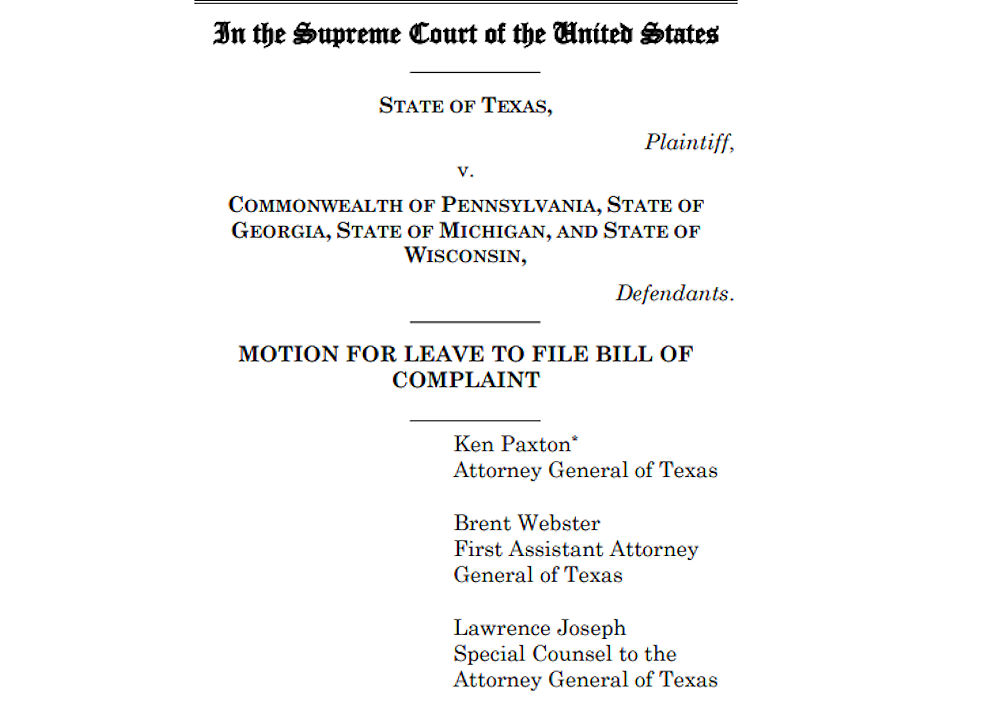
Consider what it actually means when the Republican Attorneys General–the chief law enforcement officers–of 17 Republican-controlled states join a lawsuit initiated by the criminally indicted Attorney General of Texas to disqualify the duly certified election results of four other states that voted narrowly for Joe Biden. The lawsuit seeks nothing less than to overturn the election of Biden as president by eliminating those four states’ electors from the official electoral college vote on December 14, thereby assuring the re-election of Donald Trump, who lost nationally by more than 7 million votes.
Unless the Supreme Court has become utterly debased, this frivolous lawsuit will be summarily dismissed and never heard in court. But that’s not the point. What it means is that the entire Republican party–specifically including those Republican officials charged with upholding the Constitution and enforcing the rule of law–are willing to enlist in an attempted legal putsch that they certainly know will fail. Why are they doing this? It has to be that they are terrified of the belligerent anarchic forces that Trump has mobilized throughout this country.
With “Stop the Steal” rallies being organized to trumpet ever more fantastic lies about the November vote, citizen election officials receiving death threats from Trump supporters and armed demonstrators showing up at their homes, the tinder is being laid in place to ignite violence when Biden officially becomes president-elect. And the Republican Party remains silent and complicit.
The Texas lawsuit might have been disregarded as a transparent attempt by Texas Attorney General Ken Paxton–currently under indictment for felony security fraud charges and reportedly under investigation for other crimes–to secure a Trump pardon. The lead attorney for the lawsuit, John Eastman, is a fixture of the radical right and in August published an op-ed piece in Newsweek arguing that Kamala Harris, who was inarguably born in Oakland, California, is ineligible to be vice-president because her immigrant parents were not yet US citizens at the time. [Newsweek later added a kind of faux-apology for the piece, saying that it had failed “to anticipate the ways in which the essay would be interpreted, distorted and weaponized” and was “horrified that this op-ed gave rise to a wave of vile Birtherism directed at Senator Harris.”] And yet 17 Republican state attorneys general joined in the lawsuit.
This case, like most of the other failed cases mounted by the Trumpistas, rests on an inherently racist premise because it focuses its challenges not on vaguely alleged voting irregularities in the entire states of Pennsylvania, Georgia, Michigan, and Wisconsin, but specifically on the cities of Philadelphia, Atlanta, Detroit, and Milwaukee, where a large proportion of the population is non-white. The unstated, but clearly implicit, assumption is that those votes are therefore suspect and probably illegitimate. Even when the lawsuits all lose in court, they stoke the belief among the white faithful that they are the aggrieved in a corrupt system.
The damage that this is doing is both incalculable and long-lasting, because it seeks to destroy the belief of ordinary Americans in the integrity of the country’s elections. It is now essentially out of control, with Trumpista attorneys like Lin Wood and Sidney Powell telling people at a Georgia “Stop the Steal” rally that they shouldn’t vote in the Georgia senate runoff elections until the “fraud” has been fixed. If American can’t trust in their elections, then what is left but insurrection?
That’s where we are now, and that’s why this ridiculous case matters.
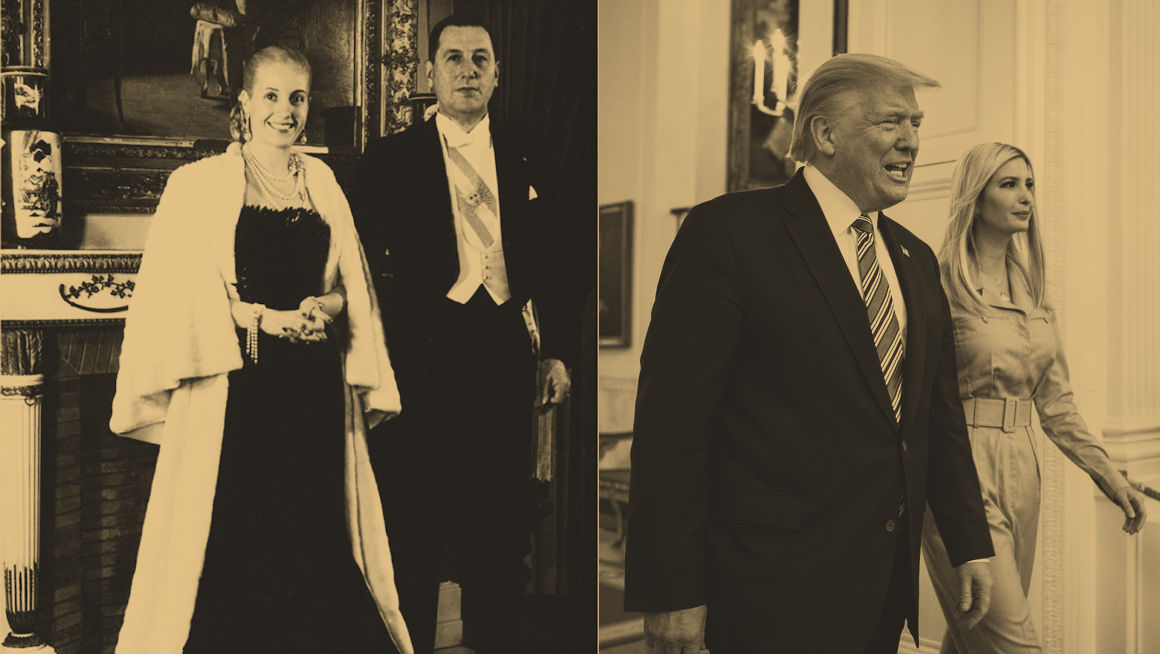
And the impossibly dark punchline offered by the Broadway-caudillo drag of Trump’s latest phase is that the United States, the world’s most powerful democracy, did not even get a real Perón. The authoritarian style arrives in America not in the form of a general or an intelligence-agency thug, but in the form of a guy who was sweating along to the disco cover of “Don’t Cry for Me, Argentina” at Studio 54. — Charles Homans, in the New York Times
As Americans wait incredulously to find out whether Trump’s efforts to overturn the 2020 election and remain president are an attempted coup or just another con, either way the damage will be deep and lasting. Once elections become viewed by a large segment of the population as rigged and illegitimate, then democracy really is on the ropes.
In the US, we don’t know how to deal with this because we’ve never had to before, and the clueless public doesn’t even recognize the milestones of impending authoritarianism as we keep passing them. But Latin Americans, including the millions who have immigrated to this country, certainly do or should, because they’ve been through this many times before.
Political instability has been the enduring curse of Latin America, preventing democracy from ever taking firm root. Virtually every country in Latin America–not just the much-mocked “banana republics”, but big advanced complex societies like Brazil, Argentina, Peru, Mexico, Venezuela, and Cuba–have seen their constitutions discarded, elections manipulated or overturned, and watched as their freedoms disappeared in a descent into capricious thuggery or outright authoritarianism. Very often the US–both government and private corporations–has played a major role in abetting or instigating such changes and supporting anti-democratic caudillos once they achieved power.
No two cases are alike, but the patterns are basically the same whether it’s authoritarianism of the Left or the Right. This is how it goes:
- A large segment of the population festers with inchoate economic and/or social grievances against the existing regime.
- A charismatic leader comes along who is able to exploit those grievances and present himself as the savior who will solve everyone’s problems.
- The charismatic leader is swept into power, often by (sometimes disputed) election or possibly with the support of the military or security forces.
- Once in office, the caudillo makes radical changes in the country’s institutions to make sure he stays in power.
- He gains control over the country’s law enforcement and judicial systems.
- He secures authority over the economic engines of the country either by nationalizing them (usually, though not always, if coming from the left) or co-opting the economic elite who then give him financial and political support and kickbacks in exchange for tailored favors from the government–always with the threat of retribution if their support should waver.
- Corruption inevitably increases, as it becomes evident that the only way to get approval and funding for projects is to secure the favor of the caudillo and his supporters.
- As opposition and criticism grow, the caudillo attacks the media and uses the levers of government to stifle dissent coming from the press, academia, and the political opposition. He mobilizes paramilitary groups and militias and popular mobs of supporters to intimidate opponents.
- The caudillo panders to the military for their support and encourages the police to target and harass groups that oppose him.
- Subsequent elections are manipulated and tightly controlled to insure the caudillo is kept in power.
What is important to keep in mind is that caudillos usually retain strong bases of popular support. Even in cases where they are somehow removed from office, they remain major political power centers because of their hold over their true believers. Juan Perón was ousted by the Argentine military in 1955, but then regained power (initially through a surrogate) in 1973. In Cuba, Fulgencio Batista served as elected president from 1940 to1944 and then left for Florida when his handpicked successor lost the election. But he continued to conspire from exile, got elected to the Cuban senate in absentia, and ran for president in 1952. Then three months before the election, he staged a coup with military backing and reinstalled himself in the presidency which he held until ousted by Fidel Castro on January 1, 1959. Peru’s strongman Alberto Fujimori, even after fleeing the country following the disputed 2000 election, being extradited and sentenced to prison for corruption, still retained strong support among the Peruvian electorate.
It’s easy put Trump somewhere in the authoritarian paradigm outlined above. There is no exact analog for him among the rogues gallery of Latin caudillos, but rather elements of several different ones. He clearly has channeled Perón’s use of public pageantry with his White House balcony appearances. He even managed to create his own Evita, using Ivanka as an eager substitute when Melania proved unsuitable for the role. (Evita is reportedly Trump’s favorite Broadway show ever, and he claims to have seen it at least 6 times.)
But even caudillos from the right, like Perón and Batista, actually initially promoted labor reforms that strengthened unions and boosted wages for his political base. Trump has done nothing of the sort. The economic benefits of his policies have gone overwhelmingly to the very rich and big corporations–the very forces that created the conditions that his base claims to be upset about. His primary appeal was and remains rhetorical validation of the prejudices and perceived grievances of “forgotten” white Americans, who have stayed passionately loyal despite getting nothing tangible from his administration beyond stoking their resentments. So far, that seems to be enough.
Ironically, given the support Trump received from Cuban-Americans in South Florida, the caudillo who most closely represents a more extreme version of Trump’s own style and inclinations is indeed the Cuban strongman Fulgencio Batista. Cubans who fled the island after Castro took over often look back with gauzy nostalgia on pre-Castro days as a time of Edenic prosperity and freedom. For a small minority, perhaps it was. But by the mid-1950s, the Batista regime was a thuggish and repressive criminal enterprise that had sold off most of the national patrimony to US and other foreign owners and was thoroughly in bed with the Mafia, which controlled the gambling, drugs, and prostitution that attracted Americans for hedonistic holidays in Havana.
As John F. Kennedy stated in an October 1960 speech, the US supported the Batista regime with weapons, which reinforced the repressive apparatus, and gave “stature and support to one of the most bloody and repressive dictatorships in the long history of Latin American repression. Fulgencio Batista murdered 20,000 Cubans in 7 years…, and he turned democratic Cuba into a complete police state – destroying every individual liberty….We used the influence of our Government to advance the interests of and increase the profits of the private American companies, which dominated the island’s economy. At the beginning of 1959 U.S. companies owned about 40 percent of the Cuban sugar lands – almost all the cattle ranches – 90 percent of the mines and mineral concessions – 80 percent of the utilities – and practically all the oil industry – and supplied two-thirds of Cuba’s imports.”
The first wave of emigrés that fled the new Castro regime to the US in the early ’60s included wealthy property owners who were targeted by the revolutionaries precisely because they had collaborated with or directly participated in the Batista government. Some had seen the writing on the wall, and left Cuba before the fall along with a substantial portion of their wealth. They didn’t leave because they were opposed to dictatorship in principle; after all, they had been quite comfortable with the one under which they had prospered.
One example of those who did was Rafael Diaz-Balart (the brother of Fidel’s first wife, Mirta Diaz-Balart), who had been a deputy in Batista’s Ministry of the Interior which controlled Cuba’s internal security forces. Two of Rafael’s sons (Lincoln and Mario) would later be elected US congressmen from South Florida; a third (Jose) is now a successful anchorman on NBC and Telemundo.
That first wave had both money and influence with the US government, and they set the tone of implacable hostility to the Castro regime which has dominated both US policy and Cuban-American politics to this day. Only a few months after taking office, the same President Kennedy who had lamented US support to Batista approved the ill-fated Bay of Pigs invasion which was intended to topple Castro and restore the old regime. Sixty years later, almost nothing has changed, and Cuban-Americans who support Trump don’t want it to, because reactions in the community have become so Pavlovian that all they have to do is press the button to get the desired response. They don’t really want to change Cuba; they just want that rush they get from imposing punishment and extracting revenge.
Trump doesn’t yet have a political police force that kills and jails his opponents, but he has turned the US Department of Justice into his personal law firm and has fostered heavily armed white supremist vigilante militias who turn out to intimidate and occasionally kill peaceful demonstrators. He used the US military against protests on the streets of Washington, DC, and he claims that he has the loyalty of police departments across the country. In the midst of a pandemic that has so far killed 250,000 Americans, his inaction and disinformation campaign have been responsible for tens of thousands of needless fatalities and economic devastation.
Trump has turned the presidency into a personal cash machine, while delivering lucrative political favors to his supporters who eagerly pay to try to keep him in the White House. He has turned the Republican Party into a cowering cult of personality that openly or silently endorses his every whim, fearful of his wrath if they don’t. He has normalized blatant nepotism, putting unqualified family members–the only people he can really trust–in positions of critical importance, thereby expanding the opportunities for graft, corruption, and incompetence.
And now, having clearly lost an election by any measure, he persists in his preposterous claim that he actually won, while his minions pursue increasing ludicrous, but conceivably successful, stratagems to overturn the vote. Importantly, these efforts are blatantly racist, focusing on urban counties with large black populations, which are being smeared as being inherently suspect. According to polls, around 70 percent of Republicans believe that the election was not free and fair–a finding that will inevitably feed further attempts to manipulate the election system and disenfranchise selected segments of the population.
Americans used to look with condescending contempt on Latin America with its instability, violence, corruption, and the preening dictators that would come and go, fleecing their countries while in power and then fleeing into exile with their loot when the public (or the military) finally turned on them. Now this is us. We have our own caudillo.
In May 2016, Adam Gopnik wrote a prescient essay in The New Yorker about what electing Trump would mean:
If Trump came to power, there is a decent chance that the American experiment would be over. This is not a hyperbolic prediction; it is not a hysterical prediction; it is simply a candid reading of what history tells us happens in countries with leaders like Trump. Countries don’t really recover from being taken over by unstable authoritarian nationalists of any political bent, left or right—not by Peróns or Castros or Putins or Francos or Lenins or fill in the blanks. The nation may survive, but the wound to hope and order will never fully heal. Ask Argentinians or Chileans or Venezuelans or Russians or Italians—or Germans. The national psyche never gets over learning that its institutions are that fragile and their ability to resist a dictator that weak. If he can rout the Republican Party in a week by having effectively secured the nomination, ask yourself what Trump could do with the American government if he had a mandate.
Maybe we managed to escape the worst this time, but I think he’s right: The damage will never fully heal. After a century and a half, America has never really recovered from its Civil War, and Trumpism is just another outbreak in a somewhat different form of the same national disease. More than 70 million people voted for Trump, which means that almost half the electorate–and a majority of white people, both male and female–were just fine with keeping him in power.
Trump may be evicted from the White House, but he will remain a hugely disruptive force in American politics. Like Perón or Batista, he will be plotting a comeback, and it’s entirely possible that he might succeed.
Welcome to the Third World, America!
If you’re looking for a diversion from the non-stop horror show that is our daily newsfeed, may I enthusiastically recommend Lovecraft Country, the television series now streaming on HBO.
I have never been a big fan of the horror genre. Or, for that matter, of fantasy fiction and films. But there are exceptions, and this is decidedly one of the best. I had to reconsider my prejudices after seeing Jordan Peele’s 2017 film Get Out, in which he reimagined the horror genre as a pretty realistic way of viewing the black experience in America. Peele’s brilliant insight was to use the conventions of horror films to illuminate the real life dangers of just being black in this country, where there are few places of real safety and a simple ordinary encounter with a white person or, worse, law enforcement can in an instant turn dangerous or even deadly. Where even seemingly friendly white folks can’t be trusted not to conceal some variety of monster with malign intent.
Peele followed that up in 2019 with Us, a more complex narrative that uses the horror genre to look at race, inequality, insecurity, and fear of the “other”–all issues that actually what our politics are all about. As he put it in an interview, “On the broader stroke of things, this movie is about this country. And when I decided to write this movie, I was stricken by the fact we are in a time where we fear the other. Whether it is the mysterious invader that we think is going to come and kill us, take our jobs, or the faction that we don’t live near that voted a different way than us.” It is a highly ambitious film and full of ideas, and I loved it even though it did not quite receive the critical acclaim of Get Out.
Now Jordan Peele is executive producer of Lovecraft Country, an even more ambitious undertaking that so far, in my opinion, is nothing short of amazing. A new episode is released on HBO every Sunday at 9 Eastern.
The series is based on a novel by Matt Ruff, who took the title from H. P. Lovecraft, an early 20th century writer whose “cosmic horror” style is reflected in the series, where danger lurks at every turn both in the normal realm as well as in the supernatural. But Lovecraft was a blatant racist and Nazi admirer. As the NY Times observed, Ruff (who, incidently, is white) “upended this legacy by centering Black characters and making the story a parable about throwing off the constrictions of white supremacy.”
The showrunner, Misha Green (“Underground”), has taken the book and run with it. The series is unapologetically written from a black point of view and isn’t at all concerned about sparing white sensibilities. And why should it be? The story takes place in the early 1950s just before Jim Crow began to crack, and its flawed protagonist Atticus Turner (played by Jonathan Majors, of The Last Black Man in San Francisco–count me as a total fanboy!) is a Korean War vet returning to a very racist and hostile country. Interestingly, the action mostly takes place in the supposedly more enlightened North, not the segregated South, and it also has a pronounced feminist theme throughout and complex female characters, led by Jurnee Smollett and Wunmi Mosaku as half-sisters Leti and Ruby.
I won’t be a spoiler and attempt to summarize the plot, but I will say that each episode has layers and layers of references to literature, pop culture, music, and black history. Sometimes they zing by so fast that you can easily miss some of them on a single viewing. If you followed all of them up, they would amount to a very interesting course in American history. I would also recommend listening to the illuminating commentary on the podcast Lovecraft Country Radio after each episode is released. It is available on HBO on demand, as well as Spotify, Apple Podcasts, Prime, and other podcast sources.
It’s nerdy, pulpy, sexy, horrifying, serious, and funny. Just simply great television. And most definitely NOT for the kiddies. Most of all, it tackles themes that we are very much still dealing with in our own real life daily horror show. Just go with it.
When the president is deliberately spreading a deadly disease which he insists is no big deal, when QAnon believers can be elected to Congress, when cops can burst into your home and kill you while you’re sleeping or kill you on the street in front of witnesses, when backwoods “militia” can plot to kidnap the governor of Michigan, Trump country doesn’t seem all that different from Lovecraft Country.
 TrumpWorld for Beginners