Probably the biggest single reason people visit or move to South Florida is the weather, which is pretty fabulous for half of the year. Then comes summer, which brings the three H’s: heat, humidity, and hurricanes. The conventional wisdom is that South Florida is all but uninhabitable in the summer months, which is why them what can shutter up their homes and flee to cooler and drier climes.
Me, I beg to differ. I actually like the summer here. Let me explain:
First of all, yes it’s hot, but compared to what? I spent the last four decades in Washington, DC where the summer humidity is just as bad or worse and the temperatures are even hotter. There we often had long spells of stifling muggy heat when temperatures stayed in the upper 90s, the sky turned a nasty hazy gray, and the humidity made your clothes feel like little needles were pricking your skin. Last summer I witnessed a near-riot at DCA when the temperature was 105 and the airlines were bumping passengers because the planes couldn’t take off with a full load. Or I recall my Texas boyhood days when the thermometer regularly topped 100 degrees for weeks on end.
So this really doesn’t seem that bad. The temperature rarely gets above the low 90s, and the average high in Miami from June through September is right at 90 degrees. The last time it hit 100 degrees in Miami (the all-time record) was in 1940. Yes, it’s humid and the sun can be brutally strong. Walk a block in the noonday sun and you’ll be schwitzing for sure. But there’s usually a nice breeze, and once you’re in shade it’s okay. And I’m not wearing a coat and tie—though I feel for the few poor schmucks who are (unless they’re lawyers riding in their air conditioned BMWs).
Besides, the nights feel sexy and sensuous. If you go the beach, the ocean temperature is heavenly. Even in the height of the summer the water at Rehoboth or Fire Island is cooler than it is here in January—never mind Maine where even Canadians avoid the water in August.
And it’s easier to find a parking place.
In weatherspeak, South Florida has a “tropical monsoon climate.” Because the temperature throughout the year fluctuates within a relatively narrow band, the controlling variable is humidity and its handmaiden, rainfall. The rainy season usually starts in late May, peaks in June and again in September before tapering off in October. Rainfall drops off dramatically in the winter months, bottoming out in January with an average 1.6 inches for the month. Those gorgeous mild sunny winter days are the real basis for the area’s economy.
Before moving to Florida, I had never seen TV weathercasts show graphics displaying atmospheric water vapor. The TV weathermen and their incredibly voluptuous female colleagues use technical terms like “juicy” to describe conditions likely to produce rain. But apparently it’s quite difficult to predict when, where, and how much it will rain in any given location because showers tend to be of the pop-up variety rather than the widespread blankets or fronts of precipitation typical of other parts of the country. It can be pouring buckets in one location, while a couple of miles away there’s not a drop. As a result, South Florida weather forecasts are usually too vague to be very useful in telling you whether to take your umbrella or not. You’d do about as well just looking at the sky.
If you have more than a passing interest in Florida weather, I highly recommend a blog called Go Hydrology, produced by Robert V. Sobczak, a hydrologist for the National Park Service at the Big Cypress National Preserve in the Everglades. It does a great job of explaining what’s happening as the seasons change as well as making clear why we who live in the Miami-Broward megalopolis need to care about what happens to that big swamp just west of us.
Then there’s the hurricane thing—the serpent in the Garden of Eden. Before moving here, I had only a passing interest in Atlantic tropical cyclones unless one came barreling up the Chesapeake Bay like Isabel in 2003 and knocked out my electricity for a week. Now that I’m here, I compulsively go to the National Hurricane Center website during the hurricane season between June and November to see if anything is brewing out there. I guess veteran Floridians are more blasé about all this, but I haven’t been through a major hurricane since Carla in 1961 and am not eager to do it again.
South Florida hasn’t been hit by a hurricane since 2005, so it’s hard to avoid the feeling that we’re living on borrowed time. This area has seen the horrific destruction that a monster hurricane can wreak. The great Miami hurricane of 1926 produced a storm surge of more than 11 feet and virtually wiped Miami Beach into Biscayne Bay. People in southern Miami-Dade who lived through Andrew in 1992 will never forget what they experienced. Statistically, the greatest risk occurs in September and October.
Meanwhile, I’m enjoying the tropical languor while the rain takes care of watering my yard and the sun heats my pool for free. I think I’ll have another gin-and-tonic before I go out to check if more mangos have dropped from the tree. Isn’t summer awful?
I came across an interesting piece in The Daily Beast, prompted of course by the Trayvon Martin killing, showing how easy it is to get a permit to carry a concealed firearm in Florida—something I had remarked upon previously.
But the discussion of the idiosyncrasies of Florida law on when a gun can be legally used—or not—was even more fascinating…and disconcerting.
The article quotes Jon Gutmacher, the gun- and taser-toting author of Florida Firearms: Law, Use, and Ownership, as saying that:
“people don’t realize that absent an “imminent threat,” simply reaching for your handgun, or showing off that you are carrying it, is illegal. Brandishing a gun can get you charged with ‘aggravated assault,’ which carries a three-year minimum prison sentence.”
It goes on to observe:
“As for warning shots—fired into the air or at the ground—they are a legal no-no. In Florida a warning shot carries a 20-year mandatory minimum sentence. The irony is that if Zimmerman had merely displayed his weapon to Martin, or if he had fired shots in the air, he could be subject to a lengthy prison term. But under Stand Your Ground, actually killing an unarmed person can, in some cases, be legal.”….
“Earlier this year, a Miami judge ruled it was a justifiable use of deadly force when a man chased down and stabbed a suspected thief to death, because the suspect had swung a bag of radios at the man’s head. In contrast, when a 31-year-old woman named Marissa Alexander fired a gun in her own home during an altercation with her husband, who no longer lived there, her Stand Your Ground defense claim was rejected….Alexander was sentenced to 20 years in prison, even though the round she fired injured no one.”
As University of Miami Law Professor Mary Anne Franks remarked to the Daily Beast author about the Stand Your Ground law, “Our laws are not written for clarity, but this is a particularly confusing statute.”
I’d say she definitely got that right.
Apparently the moral of the story is: If you’re feeling threatened, shoot to kill. Otherwise, you could go to jail.

HAVANA — The daughter of Cuban President Raul Castro said during a rousing gay rights march Saturday that her father advocated eliminating sexual discrimination, and reiterated her own hope the country would soon legalize same sex marriage. [AP story, May 13, 2012]
Now that would be ironic, wouldn’t it? Because the State of Florida is not exactly gay-friendly.
In 1997 the Florida state legislature passed its own “Defense of Marriage Act”, barring legal recognition of same sex relationships including those recognized by other states. In November 2008, the state constitution was amended to ban same-sex marriages and civil unions in Florida—a measure supported by then-governor Charlie Crist despite rampant rumors that Crist himself was gay and married (a woman) just to get political cover and maybe the Republican VP slot.
By state law, individuals in LGBT relationships are entitled to no rights or responsibilities that pertain to their relationship. Moreover, Florida is the only state that bars adoption of children by gay parents—though the constitutional challenge to that law is still making its way through the courts. There are horror stories about gays being denied hospital visitation rights and ability to make medical decisions for their long-term partners in Florida, even though they had legal documents giving that authority.
The paradox is that South Florida is actually quite gay-friendly and has attracted a very large and very visible gay community (including—full disclosure—your humble blogger).
Both Miami-Dade and Broward have procedures for registering domestic partnerships and offer spousal benefits for county employees, in apparent defiance of state laws.
The place has come a long way since 1977 when singer Anita Bryant and her then-husband Bob Green led a successful campaign to overturn an ordinance passed by Dade County prohibiting discrimination against gays. [Karmic note: Bryant was supported by evangelist Jerry Falwell, who founded Liberty University, where Mitt Romney chose to make his recent flip-flopping stand against gay marriage. Backlash against Bryant’s “Save Our Children” campaign ultimately wound up sinking her career, and when Green died this past January, Bryant—still mean as ever at 72—had nothing nice to say about him.]
The conventional wisdom is that gay life in South Florida has migrated from Miami (or more specifically, South Beach) to Fort Lauderdale.
Like most such memes, this one contains a grain of truth, but as usual the reality is a lot more complicated than the typical Broward vs. Miami-Dade thing.
Broward County is indeed the epicenter of gay life in the area. For gays, Fort Lauderdale’s image is a bit like an endless Atlantis cruise, but with a somewhat, uh, “more mature” age demographic. That’s where most of the bars are found—everything from sex clubs to male strip clubs to leather bars to geriatric karaoke. If you’re looking for a clothing-optional all-male resort, Fort Lauderdale offers lots of choices, including monthly naked “tea dances.” The city of Wilton Manors (or as the cruel ageist joke goes, “Wilting Manors”) vies with Palm Springs and P-town as the queerest place in the country.
People will tell you there are no gays left in Miami except twinks in South Beach, but don’t believe it. Gay life in Miami is a little different—it seems less public and more interwoven into the rest of the city. There’s no gay ghetto like Wilton Manors—although Belle Meade on the upper east side might come close. If you have a male realtor, chances are pretty good that he’s gay. There are gay men in every part of the city from North Beach to Hialeah from Coral Gables to Miami Shores. There are cubanitos and papis, some of whom might not admit they’re gay, but like a little…well, you know. There are gay bowling and softball leagues. And there is the north end of Haulover Beach, which attracts gay men from all over the area (and the country) to enjoy the surf and scenery.
Miami Beach plays host for huge gay circuit party events like the Winter Party, the Sizzle Miami party over Memorial Day weekend, and the White Party in November, if that’s your cup of tea. Miami Beach has a splashy gay pride weekend in April, in which local politicians and media personalities are eager to be seen. There are also big pride weekends in Fort Lauderdale in March and in Wilton Manors in June.
So gay culture—in all of its varieties, from homebodies to party boiz—is definitely thriving in South Florida. If you can deal with the political hypocrisy and homophobic malevolence out of the state capital, then it’s a pretty good place to be gay.
CBS’s infomercial for grossly overpaid corporate CEOs, Undercover Boss, tomorrow will feature Miami’s Jose Mas Canosa, CEO of MasTec, which according to the company’s website, does ”engineering and construction for electrical transmission, oil and natural gas pipelines, renewable energy and wireless networks.”
Of course, I haven’t seen the show yet since it doesn’t air until May 11, but if previous episodes are any guide, it will show a benevolent boss incompetently trying to do the jobs of his poorly-paid peon employees and discovering that they have problems trying to make ends meet. At the end of the show, he will reveal himself as Lady Bountiful and bestow some largesse on a few tearfully grateful subjects, demonstrating that He Has a Heart and All is Right with the World.
As is often the case, the back story here is a lot more interesting.
If you Google Jose Mas Canosa, you won’t find much except references to Undercover Boss. What you will find is hundreds of links to stories about his late father, Jorge Mas Canosa, the founder of the Cuban American National Foundation, which basically ran US policy on Cuba as well as much of South Florida politics during the Reagan and Bush I years. As local CBS Miami puts it: “Cuban immigrant Jorge Mas Canosa was known for his brave opposition against Fidel Castro and his leadership in the Miami community in the 1980s.” For a less rosy picture of this larger-than-life figure, read this obituary by Cuba scholar Saul Landau. Or this 1995 profile by Larry Rohter of the New York Times.
It’s a real South Florida story and, well, a bit more complicated. The senior Mas Canosa was inarguably a brilliant organizer and strategist. The official version of his story is a real Horatio Alger immigrant-makes-good tale, but at least according to some other versions, he was helped along by connections with US-government intelligence which gave covert assistance to him and other violence-oriented Cuban exiles, including hooking him up with the engineering firm Iglesias and Torres, of which he soon became the Miami branch manager. In 1969 the company name was anglicized to Church and Tower, and Mas Canosa was able to buy it in 1971 for a reported $50,000. The company prospered, allegedly due at least in part to intertwining business and political connections—not an untypical Miami scenario. After another merger, the company became MasTec in 1994—three years before Jorge Mas Canosa’s death.
Jorge Mas Canosa’s real legacy was CANF, which got off the ground soon after Reagan’s election. He modeled CANF on—and was tutored by—the Israeli lobby AIPAC, and was spectacularly successful in manipulating congress to support an hostile policy toward the Castro regime, in part by giving contributions to vulnerable congress members whose constituents couldn’t care less about Cuba. Perhaps his crowning achievement was the passage of the Helms-Burton bill in 1996—named after the odious North Carolina senator Jesse Helms and the goofball Indiana representative Dan Burton. This act allowed Cuban exiles to file suit in US courts against any foreign company “trafficking” in property nationalized by the Castro regime. Among other achievements, CANF was also instrumental in getting to US government to sponsor Radio Marti (and later TV Marti) under the aegis of the Voice of America.
Mas Canosa never hid his associations with Cuban exiles who engaged in violent acts against Castro’s Cuba, but always managed to maintain plausible deniability. (For a fascinating account of this aspect, see the New York Times story here.) He was an implacable foe of anyone in the Miami community who questioned his actions or authority, in 1986 challenging Miami City Commissioner Joe Carollo to a duel for saying that he had used his contacts to push the city into awarding him a large contract.
He at least contributed to the creation of an atmosphere of violence in Miami where between 1987 and 1990, some 13 bomb explosions were directed at shippers and travel agents dealing with Cuba or Cuban-Americans who questioned the embargo. In 1992 he took umbrage at the Miami Herald and launched a vituperative campaign against the newspaper, plastering the city with his “I Don’t Believe ‘The Herald’” stickers. Perhaps not surprisingly, Herald executives received death threats and the paper’s vending machines were vandalized. [Update: This 1992 article from the St. Petersburg Times captures the tensions of the moment.] The New York Times thought it was alarming enough to print an editorial decrying the climate of intimidation in Miami.
Of course, all of this makes Jorge Mas Canosa a hero in the eyes of many Cuban Americans, and the supercharged political atmosphere he helped foster lingers on as witnessed by the recent flap over remarks of the Marlins’ manager Ozzie Guillen—if in a somewhat attenuated state.
In the end, Jorge Mas Canosa always considered himself a Cuban, not an American, and in a 1992 interview famously said “I have never assimilated. I never intended to. I am a Cuban first. I live here only as an extension of Cuba.” After the Soviet Union collapsed and ended its subsidies to Castro, he seemed to see himself as the future president of a post-Castro Cuba and started trying to set up a shadow government in exile. But Castro outlasted him.
For all I know, the son Jose Mas Canosa may be a fine man and a brilliant and generous executive. But his father’s story is something to keep in mind if you watch Undercover Boss on Friday.
If you want to buy groceries in South Florida, you’re pretty much stuck with the Publix supermarket chain. It’s not technically a monopoly, but it comes pretty close. Publix’s only real competitor is Winn-Dixie, but even though there are a couple of dozen W-D outlets in South Florida, somehow I never seem to see them, while Publix is literally everywhere.
The thing about Publix is: It’s not really good, it’s not really bad, it’s just meh. I’d love to know the story on how they came to dominate the grocery market, because it can’t be because of the quality of the stores—unless maybe the competition was worse. Of course, some Publix stores are better than others. As is so often the case, the more affluent the neighborhood, the better the quality in the local supermarket—at least up to a point.
I tend to judge supermarkets by the produce department, and this is where I really think Publix falls short. Again, it’s not that it’s really lousy. It’s just so damn mediocre.
You would think that this is an area where the dominant grocery chain in Florida would shine, since this is where so much of the vegetables for the entire US eastern seaboard are grown, especially in the winter. But the produce in Publix looks no better and often worse that what you would find in a typical supermarket in the northeast, and the prices are just as high if not higher.
You don’t see locally-grown produce on the shelves, and apparently it’s a company policy not to allow individual stores to purchase produce from local farmers. And what’s up with bundling certain vegetables in packages so that you have to buy a pound of red chili peppers or a half dozen zucchini when you only want a couple of them? (This practice may be more prevalent in some Publix stores than others.)
Compare Publix to any decent supermarket in California, and you would see the difference. Or even Texas, for that matter, where the local HEB chain has really raised the quality bar for groceries. When I was in San Antonio recently I was amazed by the quality of the produce in the HEB stores as well as the low prices, which were often half of what I was used to paying in Florida or DC. HEB’s gourmet stores called “Central Market” are incredibly good; they make Whole Foods (another Texas-based company) look like, well…, Publix by comparison.
Since there’s essentially no competition, Publix can get by with a gentleman’s C, and the public has nowhere else to go. Well, that’s not entirely true, since there are a handful of Whole Foods markets in Broward and Miami-Dade, but chances are you’ll have to drive quite some distance to get to them. There are also a few Fresh Markets scattered about that cater to customers who care about better food. Even Publix is trying to get into the high-end grocery market with its GreenWise Market stores, but so far there are only three of them, and the closest is in Boca Raton.
You can also try farmers’ markets for locally-grown food—though the season for them is coming to an end. And there are the mass-market megachains like Walmart, Target, and Costco that offer limited selections of vegetables and meat in addition to packaged food with long shelf lives.
But when you just need to run to the grocery store, you’ll probably wind up in a Publix because it’s there.
Maybe they should change their motto from “Where shopping’s a pleasure” to “Resistance is futile”.
Last night I came across a post on the Herald’s political blog Naked Politics that grabbed my eye. The article (read it in its entirety here) concerned a proposal under consideration by the Citizens’ Insurance board to charge new customers rates higher than those of existing customers. But here’s the part that really got my attention:
Existing Citizens policyholders are protected from large rate bumps by a statutory 10 percent cap on premium increases — and will continue to be. Under the proposal to be considered Thursday, new policyholders could be charged initial rates far more than similar customers who have already been in the pool. Going forward, however, all customers would be protected by the 10 percent limit in effect for the company’s nearly 1.5 million current policies.
I found this astonishing because: 1) I didn’t know there was any 10 percent cap, and 2) my annual premium just increased by nearly 30 percent. If there is a “statutory 10 percent cap”, then how is that possible?
I called my insurance broker to ask what’s up with that, but am still waiting for an explanation.
What’s also noteworthy about the article is that the political discussion in Tallahassee seems to be taking place in some parallel universe where there is a private market for home owners’ insurance. The article goes on:
Sen. Garrett Richter, R-Naples and chairman of the Senate Banking and Insurance Committee, has been a long-time advocate of boosting Citizens premiums to bring them in line with the private market [emphasis added]. As long as Citizens has below market rates, Richter said private companies will not return and Florida taxpayers will continue to be on the hook in the event of a catastrophic storm.
Doesn’t this guy know that there is no private market in South Florida and that Citizens is the only one writing new policies? If there is no private market, how can there be ”market rates”? As far as I can tell, the only private companies taking on home owners’ policies are the ones set up to take over the policies that Citizens is trying to dump as part of its “depopulation” policy. (See related previous post.)
I can’t seem to escape the feeling that there is no adult supervision of Citizens in the state government, which accounts for the capricious and arbitrary rate changes. Or perhaps rather that the entire discussion is being stage-managed by the insurance industry.
It would be interesting to know how our insurance rates compare with similar coverage in places like Biloxi or Galveston.

If you like to gamble (which I don’t—hate watching my money just evaporate), you have plenty of opportunities in South Florida.
Let’s see: There’s the Hard Rock Casino in Hollywood, the Miccosukee Resort in Miami, the Magic City Casino also in Miami, the Mardi Gras Casino in Hallandale Beach, the Coconut Creek Casino west of Pompano Beach, Gulf Stream Park in Hallandale Beach. There are gambling day cruises from Fort Lauderdale. You can do pari-mutuel betting on horses, dogs, and jai alai. There are internet cafes for on-line gambling. Apparently, you can even gamble on pee-wee football leagues, which is pretty creepy.
But all of this is just penny-ante compared to what may be in store for South Florida if the big Asian and Vegas gambling interests get approval for megacasinos that would dwarf any of the existing gambling venues. When the Malaysian gambling behemoth Genting bought the Miami Herald building on Biscayne Bay in downtown Miami last spring and released plans for a huge resort/casino, everyone woke up and took notice. A bill to allow three megacasinos without requiring local voter approval failed in the state legislature in February, but nobody believes the issue is really dead because there is big money behind it, and in Florida politics—perhaps even more than elsewhere—money talks.
I don’t really have a moral objection to gambling. My distaste for it is more an esthetic one. I used to be a sucker for old school Hollywood movies where men in black tie played roulette in tony European casinos while sipping champagne and exchanging lascivious glances with women in deep décolletage and fabulous jewels. It just seemed so damn cool!
One trip to Atlantic City destroyed that fantasy for good. The only ones wearing ties were the croupiers, and the players were more likely to be the pension-squandering retired plumber from Queens in shorts, black socks, and a fanny pack or the chain-smoking widowed grandmother feeding the slots for hours on end. Maybe Vegas is a tad more glamorous, but just could never understand why people wanted to go someplace where everything from the boobs to the “Venetian” canals is fake. (But then, I never wanted to go to Disney World, either.)
Of course, the argument the megacasino proponents make is economic: more tourists and more jobs. When unemployment is near double digits, the promise of jobs and investment in new destination resorts can sound pretty appealing. But do those promises have any reality?
Again, looking at Atlantic City might be a sobering antidote to giddy expectations. Walk a block inland from the glitzy Boardwalk casinos, and you’re in another world entirely. The rest of the town is still as depressingly seedy as it was before the arrival of Harrah’s and Trump and the rest of the “destination resort” hotels. I had dinner in an empty Italian restaurant two blocks off the Boardwalk and felt like I’d walked into a morose Edward Hopper painting. I don’t know where all the casino-generated revenue is going, but it doesn’t seem to be helping the rest of Atlantic City much.
Eye on Miami blogger Geniusofdespair observed pretty much the same thing when he visited the Genting casino in Queens, NYC out near JFK.
The problem, of course, is that people who go to a “destination resort” casino are likely to stay in the resort. And the bigger it is, the less likely that they will venture out into the surrounding city, because everything they want is already right there. It’s like being on an enormous cruise ship that doesn’t go anywhere. Restaurants that can open up branch concessions inside the resort may do well, but how likely is it that resort guests will patronize other local restaurants when there are so many choices available without leaving the compound. It’s analogous to the “Walmart effect” on small town retail business, only on a much larger scale. That’s why the sheer size of the Genting proposal is important (even if, disappointingly to some, it wouldn’t be the world’s largest casino after all).
What’s unusual about the gambling issue is how it scrambles the normal political line-ups:
- Genting’s shills for getting its bill through the state legislature were two South Florida Republicans: senator Ellyn Bogdanoff (Broward) and representative Erik Fresen (Miami-Dade), who presented a bill that would give the state a measly 10 percent tax on gambling revenue, much less than many other states get and—perhaps more important—less than the 35 percent that existing Florida gambling venues pay. (This was later changed to parity.)
- Not surprisingly, the Indian tribes that operate casinos on tribal lands and the pari-mutuel operators (termed “greedy” by Bogdanoff) who have been greasing legislative palms lobbying state lawmakers and making political contributions for years didn’t like any of this and joined the opposition.
- The state GOP found itself in a quandary with a religious base that thinks gambling is sinful, but then there was all that money… Governor Rick Scott clammed up on the subject.
- Former congressman Lincoln Diaz-Balart (brother of current Miami-Dade GOP congressman Mario Diaz-Balart) hopped on the Genting bandwagon, along with the Latin Builders Association and South Florida Associated General Contractors.
- Frank Nero, president of Miami-Dade’s county-funded economic development group came out swinging, saying “casinos are vacuum cleaners.”
- Disney opposed the bill, as did their ally the Florida Chamber of Commerce.
- The City of Miami Beach vowed to fight the bill. Miami mayor Tomas Regalado was sorta for it, then equivocated.
Well, you get the idea. The Herald published a good chronology of the issue here.
Now the gambling interests may try to circumvent the legislature by seeking a referendum for an amendment to the state constitution to allow the megacasinos. A PAC called (what else?) “New Jobs and Revenue for Florida” is reportedly being formed for that purpose. And it could work: Polls have shown broad public support for gambling casinos. So expect to see lots of TV commercials claiming that casinos will cure Florida’s economic ills—there’s plenty of money to pay for the propaganda. Or politicians’ votes. Whatever.
One way or another, it’s not over until the fat cats sing.
I think most people moving to Florida either full time or as snow birds just want to enjoy the nice weather, hit the beach, and take a long vacation from state and local politics where they came from, thinking that all of that stuff happening here really doesn’t affect them. Unfortunately, it does.
Politics ultimately shapes almost everything in our daily life—taxes, transportation, schools, health, the environment, insurance—you name it. I think one of the reasons Florida politics is so corrupt and generally screwed up is that too many people have just tuned out. So pay attention, people!
Here’s a primer on local news media:
Television: If you depend on TV as your only news source, you will have no clue whatever about what’s going on. The local news broadcasts will tell you about traffic accidents, shootings, drug busts, the Marlins, the Dolphins, all the typical local news fodder, but they almost totally ignore decisions and—more important—process taking place in state and local government. When they do report on such issues, it’s in the most perfunctory and superficial way.
One important exception: Former Miami Herald columnist Jim Defede periodically does stories on CBS4 news that are definitely worth watching. Defede may look like a bit of a shlub, but he’s a real bulldog of an interviewer and a true investigative reporter. If you miss his segments, you may be able to find them here.
Newspapers: The Miami Herald has long been the leading newspaper in Florida and by the low-bar standards of regional US journalism was once pretty good. Its coverage of Latin America—especially Cuba—was perhaps the best among US papers, and it started a Spanish-language edition, El Nuevo Herald (now an independent publication), in 1976 in response to Miami’s changing demographics. It has occasionally run afoul of Miami’s Cuban community for not being sufficiently hardline on Fidel, but I wouldn’t consider that a deficiency.
The Herald used to be the flagship of the Knight-Ridder papers, but in 2006 was sold along with the rest of the K-R chain to the California-based McClatchy Company. Like most US newspapers, it has been hit by declining circulation and has cut its reporting and editorial staff, with predictably negative impact on the quality of reporting.
The Herald is still an important resource, and does produce good reportage and editorial content—if less consistently than it used to. It is available online. It also supports a blog called “Naked Politics” that contains material that may not make it into the Herald’s print edition and also sometimes seems a bit less inhibited.
The Herald’s major weakness, at least in recent years, has been excessive coziness with Miami’s business elite—especially developers and gambling interests—which seems to have influenced its coverage (or lack thereof) of related news stories. Indeed, the Herald itself has become a player in the controversy over casino gambling with the decision by its parent company to sell its downtown bayside building to the Malaysian Chinese gambling conglomerate Genting Berhad to build a megacasino resort on the site. Just Google that name.
Up the coast in Broward, the Sun-Sentinel fell into the clutches of loathsome real estate mogul Sam Zell when he acquired and then proceeded to loot its parent Tribune Company, in the process eviscerating once-proud and important newspapers like the Chicago Tribune, Los Angeles Times, and the Baltimore Sun. Zell is no longer in control, but the damage he wrought lingers on. The Sun-Sentinel limps along, and still produces some good stories and editorials from time to time. It’s also available on-line, but recently announced that it will put up a “pay wall” for access to its content. For political coverage check out its blog “Broward Politics” written by the paper’s political journalists.
Still further north, the Palm Beach Post has a pretty good reputation for covering state politics. To be honest, I have not read the paper that often, but I’ve seen some good material from it picked up in the blogs. You can catch it on-line here.
Alternative Press: The Miami New Times is a free tabloid weekly available all over town. It covers restaurants, the arts, music, performances, etc.—typical alternative stuff—but also does great feature articles on local stories that break new ground. And sometimes they’re really juicy, like this one. The paper also supports a political blog called Riptide 2.0, which is worth checking out.
The rival monthly free tabloid Biscayne Times covers the Biscayne Boulevard corridor from Wynwood/Midtown to Aventura, and focuses more on real estate and neighborhood issues in addition to the arts. It features columns covering individual neighborhoods like Belle Meade or incorporated entities like North Miami, so here you get political reporting that dishes the dirt on a really local level. There is usually also an article about some fascinating but half –forgotten aspect of local history. I found it very helpful in getting oriented when I first got to town, and continue to learn something I didn’t know with every issue.
The Blogosphere: South Florida has an extremely robust blogging community, and some of the blogs are quite extraordinary. You will find great material here that you’ll never see in mass media. Of course, blogs vary tremendously in content and quality, but I think all of the ones listed in the Blog Roll at right are worth reading regularly, and want to point out a few for special praise. There are lots more out there.
For starters, “South Florida Daily Blog” scans the blogs for you and provides little excerpts with commentary so you know what the featured posts are about. Now how cool is that! The blog roll covers about every imaginable subject from food and photography to politics. The dedication to keep this going is pretty amazing. Blogger Rick also does his own posts on various issues of the day, which I find very sharp and well-written. If you’re looking for a place to start diving into the local blogging pool, this is it.
If you read only one South Florida blog, let it be “Eye on Miami.” The two anonymous [see comment] bloggers—Gimleteye and Geniusofdespair (love the names!)—delve into local politics and environmental issues with an intensity and depth and tenacity rarely if ever shown by any traditional media source. They go to godawful commission and committee meetings, read and dissect the reports, and connect the dots. Best of all, they follow the money, which is usually what it’s all about. Their archived posts are easily searchable and can provide an amazing depth of background on almost any issue. I think these guys are awesome!
If you want to know why South Florida traffic is so terrible and want to know what local authorities are or are not planning to do about it, check out “Transit Miami”. About all I can say is: Read it and weep.
Finally, I really like “Bark Bark Woof Woof.” I know, he mostly blogs about national issues rather than local ones, but when he does, the posts are rapier sharp. I like his style, and the way the material is organized, and I love the whimsy of the “little night music” videos he posts every day. And, of course, I almost always agree with what he has to say.
Okay, I’m sure I’m neglecting others, but it’s getting late. To repeat: All of the blogs in the roll are worth your time and attention.
So now no one has any excuses for staying blissfully ignorant of the chicanery swirling around them. Salud!

When you turn on the tap in your kitchen or take your morning shower, do you ever wonder where that water comes from? I did, and when I started looking into it, the answer was not totally reassuring.
Turns out that virtually all of the water we consume in South Florida comes from wells that tap a large underground water system called the Biscayne Aquifer which basically underlies all of the inhabited parts of southeastern Florida and extends into the Everglades. It is what’s known in the trade as a “sole source” aquifer, which means that there is “no alternative drinking water source(s) that could physically, legally, and economically supply all those who depend upon the aquifer for drinking water.” More than 6 million people from south Palm Beach County to Key West are dependent on water drawn from the aquifer.
Most of the water pumped from the aquifer goes into municipal water systems, but a substantial portion is used for agriculture, and smaller amounts for industry and private wells. The problem is that as the area’s population has grown, in dry spells the amount of water extracted can exceed the amount that enters the aquifer to “recharge” it. That’s why in years of drought like last winter and this one, our restrictions on yard watering are more stringent than those in Los Angeles, even though LA is climatologically a semi-desert. Remember Chinatown?
The aquifer is increasingly threatened with contamination from several different sources: salt water, sewage and surface pollution, and agricultural chemicals. The US Geological Survey published an interesting paper about threats to the Biscayne Aquifer in the 90’s, but the problems have, if anything, deepened since then. You can read the report here, but this is a brief summary as I understand it:
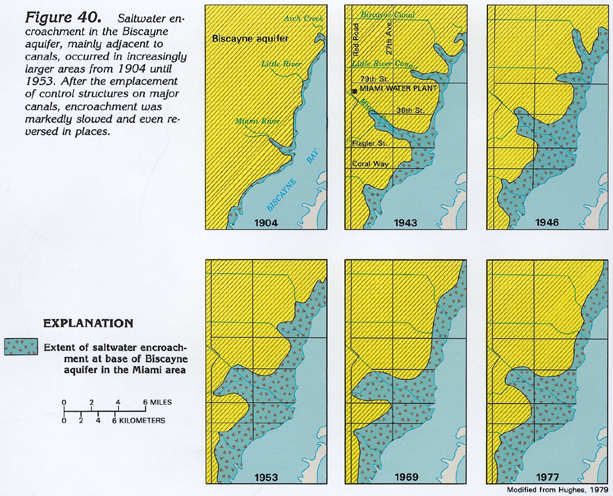
The water in the Biscayne Aquifer moves slowly down and eastward from the Everglades toward the Atlantic. Inland, the water table may be only a few feet (or even inches) from the surface, but as it goes under the ocean it is much deeper—a couple of hundred feet. But because the aquifer is “uncontained”, as it meets salt water near the coast, there is a shifting boundary between salt and fresh water. Basically, the fresh water column needs to be high enough to keep the salt water from pushing inland.
Salt water has already intruded far inland since the early 1900s when Miami was just a small village. (See map here.) Once water at a well head becomes salty, it is no longer usable for drinking or agriculture.
To stem this process, an elaborate series of measures—including canals, pumps, and locks—has been developed by the South Florida Water Management District to keep the aquifer recharged by distributing fresh water flowing down from Lake Okeechobee through the Everglades. That’s why the TV newscasts report the lake level: It’s not that we get our water directly from the lake, but when the level drops, there is less water to distribute and recharge the aquifer. It’s also why even a small rise in sea level could be disastrous because it could overwhelm the means available to control salt water intrusion.
The good news is that because the covering limestone and soils are so porous, a good rain can recharge the aquifer quite rapidly. The bad news is that contaminants from the surface can enter the aquifer equally easily. These can include waste from municipal sewage treatment plants and septic tanks, agricultural chemicals, lawn fertilizers, pesticides, all the nasty stuff that washes off our streets every time it rains, and anything people dump on the ground. The canals that crisscross our area cut into the aquifer and therefore both directly feed and are fed by the aquifer depending on the water level. Unfortunately, they contain a pretty noxious soup of chemicals and bacteria that you wouldn’t want in your drinking water.
Ultimately, the viability of the Biscayne Aquifer depends mostly on the health of the “River of Grass” trickling through the Everglades, since that’s where most of the water comes from to flush and dilute the pollutants and to recharge the system in dry times.
This is also where it gets really political. Huge tracts of land around Lake Okeechobee have been converted from ‘glade to agriculture so that the rest of the country can have hard, tasteless, but reddish tomatoes year-round and so that growers can sell us US-produced sugar that is profitable only because tariffs keep the domestic price of sugar artificially inflated. Chemical runoff from these farms continues to pour into the lake and the Everglades, and agribusiness continues to resist efforts to clean it up.
At the same time, pressure from developers continues for pushing new subdivisions in Miami-Dade and Broward westward into the Everglades regardless of the fiscal impact on residents and heedless of the environmental implications for the future.
The state government seems to have lost interest in protecting the Everglades and, indeed, has become actively hostile to environmental protection in general. The assaults come in obscure legislation that gets little or no attention in the media. And local decisions are made in boring commission meetings too tedious for any but the most determined to keep an eye on. The stalwart bloggers of Eye on Miami have followed these issues with a tenacity and depth that I could never hope to match. For starters, take a look at these posts that deal with these issues. It behooves the rest of us to pay attention too.
As demand becomes greater, fresh water is increasingly regarded as a commodity to be bought and sold rather than a basic benefit of civilized societies. We will probably be paying more for it, and that may be a good thing if it makes us more mindful of how we use it. The question is why we should support politicians who favor private economic interests over the broader public good–I just wish it weren’t so hard to find some that don’t.
So what are the odds of a real water crisis in South Florida before your mortgage is paid off? I don’t know, but when it comes down to it, we’re all crossing our fingers and betting the house that it won’t happen.
The Miami Marlins’ general manager Ozzie Guillen caught his ass in a crack when he told a Time magazine interviewer that “I love Fidel Castro.” The remark was in the context of an expression of admiration for the Cuban dictator’s longevity: “A lot of people have wanted to kill [him] for the last 60 years, but that mother[expletive] is still there.” And Guillen later backtracked and groveled an apology. But the gaffe generated outraged protests amongst Miami’s Cuban-American community and demands for his head. So far, he still seems to have his job, but with a 5-game suspension.
The lesson here is that after 50+ years, Fidel Castro is still a very hot button issue and the proverbial “third rail” of South Florida politics. So, newcomers, consider your audience when expressing opinions about Castro and Cuba.
The politicians predictably piled on:
- Congresswoman Ileana Ros-Lehtinen: ”Guillen should meet with the many victims of Castro’s tyranny who live in our community to learn about the horrors of Castro and his regime, and he should make a donation to a group that helps the families of political prisoners in Castro’s gulags.”
- State Senator Rene Garcia: “What I also consider disturbing is the fact that the Miami Marlins received tax dollars from this community, including Cuban-American exiles, to fund the construction of the new stadium. As a result, I expect your organization to honor the commitment it has made to this community by taking a strong position against Mr. Guillén.
- Miami Mayor Carlos Gimenez was reported to say that Guillen would be better off leaving because the punishment didn’t go far enough.
Sure enough, there are a few commentators saying the whole thing has gotten overblown, but they sort of get lost in all the noise.
It didn’t help that Guillen made his remarks in the new Marlins stadium in the middle of Little Havana (where residents are complaining that they can’t park on their own streets on game days). Or that Guillen is Venezuelan and has previously expressed support for strongman Hugo Chavez, who is mostly loathed by Miami’s growing Venezuelan expatriate community, and who is now Fidel’s BFF. Or that he said pretty much the same thing before. There is no question that what Guillen said was stupid, but he has shot his mouth off repeatedly before and gotten into hot water for it so it wasn’t exactly unexpected.
There seem to be lots of cross-currents at work here, including controversy over public funding of the new stadium itself. But the Gulf Stream among them is the continued visceral hatred among a large segment of the Cuban-American community for Fidel Castro. They will stand for hearing nothing even mildly positive about Castro, and woe betide any Florida politician who might suggest that punitive US policies against the Castro regime have had no success whatever in lessening his grip on the island after 50-plus years. [Full disclosure: I once worked for several years on Cuban affairs at the State Department.] When Janet Reno sent little Elian Gonzalez back to his father in Cuba, it probably cost Al Gore the presidency.
Cuban-Americans are no longer the monolith they once were, and there are now other voices and nuanced positions within the community. But attitudes are often passed on to the new generation, and—as is often the case in identity politics—the extremes tend to set the tone for the whole. It’s not all that different from the risk Florida politicians take with Jewish voters if they dare to suggest that Israel might not always be right and deserve unquestioning US support in all things. Politicians line up to do obeisance at AIPAC, just as they make a beeline to the Versailles Restaurant in Little Havana for the obligatory cafecito and make the obligatory statements about how strong the coffee is and how determined they are to bring the Castro regime down.
A few months ago, I met friends at Versailles and as I pulled into the parking lot, one of them (a Cuban-American, as it happens) exclaimed: “Oh my God, you have an Obama sticker on your car! Hope nothing happens to it!” Well, nothing did. We had a nice meal and a good time and that was it.
Unfortunately, Guillen may not be so lucky. He might as well have tattooed “I love Fidel” on his arm for all the good his apologies and explanations will do. Maybe it will all eventually blow over, but some people are just never going to forgive and forget.
 TrumpWorld for Beginners