

“The fox knows many things, but the hedgehog knows one big thing.”
That aphorism, attributed to the ancient Greek poet Archilochus, has been cited by scholars since Erasmus to classify people according to how they think. It’s an amusing exercise, but the problem is that no one can agree on what it actually means, and when applied to specifics it dissolves into ambiguity. Sort of like this Democratic primary.
Democratic voters are hedgehogs* when it comes to the Big Thing for this election: We want to get rid of Trump. But when it comes to how to do that, we become foxes, scurrying after a hundred different theories on who can win.
As for the remaining candidates, presentationally Bernie is more hedgehog–prickly and, to some, oddly adorable–while Joe is definitely more foxy. But strategically, it’s the opposite. Bernie doesn’t just want to get rid of Trump, he wants to start a revolution in American political and economic life, while Joe really only wants a restoration of the Obama regime. No wonder people are conflicted and confused.
Count me among them. Now that my preferred candidate, Elizabeth Warren, has dropped out, I’m trying to decide who to vote for in the Florida primary and am not really happy with either of the choices. I realize that my vote is almost totally symbolic and is likely to matter to no one but me, but the decision still feels morally important.
My problem is that I believe the country desperately needs the kind of progressive reforms that Warren articulated so clearly, but I don’t believe that Bernie will be able to make them happen. Give Bernie full credit for bringing these issues to the forefront of the campaign, but I see him primarily as an effective critic and movement leader, rather than an effective politician who can get his program enacted if he gets elected.
Conversely, Biden seems to have no program at all, other than restoring what Obama did and Trump destroyed. There are worse things than that, of course. Joe is running on a smile and a shoeshine and Obama’s reflected charisma. He’s likable, and that counts for a lot in politics, but I find him uninspiring and often cringe-worthy. Then there’s the fake Ukraine scandal, which the Party of Trump is clearly gearing up to deploy again, which indicates that they think it will have an impact. Who knows?
So who can get elected in November? No one really knows. As far as the polls go, for what they’re worth, it seems pretty much a toss-up on who could beat Trump. Bernie’s vaunted army of enthusiastic younger voters hasn’t really turned up at the polls, which seriously weakens his theory of how to win. A lot of down-ballot Democrats are afraid of having him on the ballot. On the other hand, African-American voters turned out in big numbers for Biden, and their support and turnout is absolutely critical for Democrats to win. That looks like a point for Biden.
Ultimately it comes down to who, overall, do you think would be the better president, given the cards that we have dealt ourselves. Unless something major happens in the next eleven days, that means I’m probably going to mark my ballot for Biden.
I guess that makes me a hedgehog.
* For Americans unfamiliar with hedgehogs, they are supercute European relatives of the porcupine.

Sometime seemingly small events have major consequences.
On November 21, 1999, a divorced young mother named Elizabeth Brotons Rodríguez fled Cuba in a small boat, along with her almost 6-year-old son Elián Gonzalez and twelve other people. The boat’s engine failed, and it drifted in the Gulf Stream for days, until it was sighted by an American fishing boat. By then, 10 of those on the boat had died, including Elizabeth, but Elián survived. INS released Elián to his paternal great-uncle, Lázaro González, in Miami. He and other relatives in Miami’s Cuban community were determined to keep him in the US. Thus began a protracted custody battle between Elián’s father, back in Cuba, and his Miami relatives, who enlisted the support of the South Florida Cuban community and their political connections in Florida and Washington, DC.
The courts eventually ruled in favor of Elián’s father, but the decision was bitterly denounced in Miami. Bill Clinton’s Attorney General, Janet Reno, ordered Elián’s return and set a deadline of April 13, 2000, but the Miami relatives defied the order. The standoff got increasingly heated, and on April 20 Reno ordered Elián’s removal by force from his great-uncle’s home. Before dawn on April 22, a large armed team of Border Patrol agents forcibly entered the house and, in an indelibly ugly scene, snatched Elián away. He was then returned to his father in Cuba.
That likely cost Al Gore Florida’s electoral votes in November 2000, and made George W. Bush the President of the United States.
It’s hard to overstate the anger Elián’s forced repatriation engendered in Miami. It clearly set back decades of Democratic efforts to claw back support in the Cuban-American community. One may legitimately believe that returning Elián to his father was the right thing to do, but the political consequences are hard to dispute.
In 1996, Bill Clinton got 57.2% of the vote in Miami-Dade County. In 2000, Al Gore got only 52.5%. You might recall that Bush was leading Gore by a mere 537 votes in Florida when the Supreme Court stopped the recount, thereby awarding Florida’s electoral votes to Bush.
Flash forward 20 years to Bernie Sanders’ February 23 interview on 60 Minutes, in which he said: “We’re very opposed to the authoritarian nature of Cuba, but, you know, it’s unfair to simply say everything is bad, you know? When Fidel Castro came into office, you know what he did? He had a massive literacy program. Is that a bad thing? Even though Fidel Castro did it?”
You might argue, based on a close reading of his statement, that Bernie was not defending Castro, but it’s safe to say very few Cuban-Americans (or Venezualan-Americans) will hear it that way. The message they’re hearing is that Bernie Sanders thinks Castro’s Cuba really isn’t so bad.
The reaction in South Florida was swift and sharply negative. It has been all over the local TV news. Miami Herald columnist Fabiola Santiago (who, as she points out, is a registered Democrat) published a scathing response entitled “I Went to School in Cuba under Castro. Here’s What It’s Like, Bernie Sanders“. In the Spanish-language El Nuevo Herald, Andrés Oppenheimer wrote: “La afirmación de Sanders sobre Cuba es tan estúpida como decir que la Rusia de Stalin produjo grandes bailarines a pesar de sus asesinatos masivos, o que la Alemania nazi construyó las mejores carreteras del país y redujo la tasa de criminalidad, a pesar de sus campos de concentración.” (“Sanders’ statement about Cuba is just as stupid as saying that Stalin’s Russia produced great dancers despite his massive killings, or that Nazi Germany built the best highways and reduced the crime rate, in spite of its concentration camps.”)
Oppenheimer ends his column thus: “En resumen, los demócratas pueden despedirse del crucial estado de la Florida, y tal vez de otros, si eligen a Sanders como su candidato. Sería un suicidio político, y un regalo para Trump, el peor presidente de la historia reciente de Estados Unidos.” (“In summary, Democrats can say goodbye to the crucial state of Florida, and perhaps others, if they select Sanders as their candidate. It would be political suicide, and a gift to Trump, the worst president in the recent history of the United States.”) These are not the words of Trump supporters, and I don’t believe this is going away. The attack ads write themselves.
The Miami-Dade Democratic Party was so alarmed that they immediately issued a statement strongly denouncing the Castro regime.
If Bernie Sanders becomes the Democrat’s candidate, I think Oppenheimer is right: We can kiss Florida’s 29 electoral votes goodbye. Florida is the most important tossup state and has more electoral weight than any state except California and Texas, both of which are essentially decided. The mythical “Blue Wall” no longer exists, and Democrats cannot afford to concede Florida. Recent statewide elections here have been decided by the thinnest of margins, which means that if Democrats lose even a small percentage of Latino votes or if turnout drops off, then Florida will surely go to Trump.
The Democratic nomination is still a long way from decided, and no one really knows who can beat Trump. But Bernie’s dumbass remarks have made it all but certain that he would not win Florida in November if he’s the candidate.
Remember Elián Gonzalez!
Generations of Americans have known from bitter experience what it’s like when the law isn’t there to protect you, but rather is used to suppress you. Throughout most of US history, for African-Americans the idea of equal protection under the law was an ironic joke that simply didn’t apply to them. Even during the last half century, when things at last began to improve, arbitrary and capricious law enforcement has remained one of the most powerful weapons deployed to prevent black people from full and equal participation in American society. The same applies to Latinos, Asians, and–above all–native Americans.
For the most part, white people in this country have had no similar experiences. A relative few were persecuted unjustly during the Red Scare after WWI and again during McCarthy’s commie hunts in the early 50s. Perhaps the closest analog has been the use of the law in targeting gays, but even there it was possible for most people to avoid running afoul of the law by staying in the closet or on the downlow.
Now, I think some white people are beginning to feel a chill of fear that for the first time in their lifetimes, the law could be used systematically as an instrument of oppression against them–this time not based on race, but for political opposition. Or not even for that, but simply for disloyalty and lèse majesté against Donald Trump.
I don’t mean to imply that what is happening now in any way approaches the systematic denial of rights and outright terrorism applied for centuries to African-Americans and other people of color. Yet.
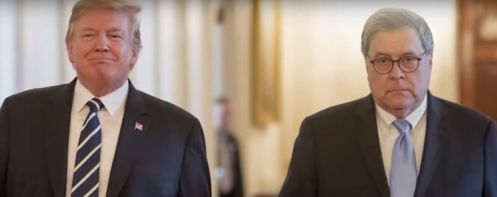
But watching William Barr’s Department of Justice act in obedience to Trump’s explicit or implicit direction, just how sure do you feel now that those anti-Trump Facebook posts, or tweets, or blogs that you’ve been putting out there on the Internet will never be used against you? It has happened in many countries of the world. Why should the US be immune?
What is happening now at main DOJ remains only partially visible to the public, but we can see enough to be legitimately alarmed. Trump is telling Barr–directly or indirectly–what he wants done on cases that involve his supporters or his purported enemies, and Barr shows every indication that he is complying. Trump tweets and Barr hops to it. Indeed, Trump is now openly calling himself the nation’s chief law enforcement officer.
Last spring, at Trump’s insistence, Barr launched an investigation into the origins of the Mueller probe, designed explicitly to expose it as a Democrat-led plot against Trump. Investigations have been directed against key FBI officials like James Comey and Andrew McCabe, as well as others. Barr’s very public “rebuke” that Trump’s tweets make it difficult to do his job, appears to be merely a complaint that the tweets reveal precisely what he’s doing and why. He has shown no reluctance to carry out directives to recommend reduced sentences for convicted Trumpians like Roger Stone and Michael Flynn.
As of September 2019, there were no less than 10 federal investigations dealing with Trump’s businesses and political activities. It’s now unclear if these are still active or have become dormant or simply ended. Barr, of course, is in a position to kill any of them or transfer them to another venue where they are less likely ever to come to fruition. There are now some disturbing signs that this may be happening. On February 17, DOJ sent out a memo stating that decisions on all “matters relating to Ukraine, including the opening of any new investigations or the expansion of existing ones” would be transferred from the famously independent Southern District of New York to the rival Eastern District in Brooklyn. The memo adds that “any widening or expansion of existing matters should require prior consultation” with the Deputy Attorney General in main DOJ or the US Attorney in Brooklyn.
Among these matters “relating to Ukraine” are the activities of Rudy Giuliani and his associates Lev Parnas and Igor Fruman, who are currently under indictment. What this means exactly is uncertain, but it is very unusual and quite suspicious, especially in light of everything else happening at DOJ.
There is an obvious pattern here, even more blatant since the Senate voted not to convict Trump, who has retaliated against everyone who testified to Congress–and even people who didn’t. On February 19, Trump forced the resignation of the Pentagon policy official, John Rood, whose certification of Ukraine freed the military aid that Trump had withheld. At the same time, he is reveling in his power of the pardon, which he wields in a grossly symbolic way: a racist Arizona sheriff, a war criminal, a Wall Street mogul convicted of tax evasion and securities fraud, a corrupt New York City police commissioner, a corrupt former Democratic governor, a Texas construction firm owner who donated $200,000 to Trump election campaign and is pals with Don Jr., a former Bush aide convicted of perjury and obstruction of justice, a software executive who hacked into a rival’s computer, etc. The message here is that none of this stuff is really wrong. And of course, they all had connections in TrumpWorld. And they’re mostly rich and white.
The simple lesson is that if you oppose Trump he will go after you, but if you remain loyal and silent he might let you out of jail. So far, he has not pardoned any of his erstwhile henchmen convicted as a result of the Mueller probe, but it’s a pretty good bet that at least some will get sprung after November 3, if not before.
Trump has removed the pardon process from the office in DOJ that had reviewed cases, and put it in the hands of a group in the White House led by Jared Kushner and Pam Bondi. As the Washington Post pointed out, “as attorney general of Florida, Bondi once took an illegal $25,000 contribution from Trump’s foundation for her PAC and then dropped an investigation into Trump University.”
Trump has always used the legal system to try to crush small contractors and others who he stiffed in his businesses and who couldn’t afford the legal fees to oppose him in litigation. Why would anyone expect him to act differently when he has the awesome power of federal law enforcement in his pocket?
The fact that more than 2,000 former justice department officials have called for Barr to resign should be more than enough to convince us of the seriousness of the problem. These are not people inclined to hysteria or to making gratuitous accusations.
Are you in good hands?

Feeling stressed out about who to support in the Democratic primary? Join the club.
Let’s face it: There is no perfect candidate. They all have drawbacks. No one really knows who can beat Trump. But we have to choose.
So here’s my advice, for what it’s worth: Vote for the one who best represents your values and the kind of country you want to live in. Your individual primary vote is not going to determine the outcome in November, especially if we all set aside our preferences and vote for whoever gets the Democratic nomination. But it will help set the course for the Democratic party and perhaps the country as a whole.
Having said that, I intend to vote for Elizabeth Warren in the Florida primary, not because I think she’s likely to win, but because I like what she stands for. Of all the candidates, I think she has the clearest vision of what’s wrong with this country and what it will take to fix it. She knows the nuts and bolts of our dysfunctional federal government better than anyone else, and actually has specific ideas about how to renovate it, not just slogans. What she’s proposing is radical only because it stands out from the intellectual desert of present-day politics.
The main thing holding her back is just being a woman in a misogynist culture. She lacks the physical and vocal gravitas that we seem to want in our politicians, which she compensates for by sheer determination. Her wonkiness appeals to people like me, but may be a drawback to many others. She’s genuine and approachable, but maybe doesn’t seem really fun. I think she may remind people of their fifth-grade teacher who wouldn’t let them go out to recess until they’d finished their lessons. But better than anyone else in the race, perhaps even Sanders, she understands the threat that toxic, unfettered capitalism represents to our democracy and our future.
I have written previously about my reservations about Bernie Sanders, so I won’t rehearse all that again. He seems to have momentum right now, though his “wins” in Iowa and New Hampshire weren’t all that impressive. If he doesn’t become the clear front-runner by the end of March, we may be heading for a disastrously contentious convention. His “outsider” status could turn out to be both an asset and a liability, and the volatility of his supporters could blow up the convention if they decide the party establishment has cheated him. I give him full credit for focusing attention on economic and social inequality, but I don’t see that he has much of a program for doing something about it.
I was as surprised as anyone by Pete Buttigieg‘s showing in Iowa and New Hampshire. It’s thrilling to have a viable gay presidential candidate, especially one who is so clearly intelligent and talks in paragraphs, though I sometimes lose the substantive thread in the elegance of his language. I’m still a bit mystified by his appeal to older voters, but it certainly has something to do with how utterly mainstream he appears–except for, well, you know… I’m bothered by his rather limited experience and his youth as well as some pretty recent missteps as mayor, and the general fuzziness of his platform. But he clearly has star potential. I just don’t think this year is going to be it for him.
I’m not feeling Amy Klobuchar. Her main talking point is that she has passed more bills than any Democrat in the Senate. Okay, but what are the bills? In the current congress, she is a sponsor or co-sponsor of 80-something bills, resolutions, or amendments. Not one of the bills has passed the senate, let alone become law. She has gotten a few resolutions adopted, but they are for anodyne things like “National Stalking Awareness Month”. Bills that she sponsored that got passed and signed in previous congresses mostly seem to be related to crime prevention or victim rights–things that Republicans tend to like. One was to create a position for a human trafficking coordinator for the US Department of Transportation. As worthy as those bills may be, they are, shall we say, unexciting and pretty non-controversial. As for as the rest of her message, to me it boils down to “don’t rock the boat”.
Then there’s Joe Biden. Sigh. Who knows, maybe South Carolina will revive his campaign, but he seems to be mainly running on nostalgia for pre-Nixon politics and the shadow of Barack Obama. Certainly he’s decent and likable, but to me lately he just seems old and tired. His trump card (pardon the pun) was his supposed electability, but if he doesn’t have that, it’s hard to see what’s left.
Finally, there’s Michael Bloomberg, the elephant in the room. I know a lot of people are looking at him as the plutocrat ex machina sent to save us from Trump by throwing his unimaginable piles of money into the race. But that’s exactly my problem with him. He has already burned through more than $300,000,000 for TV and internet ads, and he can maintain that rate indefinitely. Is the solution to our most fundamental problem–economic and social inequality–to elect a man who is so inconceivably rich that he literally can’t spend his money fast enough? I personally find it offensive. Maybe he’s the best one to slug it out with Trump, but for it all to come down to a contest between two billionaires (or maybe a real one and a pretend one) just seems a grotesque encapsulation of our failing democracy.
Would we be making a Faustian bargain? I hope that’s not the only choice left.
Back on January 20, when the Senate was still feigning deliberation on witnesses and documents in the impeachment trial, I wrote to both of our Florida senators to urge them to vote to hear witnesses and admit documentation. That was all–theoretically something that Republicans could also accept. Yes, of course I know it was a quixotic gesture, but that’s what’s good citizens are supposed to do, right?
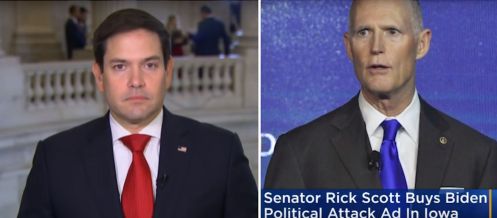
Their boilerplate responses say a lot about both Marco Rubio and Rick Scott.
Rubio’s reply came within a few days. It spent two paragraphs explaining what impeachment is and how it works. And then he wrote: “Impeaching a president is an extremely divisive and consequential decision. If this process moves forward to the Senate for a trial and vote, I will continue to approach it thoughtfully. I commit to only act on the basis of facts and in the best interests of the nation.” That was it.
Scott didn’t get back to me until February 14 after the Senate impeachment vote with the following:
“Thank you for contacting me regarding the acquittal of President Donald J. Trump. [Comment: I did not contact him regarding the acquittal.]
“Ultimately, the information presented to the Senate by House Democrats and White House Counsel demonstrated that there was zero evidence for impeaching the President. On February 5, 2020, I joined my colleagues to vote for acquittal of all charges of impeachment against the President.
“Our Founding Fathers feared that impeachment could be used as a partisan tool by partisan actors, and their fears were realized with this recent impeachment charade led by Speaker Pelosi. An act as divisive as impeachment should have bipartisan backing and overwhelming support and should be a last resort when there are high crimes and misdemeanors. That is why I have filed a constitutional amendment to raise the threshold to approve articles of impeachment in the House of Representatives from a simple majority to a super-majority vote of three-fifths. After the circus we saw in the House, it is clear changes need to be made.”
I didn’t expect much from Rick Scott, but seriously…”zero evidence”?!
Here’s the difference in style between Rubio and Scott in a nutshell. Rubio pretends to be considering different points of view, but somehow always ends up voting the party line. Scott doesn’t even make a pretense of that. He’s full-on Trumpian zealot, complete with an attack on Nancy Pelosi and “the circus we saw in the House.” In the end, of course, the result is the same.
And neither of them addressed the issue I had contacted them about.
This is where eight years of voter suppression under Governor Rick Scott has gotten us. Scott was elected senator in 2018 by 10,033 votes out of 8.2 million cast–so close that it went to a manual recount. The state governor race was equally close.
It’s time to get rid of them both. Rubio is up for election in 2022. We’re stuck with Scott until 2024.
Yesterday’s Senate vote to acquit Trump on impeachment charges was both inevitable and deeply depressing to anyone who still believes that a US president is subject to the country’s laws. But was the impeachment effort a mistake? I still believe it was both right and necessary. Let me count the reasons why.
- Once the whistleblower’s complaint became public, a failure by House Democratic leaders to move forward on impeachment would have made them complicit in Trump’s flouting of the law. Their reluctance to run earlier with the ample material supplied in the Mueller report had made them look dithering and motivated by political calculations. Had they failed to impeach, they would have carried that stigma forever. The fact that they did decide to move forward in the face of near-certain defeat in the Senate is compelling evidence that this was a matter of principle and not, as Trump claims, a politically-motivated coup attempt.
- It brought into ultra-high resolution the true nature of this president and his inner circle. Trump’s refusal to make his tax returns public should have told us that he would absolutely obstruct the impeachment investigation in every possible way. He didn’t even try to present evidence that might exculpate him. He simply defied Congress and dared anyone to do anything about it. And it worked, because his party moved in lock step to back him up. This is what organized crime does.
- It made crystal-clear that the Republican Party is the Party of Trump. There is no space for principled dissent. This is why Mitt Romney’s vote to convict is so telling, because it is in such stark contrast to everyone else in the party, Romney can probably remain senator from Utah for life, if he wants, but he has made himself a pariah in the party and will have to do severe penance in the form of votes going forward if he wants to get back in Trump’s good graces. Susan Collins, who is vulnerable for re-election, tried to have it both ways–voting for witnesses, while it was clear that she would cave and vote for acquittal. Even senators like Lamar Alexander who is on his way out and recognized that Trump was guilty as charged, voted to acquit. Crossing Trump threatens both re-election chances and earning potential after leaving office in the conservative big-money support system, which also is now thoroughly part of TrumpWorld.
- For once, Democrats stuck together. Despite pundit speculation that there would be some Democratic defections, there were none. Doug Jones and Joe Manchin both voted to convict, even though it may hurt their re-election chances–especially Jones. Both probably would have been given a pass by the party establishment if they had voted the other way. Say what you will, this took some moral courage. It is no longer possible for anyone to seriously claim that there is no real difference between the two parties–the contrast could not be any starker.
- Far from being a sinister “deep state”, the anonymous whistleblower and the career civil servants who testified at the hearings emerged as the true heroes who actually cared about laws that Trump was trampling. While the politicians hemmed and hawed, they put their own careers at risk by testifying in defiance of Trump’s gag order. They also demonstrated the falsity and cowardice of Trump administration officials who hid behind Trump’s baseless decree to avoid appearing at the hearings. In particular, Fiona Hill’s crisp and precise testimony implicitly exposed her erstwhile boss, John Bolton, as a self-serving apparatchik for refusing to testify unless he got a Senate subpoena that he knew full well would never be issued.
- It revealed the inadequacy of impeachment for holding a truly amoral president accountable, especially in a highly polarized political environment as we have today. It makes even urgent the importance of rescinding the specious DOJ policy against indicting a sitting president. Oh yeah, but we can’t do that either if the Attorney General is the president’s defense attorney.
No one can really predict what the fallout will be for the November election. Will it anger and energize Democrats to turn out and support whoever winds up with the nomination? Or is everyone just too exhausted and beat down to have any energy left to fight?
If nothing else, it’s no longer possible to pretend that we don’t know what we’re dealing with in Trump and his party. The real question is whether the American people actually care. At this point, I’m really not sure.
The New York Times columnist Roger Cohen just published an op-ed about Brexit headlined (in the print edition) “Requiem for a European Dream”, which he says “feels like the end of hope, a moral collapse, a self-amputation.”
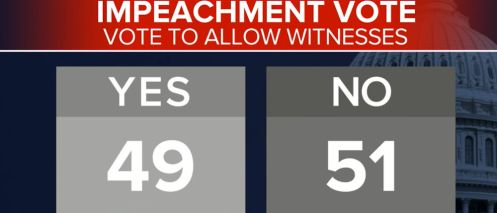
How fitting that Britain’s official divorce from the EU occurred on the very same day that the US Senate Republican majority voted to exclude witnesses and documents from the impeachment trial of Donald Trump. That, too, feels like the end of hope, a moral collapse, and a self-amputation.
Brexit, Cohen writes, leaves Britain “above all poorer in its shriveled soul, divorced from its neighborhood, internally fractured, smaller, meaner, more insular, more alone, no longer a protagonist in the great miracle of the postwar years…Britain, in a fit of deluded jingoism, has opted for littleness.” That essentially describes Trump’s America, despite the hollow cynical lie of all those red MAGA hats. The motto of Brexit might as well have been MEGA–“Make England Great Again”. (Scotland and Northern Ireland emphatically rejected Brexit.)
Indeed, TrumpWorld and Brexit are two sides of the same coin. They are powered by the same emotional and economic forces and reflect a similar cultural divide. If you look at the electoral maps, the pattern is the same: prosperous, better educated, ethnically diverse metropolitan areas voted to remain in the EU, while white Britons in rural areas and economically depressed former industrial towns opted to leave. It’s basically the same Blue/Red divide we see in the US. Both Brexit and Trumpism are fueled by white racism and opposition to immigration as well as nostalgia for a mythical past and resentment of urban elites.
I have written previously about the connection between support for Trump and “diseases of despair”. Indeed, Trumpism IS a kind of disease of despair. It explains the nihilism of Trump supporters, and their imperviousness to arguments of fact or even of economic self-interest. It’s a raw collective shout of “FUCK YOU” to the America and the world that they imagine is screwing them. If you’re self-destructive enough to kill yourself with oxycontin or smack, what do you care if Trump is destroying American democracy and ripping off the country? Bring it all down, who cares! Trump channels and amplifies that despair and rage, so they’re with him regardless of anything else. The dream has died in these places, and all that’s left is an aggrieved sense of betrayed entitlement.
Trump has done nothing that might actually alleviate the decay that his supporters are reacting to. Indeed, it’s in his interest to keep them desperate and angry. So he feeds them a poisonous stew of lies, hatred of foreigners and the press, and not-so-subtle white nationalism, and they lap it up–the more outrageous, the better. If that sounds like an unfair liberal elite caricature, just watch a few Trump rallies on YouTube. He owns them.
And that is why Trump owns the Republican party now–lock, stock, and barrel. And that’s why he owns virtually every Republican in congress as well, because those are the voters they must have to stay in office. Congressional Republicans will vote with him no matter what, contorting themselves into absurd positions to justify their cowardice. Last week it was to reject documents and witnesses, this week it will be to acquit him. Next time it will be to rubber-stamp who-knows-what atrocity in service of Trump’s personal interests. They are the living dead.
And so America too becomes, in Cohen’s words, “poorer in its shriveled soul, divorced from its neighborhood, internally fractured, smaller, meaner, more insular, more alone, no longer a protagonist in the great miracle of the postwar years.”
Under Trump, the US has unilaterally relinquished leadership in the great issues of our time, alienated our democratic allies, snuggled up to autocrats and dictators from Putin to Duterte to Kim, asserted its right to assassinate foreign leaders without any credible justification, and choked off the inflow of immigration that has made this country great. It is giving private interests license to poison our air and water once again, and laying the groundwork to shrink access to health care, disability, and retirement benefits. Meanwhile, it has given an enormous gift to the wealthiest individuals and most powerful corporations, the very ones who created the system that has desolated rural and industrial America. Perhaps most fundamentally, the Party of Trump is doing everything it can to selective roll back voting rights so that it can maintain minority rule indefinitely. All of this represents a profoundly pessimistic vision.
We have one more chance in November to get it right. Otherwise, we too will have “opted for littleness.”
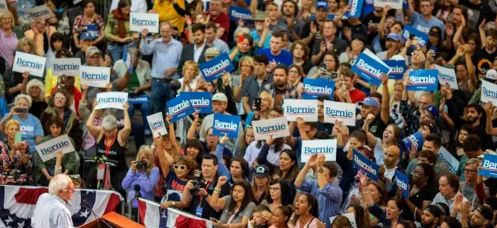
Let me state right up front that if Bernie Sanders wins the Democratic presidential nomination, I will vote for him and campaign for him. (That goes for any of the others in the race as well, even–God help us–Tulsi.) But I have doubts about him, which is why he is not my first choice. Let me explain why:
- He’s still not a member of the Democratic Party. That may seem like a nitpick, but it sticks in my craw. Why wouldn’t you join the party whose nomination you seek? The only explanation that makes sense is if he thinks that he is too pure. I distrust puritans. (As for the “socialist” label, that doesn’t bother me a bit. I think this country could use more socialism, not less.)
- He’s probably too old. This may be a geriatric election year, but he turns 77 this year which is how old Reagan was when he left office, and his main recreational activity was the nap. If he wins and lives out his term, he would be 81. He’s male and recently had a heart attack. I’m 76, so I get that people age differently, but let’s be realistic here. (And yes, I know that Biden is just a year younger–same applies to him.) At least, for heaven’s sake, pick a young 50-something for a running mate!
- I think he’s a charismatic movement leader, but I don’t really see him as presidential. I give him major props for putting into the national spotlight the glaring structural problems that plague this country, but I see more rhetoric than plans for solutions. I feel like I’ve been hearing the same speech for the last four years, and Sanders’ legislative record is, to put it kindly, modest. I suspect his finger-jabbing, get-off-my-lawn rhetorical style will get old quickly. To be fair, I don’t know if anyone could actually accomplish anything with the Party of Trump, but Bernie seems less likely that some others to work any compromises to break logjams.
- His supporters. I don’t like to generalize, but there is considerable evidence that things are shaping up for a replay of 2016 where the Bernie-or-bust folks go sulk and don’t vote if he doesn’t get the nomination. According to a recent poll only 53% of Sanders supporters said they would definitely vote for the Democratic candidate if it’s not him. While that kind of zealotry might seem an argument for making him the nominee, it fits with the I’m-too-pure image and smacks of political hostage-taking. Then there is the New York Times story about extensive on-line harassment and bullying carried out by Bernie supporters against other candidates and their staffers, which–to his credit–Sanders has condemned, but says he can’t control. It’s great to have supporters who are excited about you, but too many “true believers” scare me off.
The Democrats don’t have an ideal candidate, let’s face it. Each of them has his/her pros and cons, and none of us really knows which can beat Trump. So by all means, pick the candidate who best reflects the country you want to see. But in November, just remember that the alternative to whoever gets the nomination is another four years of Trump–this time with no restraints.
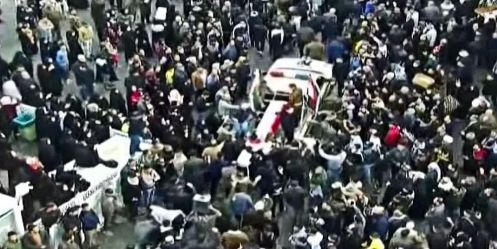
Mourners at funeral for Qasem Soleimani
Have we crossed a critical line with Trump’s implicit assertion that the US has the right to assassinate government officials of countries with which we are not at war?
Assassination of government officials has historically been used mostly by the weak against the strong–by individuals or groups struggling against governments perceived as possessing overwhelming repressive powers. In modern times, nation-states have rarely, if ever, claimed a right to kill leaders of adversary countries as a tool of statecraft. If they wanted to do that, they used proxies or clandestine operations that provided at least a fig leaf of deniability. Trump has now brazenly tossed the fig leaf aside.
While there is some international law dealing with assassination, the prohibition against one state using assassination against another state in a non-war situation is more customary than legal. The reason for that is quite simple: If you have the right to kill an official of an adversary country, then they have a right to assassinate you. It then all comes down to power, motive, and opportunity–basically gang wars on a national scale. And assassination becomes a casus belli–a justification for war.
In the US, in 1975 the Senate Select Committee to Study Governmental Operations–generally known as the Church Committee after Senator Frank Church–recommended that a law be enacted “which would make it a criminal offense for persons subject to the jurisdiction of the United States (1) to conspire, within or outside the United States, to assassinate a foreign official; (2) to attempt to assassinate a foreign official; or (3) to assassinate a foreign official.”
Two CIA directors in the 70s–Helms and Colby–issued internal agency directives to prohibit such assassinations, but the Committee found that legislation was needed because “administrations change, CIA directors change, and someday in the future what was tried in the past may once again be a temptation. . . . Laws express our nation’s values; they deter those who might be tempted to ignore those values and stiffen the will of those who want to resist.”
Indeed. Attempts to pass such a law failed in Congress in 1976, 1977, and 1980. In 1976, President Ford issued Executive Order 11905 which stated that “no employee of the United States shall engage in, or conspire to engage in political assassination.” In 1978, President Carter strengthened the language in E.O. 12306 to read “no employee of the United States, or those acting on behalf of the United States, shall engage in, or conspire to engage in assassination.” In 1981, President Reagan issued a new version, E.O. 12333, which added a section that prohibits indirect assassination by members of the intelligence community.
The Church Committee was convened in large part because the CIA was perceived as out of control–fomenting coups and plotting assassinations in countries around the world. The Committee focused specifically on five cases of peacetime assassination of government leaders in which the US government was allegedly involved:
- Patrice Lumumba, President of the Congo, killed in 1961.
- Fidel Castro, President of Cuba, various unsuccessful assassination plots from 1960 to 1965.
- Rafael Trujillo, President of the Dominican Republic, killed in 1961.
- Ngo Dinh Diem, President of South Vietnam and his brother Nhu, killed in 1963.
- General Rene Schneider of Chile, killed in 1970.
You can download the entire report here. The Committee found that:
- In the Lumumba case, two CIA officials had been asked by their superiors to kill him and provided poisons to do so, but in the end they were not actually involved in his killing, which was carried out by Congolese rivals with help from Belgian officials.
- With Castro, the CIA recruited mob figures and anti-Castro Cubans to carry various, often ludicrous, attempts on his life, but none were successful.
- With Trujillo, the US government generally supported dissidents, knew of plots to kill him, and supplied them with a few guns. But US personnel were not involved in the actual killing.
- Diem and his brother were killed during a military coup, which had US support, but their killing was not supposed to occur as part of the coup and the assassination was done without US knowledge or support.
- Schneider, the Commander in Chief of the Chilean Army, opposed a military coup which was actively supported by the US in order to prevent Salvador Allende from taking office as president. He was shot by the golpistas while trying to escape being kidnapped and died subsequently, but US personnel were not directly involved.
In each of these cases, the official US involvement was murky enough that there was some shred of plausible deniability, and no one was ever punished for their connections to these killings.
Outside of these cases, there was the death of Chilean President Salvador Allende who died in the Presidential Palace during a CIA-fomented 1973 coup. Most accounts conclude that he committed suicide during the military attack on the palace, but clearly his death would not have occurred then and there had not the coup taken place.
Then there was the 1986 US Air Force attack on three Libyan military sites in retaliation for a Libyan-sponsored terrorist attack on a Berlin nightclub. One of the sites was believed to be a residence of Libyan President Muammar Qadhafi. As it turned out, he was not present at the time, but his adopted daughter was killed and his wife and one son were injured. The Reagan Administration argued that Qadhafi was not the intended target and therefore the attack did not violate Reagan’s own executive order, but press reports revealed that US intelligence believed that Qadhafi might be there at the time of the raid, and killing Qadhafi would be been seen as a most positive outcome. This is perhaps the closest analogue to the assassination of Soleimani this week. But even in this case, the Reagan administration was not prepared to go the full Trump and openly proclaim that killing a foreign leader was the objective.
Let’s set aside any judgment on whether the targets of these assassinations had it coming and talk about blowback. The Congo has suffered through decades of dictatorship and civil wars. Certainly, not all of that can be blamed on Lumumba’s killing and he was already probably on the way out of power, but foreign manipulation on the part of the US and others certainly contributed to the chronic instability.
In the Dominican Republic, the leftist Juan Bosch won election as President in 1963, but was regarded with hostility by the US and deposed by a military coup in 1965 at which time Lyndon Johnson sent in the US military as a de facto occupying force. In 1966, Joaquin Balaguer, Trujillo’s last puppet president, was elected and remained in office for twelve years marked by repression of human rights and political opposition.
In Chile, the US government worked to destabilize Allende’s government and to deny it foreign financing which exacerbated economic distress and fed the opposition. The 1973 military brought a brutal repression with thousands of extrajudicial killings and tens of thousands of Chileans arrested, tortured, or forced into exile. The military-led government became the poster child for neoliberal/libertarian economists like James Buchanan, which brought in massive foreign investment that stabilized the economy–until it didn’t.
In Cuba, the attempts to kill Castro certainly solidified his belief that the US would do anything to destroy him and arguably made him more eager for Soviet protection–including accepting the missile sites that led to the October 1962 missile crisis that threatened a nuclear war. Sixty years later, Fidel is dead, but the regime he created remains intact and under no threat of crumbling.
Then there’s Vietnam. In 1963, the US commitment to the Saigon government was still relatively modest. But US involvement in the coup in which Diem was killed served to cement ties with the military government that took over, leading to incrementally expanding military and economic support that ultimately intensified and prolonged a decade of disastrous civil war. Vietnam is one of the great tragedies of the 20th century–for the US, certainly, but vastly more so for Vietnam itself.
Now here we are on the brink of a hot war with Iran as a result of an assassination justified on the basis of Iranian activities in the Middle East that, objectively, are not that different from those that the US has engaged in throughout the world since World War II.
Americans like to see themselves as the good guys, but increasingly that is not the way the rest of the world sees us. Trump has trampled on alliances built up over 75 years, and now we are often regarded a threat rather than a friend. The more we opt for brute power and intimidation as a means of asserting dominance in the world, the more isolated and insecure we become.
With his bellicose chest-beating over the Soleimani assassination, Trump has overturned decades of stated US policy on what is morally and pragmatically acceptable, thereby exacerbating a crisis of his own making. This is a Rubicon we should not have crossed, and I’m not hearing a lot of discussion about this fundamental issue. He is well on his way to making the US an international pariah, and karma can be a bitch.

They say people are supposed to get more conservative as they get older, but for me, the opposite has been true. Now, at 76, I find myself enraged at the reactionary racist movement that has seized control of this country and frustrated by the bone-deep fear and pessimism that prevents us from doing anything about the critical issues that we face.
Ten years ago, we were just beginning to emerge from a catastrophic recession, but I had a feeling of hope and optimism. There was still a lingering euphoria from that joyous mass celebration that was the Obama inauguration, when it seemed possible that America might finally overcome its shameful and crippling legacy of racism. Congress was on the verge of passing the Affordable Care Act, which would bring health coverage to millions of Americans who did not have it. Congress was also about to pass Dodd-Frank to reform the criminally risky practices of Big Banking and Wall Street that had brought on the Great Recession. America’s prestige and standing in the world was again on the rise.
How different things look today ten years later! The counter-reformation reaction was immediate and implacable. The lynchpin of the conservative backlash was the Supreme Court’s January 21, 2010 Citizens United decision which turned what was already a river of corporate and private money in politics into a tsunami. Corporate money funded the Tea Party movement which transformed the Republican party into an anarchic and nihilistic band of political vandals, in which establishment party leaders could survive only by going along with the radicals.
What the movement lacked was a charismatic and unscrupulous leader. Then along came Trump, who has turned the Tea Party movement and the Republican party into a cult of personality. And here we are.
I wonder where is the outrage at the corruption and defilement of the Presidency? We all knew what what going to happen. We began the Trump presidency with the Women’s March–the largest nationwide protest in American history. People joined Indivisible and showed up at congress members’ town halls. But that energy and anger seems to have seeped away in a daily onslaught of scandals so overwhelming that it began to seem normal. Democrats wrung their hands over whether to impeach Trump for his blatant offenses until a civil servant made it impossible to ignore. The national mood seems to be one of sullen resignation.
Our government is paralyzed and incapable of doing anything about urgent national problems. Where there is any action, it’s in the direction of making things worse, whether it’s regarding climate change, public health, education, poverty, racial equality, income equality, financial regulation, international relations, etc. The political battle is merely to preserve what remains against further erosion, not to seek bold solutions to our growing problems.
As cynical as I sometimes feel, I can’t help being an idealist. I believe that perhaps the first function of democratic government is to protect the weak and poor against the strong and rich and to strive to improve equality of opportunity. As a country, we have made some progress in that direction, but I sense that the tide is turning and something fundamental in the distribution of power has shifted–something our legal and political institutions are ill-equiped to deal with. The more wealth is concentrated in the hands of behemoth corporations and the wealthiest of individuals, the more government becomes their servant. Are we, as a nation, okay with that?
A decade ago, I had no grandchildren. Now I have four. I wonder what we will be leaving them. Americans are taught to believe in the inevitability of progress, but history tells us that rights gained can be lost and that economic and social progress can be reversed. I fear we are at one of those historic inflection points now. If we want to keep America a democracy, the year 2020 will be crucial. This is no time for apathy and despair, but a time for mobilization. Act like your future depends on this year’s election. Because it does!
 TrumpWorld for Beginners