
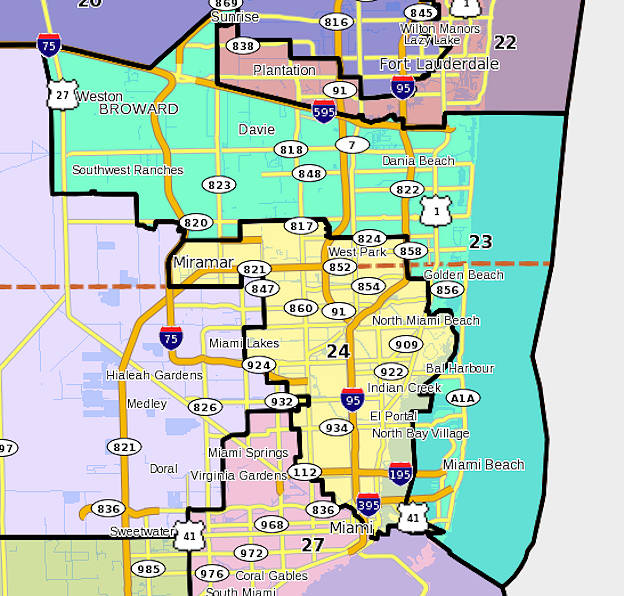
Congressional District 23 gets a lot of attention because it is currently represented by Debbie Wasserman Schultz, who is also the chair of the Democratic National Committee. The Republicans would therefore dearly love to unseat her, but the odds of doing that probably aren’t too good.
The L-shaped redrawn district covers most of the inhabited parts of Broward County south of I-595 and then hooks south to include the ocean beach communities all the way to South Beach in Miami-Dade. Unlike other districts that include parts of Miami-Dade, this one has an Anglo white plurality—almost 50 percent. Hispanics are about 37 percent of the voting age population, but only about a fourth of Hispanics in the district are Cuban in origin. Less than one-eighth of residents are black. The official demographic data from the redistricting website doesn’t include this kind of information, but the district obviously includes a substantial Jewish and gay population.
Debbie Wasserman Schultz has been in congress since 2005, and before that was a Florida state representative for eight years. She has been a rising star in the party, and was chosen the DNC chair in 2011. If you’re at all familiar with the Democratic Party’s platform, you’ll know where Wasserman Schultz stands on the issues. She has been pro-choice on abortion, pro-gay, and pro-gun control, as well as a staunch supporter of the Affordable Care Act and President Obama in general. Her website is here.
She is feisty and outspoken. Soon after she took over the DNC, she got into some controversy over an appearance on Face the Nation in which she said: The Republicans have a plan to end Medicare as we know it. What they would do is they would take the people who are younger than 55 years old today and tell them, ‘You know what? You’re on your own. Go and find private health insurance in the health-care insurance market. We’re going to throw you to the wolves and allow insurance companies to deny you coverage and drop you for pre-existing conditions. We’re going to give you X amount of dollars and you figure it out’. Of course, that has turned out to be a pretty accurate description of the Romney-Ryan position—that is, whenever that position can be pinned down.
Both the Sun-Sentinel and the Miami Herald have endorsed Wasserman Schultz for re-election.
Wasserman Schultz’s Republican opponent is Karen Harrington, who also ran against her in 2010. Judging from Harrington’s campaign website, she appears to be a typical Tea Party candidate. Her website shows her posing with Rick Santorum and firing a rifle at a shooting range (she gets a top “AQ” rating from the NRA). She has an endorsement from the Eagle Forum PAC founded by Phyllis Schlafly, who has always been the conservatives’ favorite female anti-feminist. She is also endorsed by ALIPAC (Americans for Legal Immigration) which says it opposes “any form of Amnesty for illegal immigrants”, and she accuses Wasserman Schultz of “pandering to Hispanics.”
Harrington says she wants to repeal Roe v Wade, believes life begins at conception, and would cut off funding for Planned Parenthood. She fully supports Paul Ryan’s budget plan, and says she would have voted “no” on the last vote to raise the debt limit—apparently not caring that that would have forced a financial crisis of immense proportions. She seems to be trying to be more Jewish than Wasserman Schultz, calling Obama “no friend to Israel”—the phrase that keeps popping up on those ads by the Jewish Republican Coalition PAC bankrolled by Newt Gingrich’s BFF and benefactor Sheldon Adelson.
And she says she fully supports the Defense of Marriage Act, which has now become for gays the single biggest obstacle to obtaining access to rights that heterosexual couples take for granted. Indeed, Harrington’s official photo on her website makes her look remarkably like Anita Bryant back in the day. Like Bryant, she is “no friend to gays.”
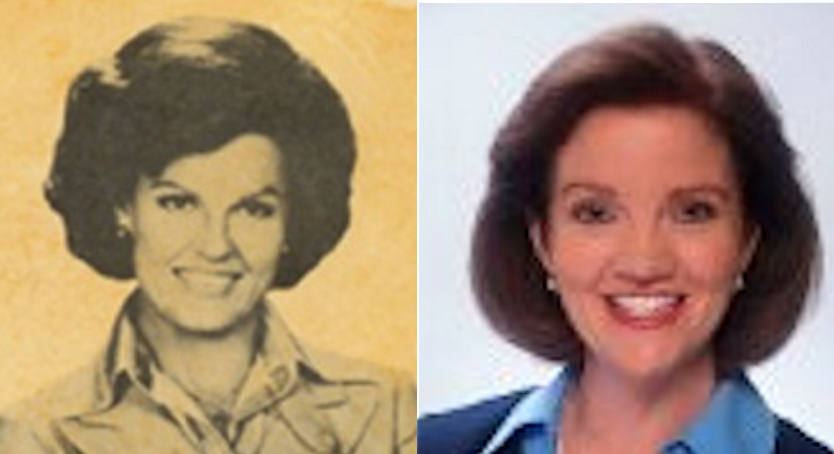
Harrington’s experience has mainly been that of the owner of Rickey’s Restaurant and Lounge in Pembroke Pines (and now two other locations), which would make her one of the “job creators”. I’ve never been there, but it’s apparently a beer-and-chicken-wings kind of place. On-line comments by patrons give it lukewarm to negative reviews. One patron (who “liked it”), said: “It’s not the kind of place you find sleaze [sic] drunks passed out and sloppy, but it kind of looks like that. It’s the kind of place you recognize from those 1970’s Clint Eastwood country movies sans bikers. The food is greasy and about what you’d expect…” I’m no restaurant snob, but it doesn’t exactly make you want to eat there, so would you really want to send the owner to Congress? Really?
Note to naturists: The extremely popular Haulover Beach is in this district. Now obviously, it doesn’t appear in the campaign websites, but I’m kind of guessing from their positions on other issues that Harrington would be a lot less sympathetic to keeping part of the beach clothing-optional than Wasserman Schultz. Just sayin’…
Bottom line: Vote for Debbie Wasserman Schultz!
And Why You Should Care
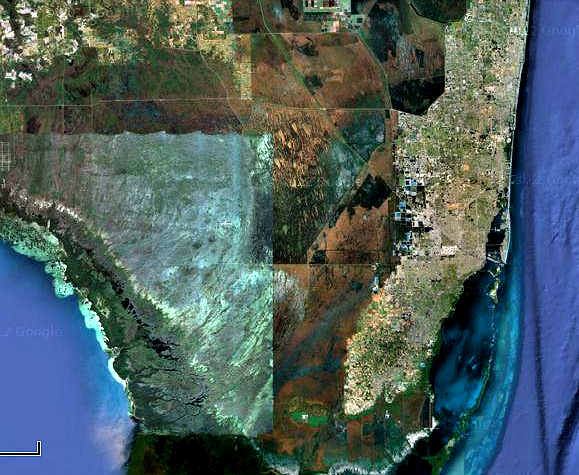
When you fly into MIA from the west, you are looking down on miles and miles of Everglades with no sign of human habitation, and then suddenly you are over a densely populated urban area. The transition is like night and day, and the reason is something called the Urban Development Boundary (or UDB). The UDB is the line that keeps development from intruding further into the Everglades and coastal wetlands.
The main reason I’m writing about this now is that the UDB is the subject of one of the proposed changes in the Miami-Dade charter that is being voted upon in the November election. At issue is incorporating into the county’s charter the current county law requiring a two-thirds majority to move the UDB to allow development in lands that are now undeveloped or agricultural. This is actually one of those better-half-a-loaf-than-none measures, since a three-fourths majority would be preferable, but it does offer some more protection than a simple majority.
To be honest, I had never heard of the UDB until I started following Eye on Miami’s posts on the subject. (The New York Times considered it worth a feature article back in 2007.) But I quickly became convinced of the importance of this issue to the future of our community.
First a little background and geography lesson: On a conventional map, Florida looks like a broad peninsula over a hundred miles wide. But when you see it in a satellite image, you realize that what we think of as South Florida is really just a narrow finger of land along the Atlantic no more than 10 – 15 miles across. We live where we do because a thin limestone ridge parallel to the coast lifts the land a few feet above the ocean on the east and the Everglades on the west. In the hundred years or so since Miami and other communities were established, developers have pushed settlement westward into the Everglades by landfill and swamp drainage, which has resulted in a lowered and distressed water table (which we all depend on) and deterioration of the Everglades ecosystem as the urban sprawl has expanded. The sprawl has in turn created the traffic nightmare that area commuters experience daily.
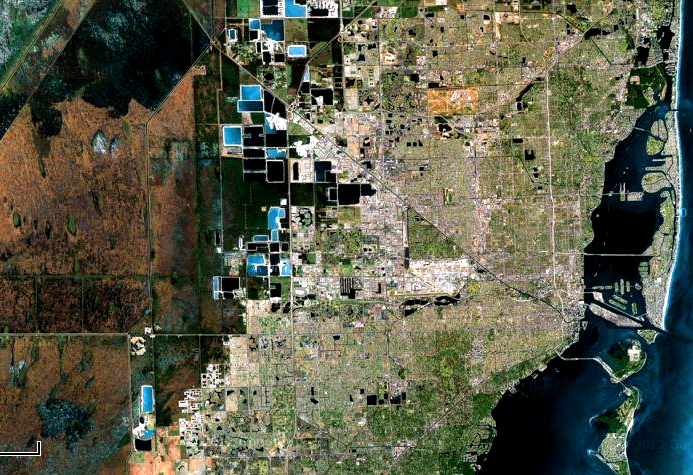
Back in the 1970s, the first efforts to contain the sprawl were embodied in a Land Use Plan for Miami-Dade, and in 1983 the UDB first appeared as a specific line on the map. [See this fascinating, if slightly wonkish, legal summary here.] However, the UDB has been under constant assault by real estate developers and rock miners ever since, and between 1976 and 2007, some 52 square miles—an area more than twice the size of Manhattan—have been added to the land inside the UDB available for development. [Note: Those rectangular ponds on the fringes of the Everglades that you see in the satellite images are former rock mines that have filled with water from the Biscayne aquifer.]
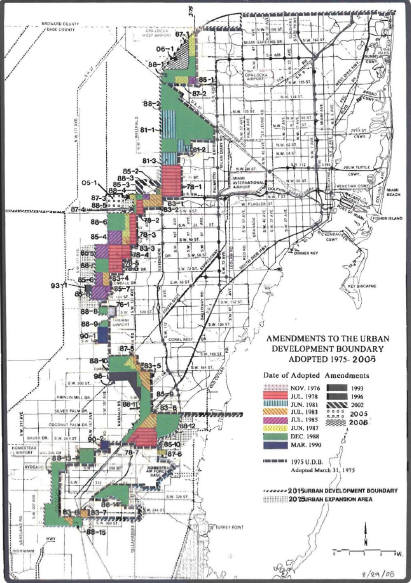
The pressure is incessant. Earlier this year, the Ferro Investment Group submitted an application to expand the UDB to include 10 acres in West Kendall and rezone the parcel from agricultural to commercial. Approval would mean an adjacent and larger agricultural parcel would be surrounded by commercial development on three sides and therefore ripe for picking on the next round. Development doesn’t just mean environmental degradation—it also means that taxpayers pick up the tab for the infrastructure that the county must provide to support the development.
At stake are huge sums of money, and therefore it is a political issue, though perhaps because it doesn’t involve sex or drugs, it isn’t one that get a lot of attention from the general public. But the developer forces, like the Latin Builders Association, which want to put up new big-box stores, strip malls, and subdivisions on vacant lands, contribute heavily to friendly county commissioners. Lynda Bell is the most shameless among what Eye on Miami calls the “unreformable majority” who reliably vote to support their interests. (There are also a few Good Guys like Dennis Moss and Sally Heyman who are trying to hold the line.)
The anti-environmental Scott administration in Tallahassee has made local resistance to moving the line even more tenuous. As Eye on Miami put it: Until the Republican-led Florida legislature gutted the Growth Management Act this spring, approved by incurious, indifferent Gov. Rick Scott, the Florida Department of Community Affairs provided pressure against local county government from doing what powerful lobbyist/law firms and their speculator clients wanted: strip malls, commercial centers, and platted subdivisions wherever and whenever they could find bank financing. The local state senator who has been most active in gutting this environmental protection is Ellyn Bogdanoff (R-Broward), who introduced a bill in May that would make it easier to move the UDB (which, fortunately, failed). You know Bogdanoff—she’s the one surrounded by those adorable kiddies in her campaign commercials. You’d never know from her ads that she is also the leading shill for the Genting gambling behemoth behind the push for megacasinos in South Florida.
Long story short: The measure now on the November ballot is a slender reed in the battle against the ongoing destruction of the Everglades, but it’s one of the few we have. Vote YES on this one.
For me, the top of the ballot is a no-brainer: Barack Obama deserves re-election. I have previously stated my reasons for supporting the President, and last night’s debate confirmed my view that Mitt Romney is a snake-oil peddler who will say absolutely anything to make the sale and constantly changes his line depending on the audience. The bottom line is that Romney’s economic prescriptions (about which he never actually reveals any details) would not produce anything resembling a balanced budget, would protect and expand the unfair advantages enjoyed by the wealthiest Americans, and would eviscerate the social safety net built up over the last eight decades. We know that the Republican agenda is to cripple and eventually dismantle Social Security, Medicare, and Medicaid. As Obama pointed out last night, the Romney/Ryan program is the George W. Bush program with a mean streak. And besides, Romney is just such a prick!
But that’s just the beginning of a very long and complicated ballot. If you’re voting in person, you really need to be prepared before facing the bewildering array of questions on this ballot. It’s really ridiculous!
The next question is the Senate race between incumbent Democrat Bill Nelson and Republican challenger Connie Mack IV (whose real name is Cornelius Harvey McGillicuddy IV). Apparently about half of Mack’s supporters are under the illusion that they would be voting for his father, former Senator Connie Mack III. In my book, Nelson’s voting record is generally mainstream Democrat, while Mack’s positions veer off into Tea Party craziness. Nelson deserves re-election.
Then come the three questions on retention of Florida Supreme Court Justices R. Fred Lewis, Barbara J. Pariente, and Peggy A. Quince. If you don’t want to give Rick Scott total control of the state supreme court, you need to vote YES on all three. Everything I have read tells me that all of them are stand-up justices who deserve to remain on the court. See here and here.
Next are the questions regarding retention of District Court of Appeal judges. Again, vote YES to retain all of them. See here and here.
Then on my ballot is a run-off for County Judge, Group 24 between Greer Elaine Wallace and Andrea R. Wolfson. It’s not easy to get a lot of information to make a decision on these judicial races, but in this case a compelling factor for me is that Wolfson has accepted the endorsement of the odious anti-gay Christian Family Coalition. As a gay man, that’s a huge red flag for me, and I urge all gay voters and fair-minded straight voters to vote for Wallace.
And that’s just the first page in a 9-page ballot! Next come the full texts of no less than 12 proposed state constitutional amendments, and there is no explanatory synopsis to tell you what you’re actually voting for. Some of them are quite insidious. Discourse.net has a very helpful analysis. Amendment 1 is a Republican attempt to nullify the Afforable Care Act (aka ObamaCare). Amendment 3 is a “starve the beast” measure to limit growth of state revenue. Amendment 4 is another one, but worse. It’s intended to kill local government services by choking off revenue, but presented in the guise of helping homeowners avoid property tax increases. Amendment 5 is basically about giving the legislature the means to intimidate judges. Amendment 6 would prohibit public funding of abortion (which doesn’t happen anyway) but also exempts abortion from privacy protections under the state constitution. Amendment 8 would undermine separation of church and state by removing the prohibition against using public funding for support of religious institutions—it’s also an indirect attack on public schools. Even the few that have some merit would be better handled by ordinary legislation. Bottom line: Vote NO on all of them.
Then comes the Miami-Dade school bond question which would authorize issuing $1.2 billion in bonds for public schools. I’m generally supportive of better funding for schools even if it might mean a slight property tax increase. So I think this one deserves support.
Then there are various proposed Miami-Dade charter amendments. (I know, eyes are probably glazing over by now, but stick with me! Some of these are actually important.) Here’s the Miami Herald’s editorial opinion on these questions, which makes sense to me. The third question regarding the Urban Development Boundary looks particularly important. So YES on all of them except the fourth one (new incorporated cities) and the seventh (county procurement)—NO on those two.
Okay, almost done now. Then there’s a county question on expanding the tennis center in Crandon Park on Key Biscayne using non-public funds. I don’t really see the harm here, so YES on this one.
Finally, there are “non-binding” straw polls on improving animal services and “Contracting with Companies Doing Business with State Sponsors of Terrorism”. I’m not sure there is a need for the first, and the second is just silly and aimed at companies that want to do business in Cuba. So I’m inclined to say NO on both.
Phew, that’s it!!
One more thing: Vote for Debbie Wasserman Schultz for Congress in District 23, and for heaven’s sake vote for Joe Garcia against David Rivera in District 26.
For another opinion that I respect on this election, see the Eye on Miami post here.
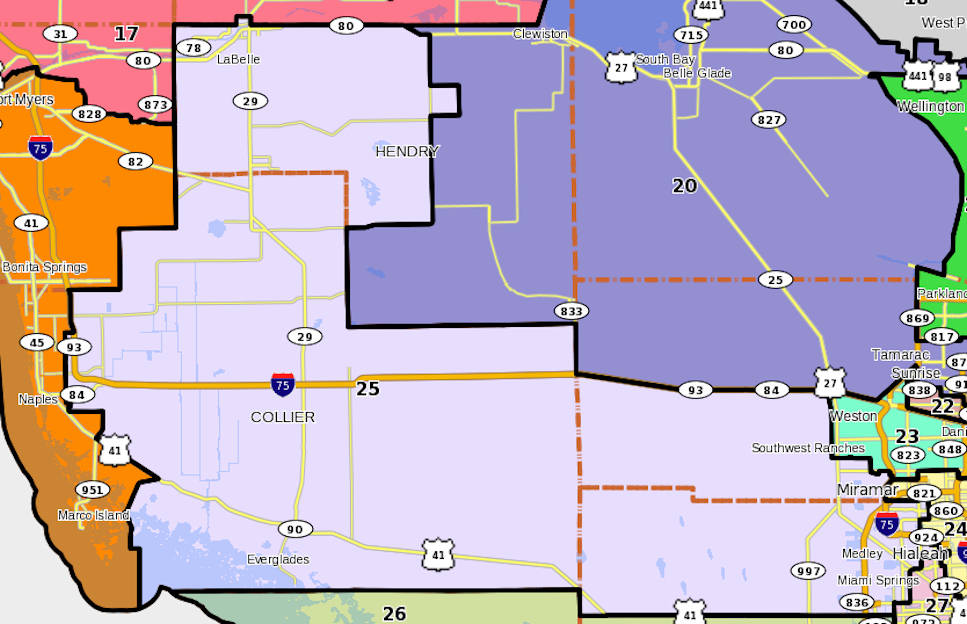
The redrawn District 25 stretches from northwest Miami-Dade and southwest Broward across the Everglades to the Gulf of Mexico, including big portions of Collier County and Hendry County. But the demographic center of gravity remains in Hialeah and Doral in Miami-Dade. The district is heavily Hispanic (70 percent), though nearly half of the Hispanic population is now non-Cuban.
Incumbent congressman Mario Diaz-Balart inherited the district when his older brother Lincoln Diaz-Balart decided the grass was greener as a lobbyist and decided not to run for re-election in 2010. Mario, who was facing a real re-election challenge in the neighboring district where he was then the US representative, carpetbagged over to his brother’s turf and ceded his old district to David Rivera.
For Mario Diaz-Balart, the district couldn’t be more ideal. He is unopposed by a Democratic candidate in the general election, and—better yet—had no opponent in the Republican primary. So he can just sit back and sip mojitos during the campaign season.
Since there’s basically nothing to talk about when it comes to the election, the story here is really about the Diaz-Balart dynasty, which requires some looking back into Cuban history. It’s a fascinating story, worthy of a family biography (I was actually surprised that one apparently doesn’t exist). Or perhaps a telenovela.
The one fact that frequently astounds clueless gringos is that Mario’s (and Lincoln’s) aunt, Mirta Diaz-Balart, was Fidel Castro’s first wife. Which means that all that ensued thereafter was in one sense a real family feud.
Fidel and Mirta and her brother Rafael Diaz-Balart (Mario’s and Lincoln’s father) were all students at the University of Havana in the 1940s. Mirta and Fidel married in 1948—according to some versions, against her family’s wishes—and had a son, Fidel Angel “Fidelito”. The familial and political strains on the marriage grew as Fidel moved increasingly leftward and from student activism into violent confrontations against the government. After Fulgencio Batista regained power in a 1952 coup and made himself dictator, the marriage was clearly doomed. Rafael Diaz-Balart became a deputy in Batista’s Ministry of the Interior (which controlled internal security), and Fidel Castro launched a quixotic armed attack on the Moncada Barracks in Santiago in 1953, which landed him in prison.
In 1955, Rafael Diaz-Balart made an impassioned (and arguably prescient) speech before the Cuban Congress pleading against releasing Fidel from prison in an amnesty. But Castro was released and went to Mexico, and later that year he and Mirta were divorced. There was a prolonged and bitter custody battle for Fidelito—Mirta accused Fidel of kidnapping him during a visit to Mexico—but Fidelito ultimately ended up with his father. (Sort of oddly foreshadowing the battle over Elian Gonzalez.)
Cuba in the mid-fifties was not exactly the idyllic democratic island of nostalgic exile memory. Batista’s regime was a thuggish kleptocracy on the model so prevalent in Latin America in the last century. He suspended civil liberties and formed a secret police force, while aligning himself with Cuba’s wealthiest families. How deeply the senior Diaz-Balart was involved with Batista’s repressive apparatus is hard to know at this point. Later he would try to distance himself from Batista, claiming that he had broken with the dictator, but the disclaimers weren’t totally convincing, as in this fascinating exchange before a US congressional committee in 1960.
In any case, Batista enjoyed US support. In 1960, then-Senator John F. Kennedy noted: At the beginning of 1959 United States companies owned about 40 percent of the Cuban sugar lands – almost all the cattle ranches – 90 percent of the mines and mineral concessions – 80 percent of the utilities – and practically all the oil industry – and supplied two-thirds of Cuba’s imports. Batista also allowed US mobsters—particularly Meyer Lansky and Lucky Luciano—to run the casinos, nightclubs, prostitution—for a sizable cut. Americans in search of sex and gambling flocked to the mob’s resorts in Havana.
Cuba’s proportionately small but well-educated and industrious middle class did well under Batista, and they became Castro’s target and scapegoat as the Batista regime crumbled. When Castro’s forces swept into Havana on January 1, 1959, Rafael Diaz-Balart had already left for Europe, doubtless seeing the handwriting on the wall. (His brother Waldo, an artist, also left and for a while became a member of Andy Warhol’s Factory and acted in a couple of Warhol films including the 1968 sex-and-drugs classic Loves of Ondine.)
Within three years, Rafael Diaz-Balart had two US-born sons: Jose (now a Telemundo anchor) born in November 1960 and Mario born in September 1961—both in Fort Lauderdale. (Lincoln, the eldest, was born in Havana in August 1954. A fourth son, Rafael J. Diaz-Balart, was born in 1959; he became an investment banker and is currently Chairman of the Board of the Miami Symphony.) The senior Diaz-Balart developed extensive business interests in Spain, where he spent much of his time. Lincoln graduated from the American School in Madrid.
All of the Diaz-Balart siblings have had impressive careers by any measure, and remarkably for such a big and prominent clan, the family has managed to avoid becoming enmeshed in scandal. It is no disparagement of their achievements to observe, however, that they did not start out as penniless refugees.
Lincoln blazed the trail in US politics, and Mario has followed closely behind. Both started out as Democrats, but both switched parties in 1985. Lincoln won a seat in the Florida house of representatives in 1986, then won a Florida senate seat in 1989, then was elected to the US House of Representatives in a newly-created district in 1992 where he remained until 2010. He deviated a bit from the Republican party line on some issues like immigration and gay rights, but fought against the Affordable Health Care Act (aka Obamacare) and voted against the 2008 economic bailout. He also was a staunch opponent of online gambling, which is kind of ironic since he is now the leading lobbyist for the Malaysian Chinese gambling behemoth Genting which is spending huge sums on politicians as part of its efforts to win approval of megacasino resorts in South Florida.
Mario’s path has followed his brother’s: Florida house in 1988, Florida senate in 1992, then the US House of Representatives in 2002. His voting record has been similar to his brother’s as well. Oddly, he seems to have a reputation as a bit of a conservationist, though it’s hard to see why. His League of Conservation Voters score for the last congress was only 11 percent, and he claims to be “agnostic” on climate change.
The main leitmotif that runs through the family is their implacable hatred for Fidel Castro. Both Lincoln and Mario have been in the vanguard of the anti-Castro hardline in Congress, and don’t seem to have modified their views one iota. Well, they keep getting elected, so why should they? And it’s really a symbiotic relationship—the Castros need the hardliners to rally support on the island, and the hardliners need Castro to keep getting elected.
In any case, the 600,000+ constituents in District 25 have no choice.

I’m talking here about the experience of voting, not who’s going to win. It’s shaping up as one of those Florida stories that make the state a laughing stock.
This will be my first time voting in Florida in a presidential election year, so I know what it was like last time only by what I’ve read or what other people have told me. What I have heard is that in many places the lines were incredibly long, and the waiting time to cast a ballot could be well over an hour.
Well, it looks like this time it may be even worse. I was just watching Rachel Maddow who did a segment on voting in Florida. (Will post the link to the video when it’s available. Here’s the link.) She held up a sample 2012 ballot for Tampa, which she pointed out was six legal-size pages long. Then she noted that the ballot in Miami-Dade will be even longer: 10 pages!
If you’re a registered voter in Miami-Dade, you can download a sample ballot here. If you’d like to avoid ballot shock, I suggest you do just that.
The main reasons the ballot is so long are: 1) There are twelve proposed constitutional amendments which are not summarized, but printed in their entirety, 2) There are a number of local questions peculiar to your county of residence, 3) There are all those judicial elections, and 4) Everything is printed in three languages: English, Spanish, and Kreyol.
Now imagine how long it will take a voter seeing this ballot for the first time just to read the thing. Then to try to figure out what the proposed amendments actually mean. Then to mark the ballot and put it into the scanner. This is not going to be a quick process, and it is very likely to make the lines extremely long and slow-moving.
BTW, if you want a guide to what the amendments mean and whether they have any merit, I would strongly recommend reading this post on Discourse.net. Or this one on Critical Miami. Eye on Miami says vote “no” on all of them–he’s probably right.
Now if I were a suspicious person, I might think that cluttering up the ballot with all those constitutional amendments (the content of most of which has no business being in the state constitution) is a very clever means of voter suppression. Why? Because the longer people have to stand in line, the more likely they are just to say “Fuck it” and leave.
So what’s a voter to do?
Well, there’s early voting, but that has been cut back severely from last time, so that this year there are only eight days of early voting, from October 27 thru November 3. Which means that you’re likely to encounter major delays when you go to the early voting locations as well. [For the schedule and locations, click here.] Again, this is part of the Republicans’ strategy of vote suppression.
So, if you don’t want to deal with that either, or can’t be here on those days, then you’re left with absentee ballots. Yes, the notorious absentee ballots. If you want to chance that—or if you don’t have a friendly boletera to fill one out for you—you can request a ballot online, by phone, or in person until the end of October. For more information, click here.
Just don’t let the bastards wear you down. VOTE!
A Post-Script: Paul Ryan and “Stench”
This has nothing to do with the foregoing post, but it was just too irresistible.
According to Politico, an influential slightly right-leaning inside-the-beltway publication that covers, duh, Washington politics, the Romney campaign has become such a clusterfuck that Paul Ryan reportedly “has been marching around his campaign bus, saying things like, ‘If Stench calls, take a message’ and ‘Tell Stench I’m having finger sandwiches with Peggy Noonan and will text him later.’
“Stench”, of course, refers to the man who picked Ryan as his VP running mate.
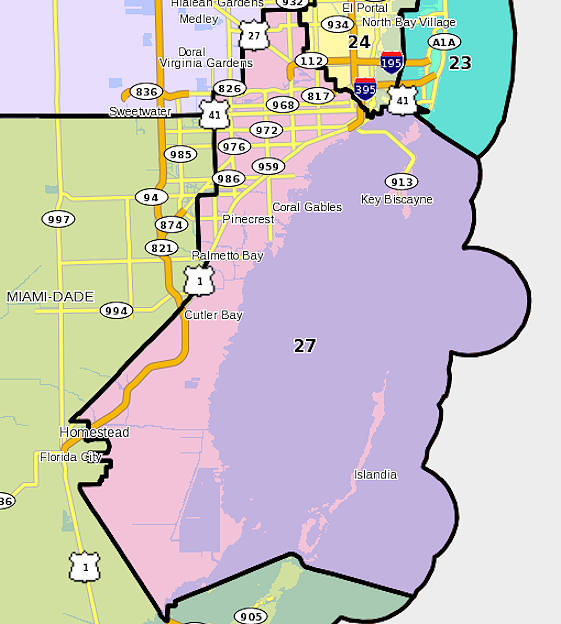
Running for re-election in a redrawn District 27, incumbent Republican Congresswoman Ileana Ros-Lehtinen nominally has a Democratic opponent, one Manny Yevancey. But that’s really just a pathetic joke.
I went online to try to find out something about the challenger, and came up with virtually nothing except this in a comment on an open thread in Daily Kos: I googled Manny Yevancey, BTW…And the most pertinent result was a (sadly, protected) Twitter page belonging to someone named Manny Yevancey in North Miami who described himself as a “gay male bodybuilder in shape @48”.
There’s no website and, apparently, no campaign. Oh, well…
So when Ileana Ros-Lehtinen is re-elected, what do you get?
First of all, you get half of one of Miami’s most powerful couples. Her husband is Miami super lawyer, Dexter Lehtinen, who was a former state legislator (first as a Democrat, but switched parties in the 80s) and former US attorney for Miami.
In today’s Republican Party, she would have to be considered a moderate on many issues. Bill Maher puts her on his show when he wants a Republican who doesn’t sound totally batshit crazy. She has been in the House since 1989, when she won a special election to replace the deceased liberal Democrat Claude Pepper and became Dade County’s first Cuban-American representative in Washington.
On environmental issues, Ros-Lehtinen has, at best, a mixed record. The League of Conservation Voters gave her a rating of only 20 percent for the current congress (which is still higher than most of her Republican colleagues), but in past congresses she has rated as high as 54 percent. She has acknowledged that global warming is real, but voted against “cap and trade” to control greenhouse gas emissions. She has also recently voted in favor of regulatory rollbacks and legislation that would gut the public health basis for the Clean Air Act.
On the other hand, she has been quite supportive on gay issues. She opposed Don’t Ask, Don’t Tell, and voted to repeal it. She opposed Florida’s “Defense of Marriage” constitutional amendment in 2008. She cosponsored a 2009 Employment Non-Discrimination Act, and was the only Republican member of the congressional LGBT caucus. According to the Almanac of American Politics, her daughter is now a transgender man. There’s nothing like real personal experience to overcome ideology.
Ros-Lehtinen has also been somewhat “liberal” on immigration issues, as perhaps befits someone who came to the US at the age of 8 with her parents, who of course never had to sweat not having a visa, because they were Cuban. She clearly recognizes the anti-immigrant measures and rhetoric by the GOP are alienating Latino voters.
But when it comes to Cuba, she’s about as hard-line as they come. She fiercely supports maintaining the 50-year old embargo, and attacked the Obama Administration’s easing of restrictions on travel and remittances to the island. If there is growing support in the Cuban-American community for a more flexible policy toward the Castro regime, Ros-Lehtinen definitely isn’t riding that wave. Any time some prominent person in Miami makes a remark even vaguely positive about the Castros, she will be ready with a statement denouncing it. She even managed to get off some snarky tweets about Diana Nyad’s attempt to swim from Cuba to Key West.
She took over the chairmanship of the House Foreign Affairs Committee in 2011 and therefore commands a lot of clout on foreign policy. She is a leader of the “Israel-can-do-no-wrong” caucus in Congress, and introduced a bill to cut off all US funding for any UN organization that recognizes Palestinian statehood. One of her major campaign contributors is Irving Moskovitz, who also funds militant Israeli settlements on the West Bank.
And she’s very conservative in other ways as well. She signed Grover Norquist’s “Taxpayer Protection Pledge” promising not to vote for any tax increase ever.
There’s lots of room here for legitimate debate and opposing views on all these issues. Too bad the voters of District 27 won’t actually get a choice.
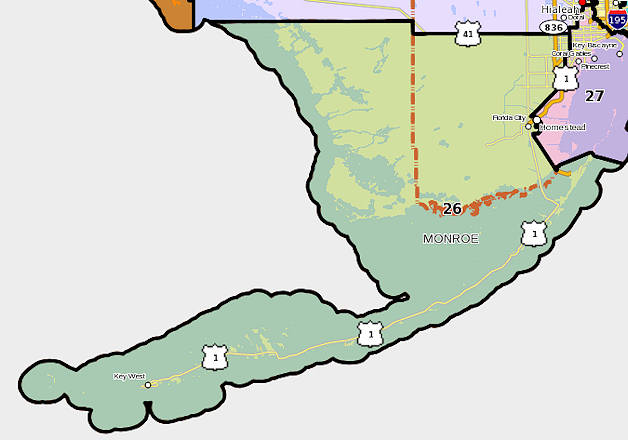
The contest between Democrat Joe Garcia and the scandal-ridden Republican incumbent David Rivera in the 26th Congressional District now looks like the most competitive in South Florida. The district includes southwest Miami-Dade and the Keys (see map), and redistricting has put it within reach of the Democrats. It’s two-thirds Hispanic, but almost half of those are non-Cuban.
This looks like a grudge match, since the two candidates ran against each other in 2010, when Garcia actually won in the election day and early voting ballots (i.e., the ones cast in person), but lost the election on the absentee ballots, which went 2-to-1 against him. Given the on-going absentee ballot fraud scandal, this still smells pretty fishy.
The race would be interesting if for no other reason than the two candidates’ positions on Cuba.
- Garcia, whose parents fled Castro’s Cuba in the 60s, has advocated relaxing restrictions on travel and remittances to Cuba. According to his website, he would “strive to get rid of bans that prevent people-to-people humanitarian aid from assisting the families of dissidents and political prisoners on the island.”
- Rivera, whose Cuban background is a bit murky (see below), built his political career on the traditional hard line on Cuba, and has attacked the Obama administration for loosening travel restrictions. Yet his congressional website says almost nothing substantive about Cuba, and his campaign website oddly does not mention Cuba as an issue.
Both Garcia and Rivera worked for Jorge Mas Canosa’s ultra-hardline Cuban American National Foundation, but Garcia’s views have evolved somewhat, while Rivera’s apparently have not. If, as some observers believe, the Cuban-American community is ready to embrace a more flexible policy toward the Castro regime, then this race might provide some evidence of that.
Rivera’s official biography is strangely devoid of any of the references to family and the circumstances of his upbringing that politicians normally provide, aside from the fact that he was born in New York City in 1965. The bio is a blank between birth and graduating from college (FIU) and makes no mention of his parents.
I don’t know if Rivera’s parents were Cuban refugees or not, but since he has hitched his political fortunes to the hardline Cuban exile political machine, you would think his bio would mention it if they were. The Almanac of American Politics refers to him as “a child of Cuban exiles.” A Google search turned up no references to his father, and we know about his mother, Daisy F. Magarino (aka Daisy F. Rivera), mainly because she (or companies she is involved with) have turned up in investigations of Rivera’s use of campaign funds. One Daisy F. Magarino graduated from George Washington High School in Manhattan’s Washington Heights in 1960, so if that is the same person, it seems rather unlikely that she would have fled the Castro regime which came to power only a year earlier. Okay—benefit of the doubt—maybe it was his father, who according to the Almanac of American Politics, was a New York taxi driver who was divorced from Rivera’s mother when little David was two years old.
I don’t mean to get all “birther” about this and mention it only because Rivera’s bosom buddy, Marco Rubio, got into a patch of trouble by claiming that his parents were political refugees from communist Cuba when in fact they left Cuba in 1956—well before Castro took power or even seemed likely to do so. And Rivera has proved willing to include a little fiction in his curriculum vita, claiming to have worked for the US Agency for International Development, which denied any record of his employment.
Of course, this campaign isn’t really about Cuba, or any other national issue. It’s about the scandals that follow Rivera like a bad smell. The scandals are so numerous and complicated that it’s hard to keep track of them all. If you want to read chapter-and-verse in painstaking detail, check out this report by the organization Citizens for Responsibility and Ethics in Washington (CREW), which has put Rivera on its “Most Corrupt” list. (And, no, the others are not all Republicans.) Or check out Eye on Miami’s archived posts.
But here is a brief synopsis:
- Allegations raised in 2002 and again in 2010 by Rivera’s Republican primary rivals that he was the David M. Rivera named in a domestic violence complaint and request for a restraining order by Jenia Dorticos in 1994. Rivera (the politician) denied that he was the person named in the complaint, and Dorticos later claimed that she didn’t know Rivera the polician, though the press dug up indications that perhaps she actually might have.
- The bizarre 2002 incident in which a car driven by Rivera (then running for the state legislature) ran down a delivery van in the middle of the Palmetto Expressway. Rivera reportedly released a statement saying that he wanted to pull the truck over to “retrieve a batch of his own campaign flyers” that were on the truck after he learned that the mailing company was also producing flyers for his opponent. (Makes perfect sense, doesn’t it?)
- A threatened foreclosure in 2010 on a house Rivera had purchased with his BFF Marco Rubio in Tallahassee when both were in the state legislature. The pair reportedly failed to make payments on the interest-only mortgage, and Deutsche Bank started foreclosure proceedings. But then it all went away.
- False statements regarding outside income sources on sworn statements required as a state legislator. These involved Rivera’s claim to have worked for USAID (see above), which the agency denied. It also involved claimed payments from other companies, including his mother’s firm Millennium Marketing, which reportedly was inactive at the time.
- Charges prepared by the Miami-Dade state attorney on 52 criminal counts involving racketeering, petit theft, grand theft, money laundering, and illegal campaign expenditures. This was a big one and involved, among other things, alleged misuse of campaign funds for personal purposes, and payments totaling more than $510,000 allegedly made by the Flagler Dog Park (now the Magic City Casino) to Millennium Marketing (purportedly managed by Rivera’s 70-year-old mother) to handle a campaign to win voter approval for Vegas-type slot machines. The first payment was made in December 2006 (when Rivera was in the state legislature) and the referendum passed in January 2008; the remaining payments were made in February and March 2008. The case never went forward, reportedly because the statute of limitations had expired, which raised other questions in itself. But the Herald reported: In a memo wrapping up their case, Miami-Dade prosecutors said Rivera “essentially live[d] off” campaign contributions for almost a decade while serving as a part-time state lawmaker, paying mortgages on four different properties and jetting around the globe though he never held a full-time job or earned more than $28,000 a year.
- Mysterious payments allegedly made in 2006 by the “Republican National Hispanic Assembly” to Rivera’s mother’s company Millennium Marketing Strategies. According to state records, the company went dormant in 2001, and his mother told prosecutors that Millennium was “almost a non-existent company” and she couldn’t recall any work that the company did.
Rivera managed to wriggle his way through all of these like a greased pig, but may finally have overreached with the latest scandal, which allegedly involved financing a fake “Democratic” candidate to run against Joe Garcia in the Democratic primary election. As usual, the story is complicated, but includes such juicy details as payoffs in envelopes stuffed with $100 bills and a disappearing key witness—so far. The problem is that this escapade could have violated federal election laws, and the FBI has more resources and is less likely to be constrained by political pressure from pursuing the case than Florida state and local law enforcement. A federal grand jury will be hearing witnesses in the case, which almost certainly will drag on beyond the election.
A reasonable person wouldn’t require a criminal conviction to conclude that Rivera looks crooked as hell and shouldn’t be in the US Congress. But this is Florida. He has raised a lot of money—Eye on Miami lists some of the donors. Incredibly, it’s still possible that he might win. I mean, jeez, what does it take???
I’ve been pretty much transfixed by national politics in the last few weeks, but a front-page story in the Miami Herald grabbed my attention this morning.
“A Citizens committee moved Thursday to advance a new $350 million program aimed at incentivizing private insurers to take over policies from the state’s largest insurer. The full board is expected to approve the plan Friday and homeowners could begin to be shifted out of Citizens in December.”
The proposed “surplus note” program would take money from Citizens’ $6.2 billion reserve fund and lend it at 1.6% interest to private insurers who would agree to take over existing Citizens’ policies and keep them for 10 years. According to the Herald, the 20 year loans would be interest-only for the first three years and would be “forgivable” if hurricanes hit Florida. Citizens’ CFO Sharon Binnum said that 20 percent of the loan could be forgiven each year if there is a hurricane. “If there is a storm in any one of the first five years…there’s an opportunity for the [insurers] to have some [debt] relief.”
The proposal has been cooked up by the Citizens’ board of directors without input from or approval by the state legislature or the public as part of its effort to dump hundreds of thousands of homeowners’ policies into the hands of private insurers. As the Herald notes: “In the last year alone, Citizens has raised rates, slashed coverage, and denied policies in an attempt to make itself less attractive and prop up the state’s limited private market.
There are so many things wrong with this, it’s hard to know where to start. Basically, the Board wants to take money that policy holders have paid into the reserve fund for insurance protection and essentially give it to selected private insurers to bribe them to insure homeowners, which ostensibly is the function for which the insurance companies exist. The private companies get the money at ridiculously low interest and pay back no principal for three years. Better yet, hypothetically, if a hurricane hits anywhere in Florida three out of the next five years—and the odds of that happening are pretty good—they would not have to repay 60% of the “loan” principal ever.
In other words, the private companies get the money and the public assumes the risk.
Then there’s the question of whether the private insurers would ever pay up in the event of a major hurricane. The track record on this point is not reassuring. State Senator Mike Fasano noted that Citizens’ could give money to private companies that go bankrupt without paying back the loan. And as the Herald notes: Program documents from Citizens acknowledge that the company may not have the power to enforce its contract with a private company that becomes “financially impaired.”
Moreover, the selection of companies that would get this opportunity has been anything but transparent. State Rep. Frank Artiles (R-Miami) claimed that the eligibility rules were written to exclude all but a few privileged insurers who are well represented by lobbyists in Tallahassee.
More fundamentally, this proposal really reveals how much the mission of Citizens’ Insurance has been perverted by its current board. Its priorities are clearly to minimize risk and support the interests of private insurance companies, not to protect Florida homeowners. And the responsibility for this rests squarely with Governor Rick Scott. South Florida residents and our representatives should be raising a stink about this.
I hate to keep harping on this issue, but the hits just keep coming.
Update: Apparently, I’m not the only one who thinks this is indefensible. See this post at Discourse.net.
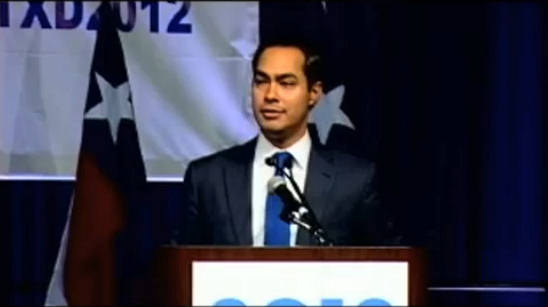
San Antonio Mayor Julian Castro
Okay, I know this post is totally off-theme for this blog, but I want to say this anyway.
My native state of Texas hasn’t given me much to be proud of for quite a long time, but tonight it did. I just watched San Antonio Mayor Julian Castro give the keynote speech at the Democratic National Convention, and it blew me away. It had me both fist-pumping and wiping tears away. It was inspiring! This guy is a star!
What was so striking to me was when the cameras panned around the crowd and showed us what America really looks like today. What a contrast to the collection of mean-spirited haters and liars that gathered in Tampa last week. And what a rebuke.
Julian Castro got the bases loaded, and then Michelle Obama knocked one out of the park. The Democrats are off to a great start. Hope they can keep the momentum building.
I’m old enough to have voted for Hubert Humphrey in 1968. I missed by only a few days being old enough to vote for LBJ in 1964 (you had to be 21 in those days). I lived through the Freedom Rides and the Birmingham bombings, several assassinations, Watergate, the Vietnam War, the OPEC boycott, Iran-Contra, the Contract with America, Monica Lewinsky, and the phantom weapons of mass destruction that gave George W. Bush the pretext to invade Iraq.
But I think I have never seen such utter lunacy and mendacity in American politics as was on display last week in Tampa at the Republican National Convention. Nor have I ever seen as stark a divide between two visions of America. This post is a bit off-theme for this blog, but I felt compelled to set down the reasons you should choose one of them.
You should vote for Barack Obama and the Democratic Party if:
- You don’t want Social Security to be destroyed. The reason Social Security works is that almost every American is in the system, and it does not depend on the ups and downs of the stock market. It’s not meant to be anyone’s whole retirement plan (although for a lot of folks, that’s what it is), but if it’s privatized then the value of the benefit becomes uncertain. Yes, the funding needs to be strengthened, but if people can opt out, it will weaken both the financial underpinning and the political support for Social Security to the point that the program will become expendable, which is exactly what the Republicans want.
- You don’t want Medicare to be destroyed. Same principle as above. Medicare works. It’s more efficient than private insurance. People like it. The Obama program does not cut benefits, despite the lies being spread in Republican political ads. So why would you want to change it to a voucher program that would give seniors an—unspecified—amount to apply to private insurance that would cost them more? Because the end result will be to eviscerate Medicare by removing future participants from the program. And, yes, it would adversely affect seniors who are already under Medicare.
- You want to see a balanced budget in your lifetime. Republicans don’t really give a shit about balancing the budget, they just want to “starve the beast” by stopping funding for non-military government programs. The last time we had a surplus was under Democrat Bill Clinton, but the Bush administration destroyed that by starting an unfunded war in Iraq while granting a huge tax cut, mostly for the wealthy. As Dick Cheney famously said: “Reagan proved that deficits don’t matter.” Most of the “crushing” additions to the national debt that Republicans moan about are a direct result of Bush policies. The “Ryan Plan” is pure Ayn Rand fantasy which would actually swell the deficit, while Romney calls for further tax cuts for the rich and cannot show how he would balance the budget. The only way that can happen is by getting wealthy Americans to pay more, which is what Obama is proposing. The Democrats are also willing to put the military budget on the table, realizing that the US probably doesn’t really need to spend more on defense than the next 20 largest countries combined.
- You don’t think that the best response to economic catastrophe is to do nothing. When the Bush team realized the depth of the abyss their policies had pushed the country into, it was the Democrats who stepped up and passed a bill that prevented a collapse of the banking system with almost no Republican support. After Obama took office, Republicans fought tooth and nail every measure proposed to keep the economy from flat-lining. A government economic stimulus has been the standard policy in every recession since the Great Depression, but this time the GOP was uniformly against it. The Obama stimulus package, which Republicans love to vilify (though they didn’t mind taking the money), kept teachers, police, firefighters, construction workers, and others from losing their jobs, even though most economists think it was too small to do what was really needed. Contrary to the Republican mantra, most economists agree that the Obama stimulus worked better than the one the Bush administration applied in 2002 (the first Bush recession—remember?) because it emphasized spending rather than tax cuts for businesses. It also saved the American automobile industry, which Romney famously wrote should be allowed to die.
- You don’t think the rich should keep getting richer at the expense of the middle class and the poor. One result of the Bush tax cuts has been accelerating concentration of wealth among the very richest in this country, while the share of the middle class and poor has declined. The Republicans have staunchly defended these entitlements for the rich, and the “Ryan Plan” would lower their taxes even further. Obama has proposed letting the two highest tax brackets (currently 33% and 35%) revert to their pre-2001 levels of 36% and 39.6%. Those would apply only to income in excess of $250,000. Not really a radical proposal, but you’d never know that by listening to the Republicans howl about it.
- You think all Americans should have access to affordable health care. I don’t know why Republicans are so opposed to Obamacare (as they contemptuously named it), unless they believe their own lies about it. There is no “government take-over” of health care—the private insurance lobby made certain of that! It doesn’t put “government bureaucrats between you and your doctor” (those would be the private bureaucrats employed by health insurance companies). Health care in the US is great if you have money, but it is very expensive and inefficient in comparison with other developed countries, and we rank shockingly low in overall public health measures. “Obamacare” may not change all of that, but at least it will extend coverage to millions of people who don’t now have it and include those who couldn’t get coverage because of “pre-existing conditions.” It’s a big positive step, and I think it would be popular if only the administration would do a better job of selling it and countering the right-wing slander.
- You think women should be able to make their own choices about abortion and have full access to contraception. I don’t believe anyone decides to have an abortion lightly, but even if you don’t like the idea of it, there are circumstances where such a decision can be justified. The Republican position is now that abortion should be illegal in all cases. If implemented, it wouldn’t totally prevent abortions, but it would make them expensive, illicit, and dangerous—just like in the bad old days—and inaccessible to women of limited means. And if you don’t like abortions, why would you be against contraception? Trying to impose restrictions based on religious conviction comes awfully close to imposing a “Christian” (or at least Catholic) version of sharia.
- You think climate change is real and the environment needs protection. The Republican Party is collectively in deep denial regarding climate change—by refusing to accept the scientific consensus that it is happening and accelerating and by fighting any policy changes that might mitigate the effects. This should be of particular concern to South Florida, where we all live only a few feet above sea level and are particularly threatened by melting polar ice caps and sea level rise. This goes hand-in-hand with the GOP’s fundamentalist base which places religious belief above science and with the Republicans’ quasi-religious (dare I say idolatrous?) faith in unimpeded capitalism, which means that profit always trumps environment. The EPA and its “job-killing” regulations are particularly hated, and wherever the GOP has taken over state governments—as in Florida—local environmental enforcement has been gutted. If the Republican platform were enacted, it would roll back progress made since the 1970s on air and water quality.
- You don’t think the noun “American” only refers to white people. Despite the GOP’s best efforts to showcase a few blacks and Hispanics at their convention (I must have missed Allen West—or was he just too crazy to put on camera?), the “party of Lincoln” has become the “party of Jefferson Davis.” The GOP is now the Angry White People’s party, as South Carolina queen Senator Lindsey Graham all but admitted. The just-below-the-surface racism that permeates the GOP—particularly now that the Tea Party Taliban has taken charge—keeps bubbling up to the top. They have (mostly) learned to code the racist language so that it’s not quite explicit, but still everyone gets it. African-Americans certainly get it, and recent polls show virtually NO support among blacks for the GOP. Hispanic-Americans, turned off by the party’s hostility to immigrants, are not far behind. The GOP has responded not by modifying its platform to appeal to minorities (which would piss off its racist base), but by implementing restrictive election rules in states they control (like Florida) designed to impede minority voting.
- You really can’t see why a gay couple getting married would threaten a straight couple’s marriage. That’s because it doesn’t. In states where gays can marry, it has had absolutely no impact on straight marriage—and really, how could it? Opposing gay marriage is just a way of perpetuating anti-gay prejudice. When one lives in an area like South Florida, where gays are widely accepted and out all over the place, it’s easy to forget that in so many parts of this country being gay is a very lonely—and too often dangerous—existence. When Obama ended Don’t Ask, Don’t Tell to allow gays to openly serve in the military, nothing happened! But the Defense of Marriage Act still denies gay couples rights that straight couples take for granted, such as being included on a spouse’s health insurance. The Republicans use hostility to gays as a wedge issue to motivate their base, while the Democrats have moved sharply in the opposite direction. That choice couldn’t be clearer.
- You think the poor and unemployed deserve some help. Republicans staunchly defend tax breaks for the rich, but their attitude to the poor is basically: “Get a job, you lazy bastard!” The problem is that most poor family heads do have jobs, but the jobs don’t pay crap. And millions of others are only a pink slip away from plunging into poverty. Earlier this year, Paul Ryan smirked that the social safety net was becoming “a hammock”, while calling for deep cuts in food stamp benefits. The “Ryan Plan” would take nearly two-thirds of its non-defense budget cuts from programs that serve the poor, including Medicaid which would take a major hit. (In case you’re wondering, the “plan’s” defense budget cuts are approximately zero.)
- You think working immigrants and their children should have a path to legal residency and citizenship even if they got here illegally. Okay, raise your hand if you’re absolutely sure that the guy who cuts your grass or cleans your pool or picks the veggies you eat is legally in this country. Do you really think the woman who cleans your apartment should be sent back to El Salvador if she can’t produce a green card? Or that her children, who probably speak English as well as yours, should be denied a public education? Well, the Republican platform opposes “any forms of amnesty” for illegal immigrants, and calls for “humane procedures to encourage illegal aliens to return home voluntarily.” Romney has endorsed “self-deportation” and said he would veto the “Dream Act” which the Obama administration has proposed to help illegal immigrants who arrived as children to acquire legal status. And of course, Republican Governor Jan Brewer of Arizona has become the poster child for GOP hostility to Latino immigrants.
- You believe that good public schools and access to higher education are critical to the future of this country. US primary and secondary education is falling behind the rest of the developed world. The reasons are complex and the remedies aren’t simple, but starving the public schools is not the solution. The Republicans have become increasingly hostile to public education, partly because they hate the teachers’ unions, but mostly because it is, well, public. The GOP preference is to support home schooling and vouchers (paid with public tax money) to move students into private and religious schools, while cutting funding for public schools and programs like Head Start, childcare, and job training. More than half of children born in the US now are minority, and most of them will be going to public schools. The US needs an educated workforce, and that means providing a decent education to all kids—not just those in private schools. It also means giving lower income kids a way to pay for college, which is what Pell Grants do. But the GOP has been trying to cut Pell Grant funding, and the “Ryan Plan” would eliminate over a million such grants over ten years. The GOP platform also calls for ending government student loans, but having the government guarantee loans from private lenders—you know, the private lenders get the profits, but the government assumes the risk. That’s Republican capitalism for you!
- You think Obama has done a good job on foreign policy. Romney and the GOP in general have clammed up about foreign policy because they have nothing to say. In an interview after her convention speech last week, Condi Rice couldn’t come up with anything when asked how Republicans would do things differently. (True, the rabid right wants the US to nuke Iran—or get the Israelis to do it for us.) Basically, things are going pretty well. Our troops have left Iraq, and the process of extricating ourselves from Afghanistan has begun. Kaddafi is gone without a single US casualty, and, oh yeah, Osama bin Laden is dead. Obama has restored our credibility with our European allies, and people there don’t hate us anymore—remember how it was four years ago? Anyone?
- You don’t want a Supreme Court dominated by more justices like Scalia, Thomas, and Alito. I would have added Roberts to this list except for his surprising vote on the health care act. The next president will likely be able to nominate 2 or 3 justices who will be on the Supreme Court for another 20 years or more. Their opinions will shape the country’s laws for decades to come. This court has already done irreparable damage with the Citizens United ruling that has corrupted the political process beyond belief.
Well, I have more reasons, but that’s enough for now. So let’s simply sum it all up with this one:
16. You just don’t want to support a party whose appeal is based on ignorance, bigotry, mendacity, and greed.
 TrumpWorld for Beginners