
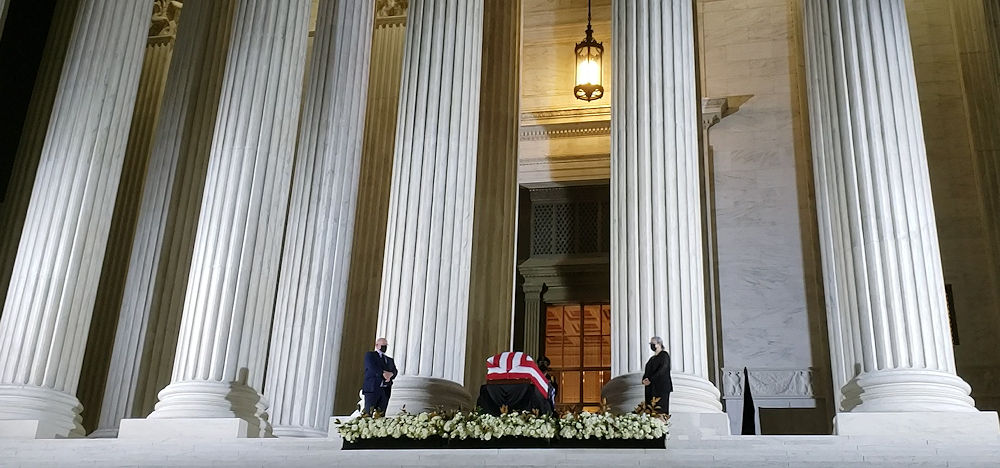
Last night my partner and I were among thousands of people who lined up to pay respects to Ruth Bader Ginsburg as her body rested on the steps of the Supreme Court in Washington, DC. That immense outpouring of respect, grief, and love by ordinary people was happening because of what she represented: The expansion of justice and equality against the entrenched forces of privilege, money, and caste. Fundamentally, that’s what the 2020 election is about.
This morning, I watched the ceremony where her body was placed in state in the rotunda of the Capitol. The Republican leaders of the House and Senate were absent. Had they been there, the hypocrisy would have been unbearable, because as the ceremony was going on they were preparing to ram through a yet-unnamed replacement for Ginsburg before the presidential election less than 6 weeks away. Trump, of course, was absent as well. The day before he had made a perfunctory appearance at the Supreme Court, where he was greeted by the crowd with a chorus of boos and chants of “Vote Him Out”.
The network then cut away to an anguished protest in Louisville, Kentucky over the failure of law enforcement there to bring any charges against police who killed an innocent black woman, Brionna Taylor, in her own apartment. The message was clear. There will be no accountability. Some people can be killed with impunity. This came after a summer of nationwide protests prompted by the police killing of George Floyd against racially-motivated police violence to which Trump’s response was to dismiss the validity of the grievance and double down on police repression.
That’s this election in a nutshell. Trump and the Republicans are doing everything possible to suppress voter turnout from targeted purging of state voter rolls to destroying the Post Office which will have to deliver an unprecedented numbers of mail-in votes. Trump, of course, continues his campaign to impugn the credibility of the election itself, setting up a pretext for refusing to accept the results if he loses. This, too, is a question of justice and may well wind up in the Supreme Court.
The basic theme of American history is ferocious resistance by reactionary forces to any expansion of rights and justice to those who had been denied them. After eight years in which a black man had violated American caste restrictions by winning the White House and expanding access to health care, the Republican Party declared its policy of implacable resistance and obstruction, and Trump rode that into the presidency. The result has been the most massive epidemic of official lawlessness, corruption, and malicious destruction since the Civil War.
It all comes down to questions of justice. Do we want to live in a country where cops can bust into your home and kill you without accountability, or arrest and shoot you without provocation? Where the president and his officials can ignore legal subpoenas and exploit their offices for personal gain? Where the tax laws are skewed to protect the fortunes of the wealthy while programs that protect low income Americans are starved of funds? Where adherents of certain religions can impose their doctrines on everyone? Should good health care depend on your income? The list could go on and on. Virtually every major issue shaping this election hinges on a vision of justice.
Ruth Bader Ginsburg represented a expansive vision of justice, using the force of government and the courts to help people who had been oppressed and relegated to the margins of society, often by the force of law: black folks, gays, women, immigrants, asylum seekers, etc. If Trump succeeds in imposing his choice to replace her, the result will move the country in the opposite direction.
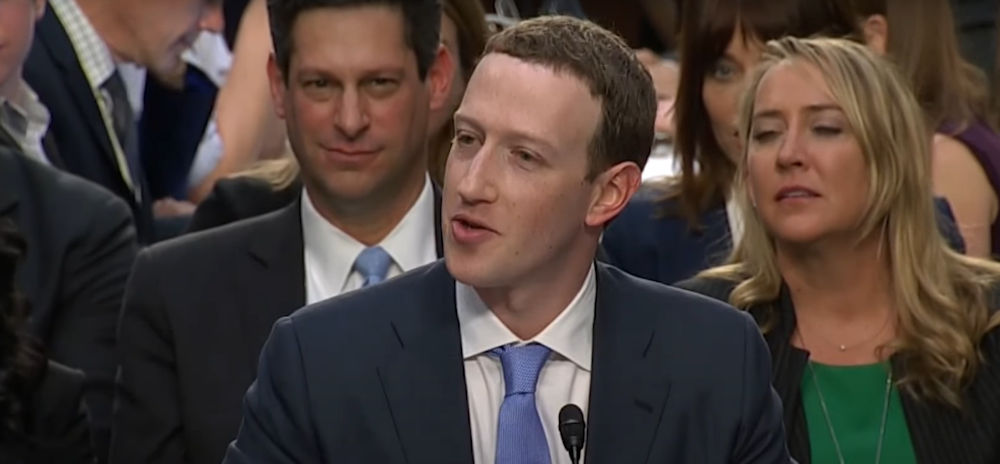
Netflix has just released the new documentary The Social Dilemma by Jeff Orlowski in which a series of Silicon Valley apostates argue that social media like Facebook, Google, Twitter, YouTube, etc. have effectively changed human behavior. The result, they argue, is increased anxiety, anomie, distrust, fear, social isolation, and political polarization which threaten democracy and exacerbate economic inequality throughout the world. These are the unintended consequences of social media platforms designed to be incredibly efficient money-making machines that manipulate users by predicting our responses with uncanny precision. We are the product they are selling.
It’s a compelling argument because we all see the evidence everywhere we look. Who hasn’t had the experience of doing a Google search and seeing a related ad pop up on our Facebook feed within seconds? Why do we see posts from the same limited number of people and little else? Because the algorithms used by social media know what we want to see and serve it up specifically tailored to us relentlessly. When we do a Google search, the results it delivers depend on the data Google has on us, and Google knows pretty much everything about us. If social media is where we go for our information, then all we get is we want to hear. The system is both much more subtle and more complex, but this gets to the general idea.
Facebook and the others sell us to political manipulators who bombard us with material exquisitely crafted to push our buttons. That’s what happened in 2016 (see another excellent documentary The Great Hack), and they have only gotten better at it since then. The Social Dilemma focuses mostly on Facebook, perhaps because it’s the biggest and Mark Zuckerberg is so easy to despise, but all of the platforms are doing essentially the same thing. For my money, Twitter is the most pernicious of all, and I avoid it like the plague.
I was among the last people on the planet to open a Facebook account. My concern then (and still now) was with the risk it posed for identity theft. I had long conversations with a dear friend years ago who argued that Facebook was a way to have a real dialogue with people all over the country on critical issues. I was skeptical about that then. Then Trump got elected, and I wanted to do what I could to raise the alarm about what I was seeing. So I succumbed in hopes that Facebook would be a medium for amplifying that message. Looking back, I think both my friend and I were naive. We didn’t persuade anyone who wasn’t already persuaded. We just got locked into a feedback loop of people with similar opinions. I now understand at a personal level just how addictive it is. We are the ones being manipulated.
Recently, Facebook has the rep of being a platform for old folks, though the available demographic statistics don’t bear that out. (The biggest age cohort for FB users remains 25-34 year-olds. Some 88% of online users age 18-29 are on FB, versus 62% of online seniors 65+ and 72% age 50-64.) The company has lately taken a few token steps to limit its complicity in spreading disinformation, but continues to resist any systemic changes that might make a real difference. Like other social media platforms, their business model requires that.
So should we abandon Facebook now? Several of my friends have done that already and others have told me they’re considering it. How much is it worth to you? What do you really get out of it? Do you really need it to keep in touch with friends and family? Or is it something else? And how do you weigh that against the harm that it does to society? If you quit Facebook, are you also going to leave Instagram and WhatsApp, which Facebook owns? Are you going to quit Google? Is that even possible? Are we all too addicted to these private companies to stop supporting them? Honestly, I don’t know what I think at this point.
But by all means watch The Social Dilemma. And, of course, Netflix will then use that data to suggest other content that you might like…
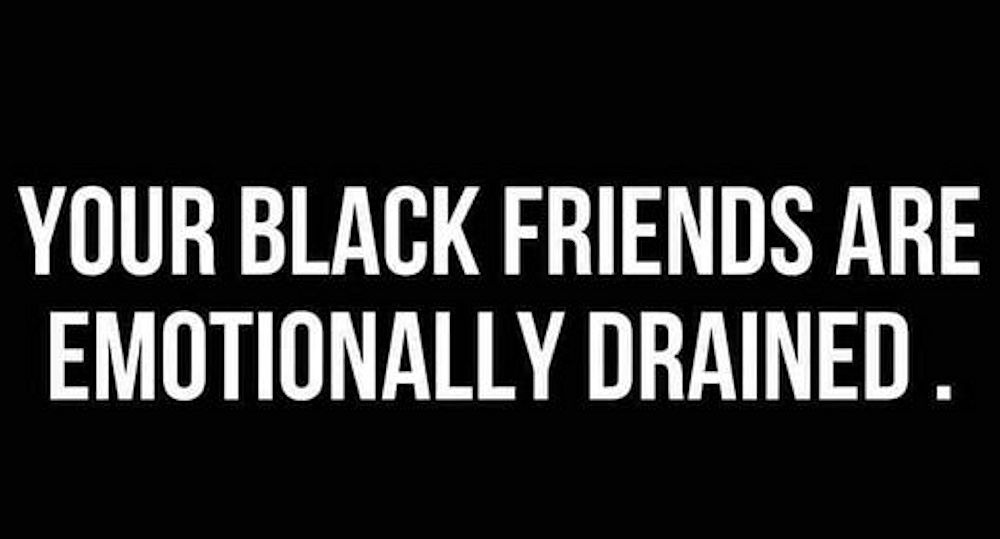
What a black friend posted on Facebook today.
WAR IS PEACE.
FREEDOM IS SLAVERY.
IGNORANCE IS STRENGTH.
Having just watched the Trump Party’s four-day festival of mendacity and corruption (aka the Republican National Convention), I think it’s time to add a fourth oxymoron to Orwell’s famous trinity: EXPLOITATION IS BENEVOLENCE.
What most stood out during the event was the mind-bending juxtaposition of a parade of African-Americans there to praise the benevolence of Donald Trump while party leaders were simultaneously making the mostly outrageously racist appeal to White America’s primal fear of black people.
The latter loomed as the principal theme of the convention. One after another, Trump’s acolytes took the podium to scream alarm that if Joe Biden won the election those people from the crime-ridden war zones of Democrat-run cities [i.e., black people] would be coming to destroy America’s idyllic [white] suburbs. There would be uncontrolled rioting in the streets, “mob rule”, and “no one will be safe in Biden’s America”, as Trump himself proclaimed. Rudy Giuliani could barely contain himself, calling–literally–for locking more people up and portraying New York City as a cartoonish Gotham City where criminals rule the streets and chaos reigns. The solution, repeated endlessly by speaker after speaker, was total support for the police.
The intended message was crystal clear: Black people are dangerous. Black Lives Matter means riots, looting, and burning down private property. The Democrats are the party of black people. Therefore Democrats want looting and rioting and sending black welfare queens to live in your safe white suburban neighborhood, bringing crime and who knows what else. Good white people will not be safe in their homes.
And all of this was taking place immediately following another grotesque police shooting of an unarmed black man, Jacob Blake, in Kenosha, Wisconsin. Then a 17-year-old white vigilante named Kyle Rittenhouse had his mom drive him and his long gun up from Illinois so he could prance around with his rifle threatening protesters in the demonstrations that followed, where he promptly shot and killed two people and grievously wounded another, and then was ignored by police until video of him emerged on social media. Young Kyle was quickly adopted as a hero by such luminaries of right-wing America as Tucker Carlson and Ann Coulter, who gushed that she wanted him “as my president” on the same day that Trump went full-on “American carnage” in his acceptance speech. No one at the RNC condemned or even mildly admonished the Kenosha police; their denunciations were entirely directed at those protesting police violence.
Then there was the cognitive dissonance of a series of black Americans giving Trump glowing testimonials about how he had helped them. If you had just arrived from Mars and were watching the convention on TV, you could be forgiven for assuming that the Republican Party was mostly African-Americans or other people of color. I won’t speculate on the motives of the black folks praising the most racist president since Woodrow Wilson, but the general tone of their speeches (and indeed of the entire convention) was one of a grateful subject expressing gratitude for some favor gratuitously bestowed by a benevolent sovereign. It’s equivalent to fulsomely thanking the boss who has been paying his workers starvation wages all year for giving them a Christmas turkey.
The stress of the physical and emotional and political abuse of black Americans is clearly taking a toll. Black journalists and analysts commenting on the RNC were visibly struggling to contain their hurt and fury at what they were witnessing and to maintain their professional composure. As several people observed, the point of having black folks praise Trump wasn’t really to persuade black voters to vote Republican, but rather to give white voters who might have qualms about Trump an excuse to vote for him anyway.
The sports world reacted immediately. The players of the Milwaukee Bucks refused to play, and then the entire NBA suspended its playoff games. Several other sports leagues including the WNBA and MLB suspended play as well. A series of black sports stars spoke up, expressing their dismay and outrage at what is happening. Clippers coach Doc Rivers said, “How dare Republicans talk about fear. We’re the ones that need to be scared. We’re the ones having to talk to every Black child—what white father has to give his son a talk about being careful if you get pulled over? It’s just ridiculous…It’s amazing why we keep loving this country, and this country does not love us back.” Charles Barkley said, “It’s exhausting being black in America.”
What I’m seeing from some black friends on social media is akin to despair.
I admit that I share that sense of despair. As a white man, I have never had to deal with the daily indignities that White America dumps on black folks, but my eyes have been gradually opened to the pervasiveness of racism in our country. Even so, until Trump won I really thought that things were getting better.
What feels different now, is that for the first time in my lifetime we have both a president and a Republican party that openly base their appeal on racial divisiveness. They are actually willing and often eager to inflame racial divisions if that’s what’s needed to stay in power. Before Trump, white nationalists had to stay in the shadows, but now his winking approval has enabled them to operate in the open. The message to racist cops and gun-packing white nationalists is: Don’t worry, we got your back.
They’re not quite mainstream, yet. That’s why Trump and his supporters still need to pretend to care about people of color and put on a show of faux inclusiveness as seen at the RNC. But it’s really just another form of contempt, because it says either that they think black folks won’t see through their hypocrisy or they just don’t care if they do or not because the show isn’t for them anyway.
It feels like we are at a watershed. I wish I felt some confidence about which way things will go.

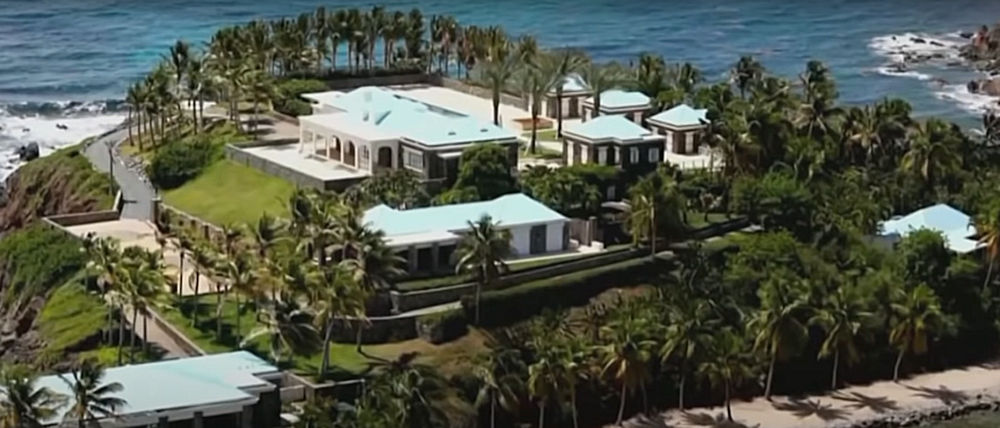
Epstein’s private island
The Friends of Jeffrey Epstein
Jeffrey Epstein’s 2019 re-arrest may finally have made him socially radioactive, but his 2008 conviction in Florida did not seem to have damaged his social acceptability too much. His plea deal made the front pages in the Palm Beach Post and the New York Post, but only rated placement on page 1 of the Business Section of the New York Times. It was all pretty discreet, considering, and most people probably just figured he had gotten caught with a couple of young hookers, so not that big a deal.
Most important, the deal kept his fortune (aside from legal fees), property, and business ventures intact. Even if he had to sleep in a special wing of the Palm Beach County jail for 13 months, six days a week he was out and about to his West Palm office and elsewhere and could visit freely with business associates and personal friends who came calling. Five months of his sentence was dropped, so by August 2009 he was able to go to his Manhattan mansion or to his private island in the Virgin Islands whenever he pleased.
Quite quickly, Epstein was again mingling in New York society. Consider this item from gossipy Page Six from August 24, 2010 recounting Epstein’s appearance at a special screening of the movie Wall Street: Money Never Sleeps in Southampton:
“Guests included hedge funder Jeffrey Epstein, who was ‘greeted warmly by guests’ after he completed a prison sentence in June. ‘It was the first time he has been out in two years, but nobody blinked he was there,’ a witness reports. ‘He was chatting to Jonathan Farkas, Wilbur Ross and Leon Black. He was sitting right near Rudy Giuliani.'”
[Farkas is an heir to the Alexander’s Department Store fortune, Wilber Ross became Trump’s Secretary of Commerce, and Leon Black is a billionaire owner of a private equity firm who, according to the NY Times, once employed Epstein and had various connections to him dating to the late 90s.]
Or this, from The Daily Beast:
“On the evening of December 2nd, 2010, a handful of America’s media and entertainment elite—including TV anchors Katie Couric and George Stephanopoulos, comedienne Chelsea Handler, and director Woody Allen—convened around the dinner table of convicted sex offender Jeffrey Epstein. It wasn’t just any dining room, but part of a sprawling nine-story townhouse that once housed an entire preparatory school. And it wasn’t just any sex offender, but an enigmatic billionaire who had once flown the likes of former President Bill Clinton and former Israeli Prime Minister Ehud Barak around the world on his own Boeing 727. Last spring, Epstein completed a 13-month sentence for soliciting prostitution from a minor in Palm Beach. Now he was hosting a party for his close friend, Britain’s Prince Andrew, fourth in line to the throne.”
Epstein had hired publicist Peggy Siegal to ease his re-entry, but the one who really greased the tracks was Ghislaine Maxwell, who had emerged unscathed from the Florida scandal. According to the Daily Beast story, “The conventional wisdom among his friends was that Epstein has been victimized by greedy, morally dubious teenage girls and unscrupulous lawyers.”
Or this, from The Hollywood Reporter:
“Even in the post-#MeToo era, Epstein, 66, frequently attended industry events, like the Gotham Awards in November 2017. Amid a climate where figures including Harvey Weinstein and CBS’ Leslie Moonves had instantly become persona non grata for alleged misconduct, Epstein had been convicted and still enjoyed film-world access. As he traveled behind the velvet rope with ease, his alleged co-conspirator Ghislaine Maxwell was also embraced…Despite well-publicized claims that she wrangled teen girls for Epstein and partook in sexual abuse, Maxwell in recent years has been spotted at top-tier awards-season parties in New York and Los Angeles, where she hobnobbed with a pre-scandal Weinstein, Elon Musk and Jeff Bezos. She even attended the 2014 Vanity Fair Oscar bash, posing with the magazine’s editor, Graydon Carter.”
Epstein also cultivated friends in the scientific and academic community with large donations. According to the NY Times, Epstein launched a PR campaign around 2013, placing self-generated articles describing himself as “a selfless and forward-thinking philanthropist with an interest in science” on websites like Forbes, National Review and HuffPost. He gave money to MIT and to Harvard, which had accepted over $9 million from him before his 2008 conviction. But other donors who Epstein introduced to Harvard faculty members gave $9.5 million between 2010 and 2015, and Epstein frequently visited an office given him on campus at the Program for Evolutionary Dynamics, a research center created in 2003 with $6.5 million from Epstein. It wasn’t until after Epstein’s 2019 re-arrest that the universities again started looking closely at their ties with him, especially after journalist Ronan Farrow published details in The New Yorker. Epstein also was still a member of the prestigious Council on Foreign Relations until 2009 when his membership lapsed for “nonpayment of dues”.
But it wasn’t quite like the good old days. After his release from detention, Epstein was fighting lawsuits for damages brought by his alleged victims, and tantalizing details about his ties with the rich and famous were continuing to spill out. In January 2015, the on-line blog Gawker published the flight logs for Epstein’s private 727, revealing that lots of bold face names had flown on the so-called “Lolita Express” back in the day, including Bill Clinton, Alan Dershowitz, and Prince Andrew. That same month, Gawker published Epstein’s “little black book” containing the phone numbers and emails (redacted) of scores of famous and semi-famous people with whom he may or may not have had ties. After his 2019 arrest, New York magazine published an annotated list of people included in the “black book”, observing that:
“Collectively, these documents constitute just a glance at the way society opened itself to Epstein in New York, Hollywood, and Palm Beach. ..Though some observers have likened Epstein’s enigmatic rise as a glamorous social magnet to that of Jay Gatsby, a more appropriate archetype may be the fixer, sexual hedonist, and (ultimately disbarred) lawyer Roy Cohn.”
The sex offender label did make some people reluctant to do business deals with him. According to the Miami Herald, when Epstein decided to buy a large parcel of land on Great St. James Island (just across the water from his home on Little St. James in the Virgin Islands) he had to set up a shell company because the owner, a wealthy Dane, was unwilling to sell to him. The company was set up in the name of a wealthy Dubai businessman, who confirmed that Epstein had asked to use his name in an unspecified deal, but he said no. Epstein apparently did it anyway, and the purchase was completed in January 2016.
Donald Trump was among those important people who had been in Epstein’s orbit. So many photos and videos have emerged of Epstein and Trump together that there is no doubt that they knew each other a lot more than just casually from at least the early 90s until around 2007–i.e., during Epstein’s heyday. A video tape shows them partying at Mar-a-Lago in 1992, and other videos show them together and engaged in bro-style banter about women on other occasions. As the Washington Post reported, “Here they are, Epstein and longtime girlfriend Ghislaine Maxwell, Trump and his then-girlfriend, Melania Knauss, double dating at a celebrity tennis tournament at Mar-a-Lago. Partying with Britain’s Prince Andrew. Hanging out with National Football League cheerleaders. Dancing, laughing, palling around at a party Trump threw to celebrate his “freedom” after he divorced his second wife, Marla Maples.”
A 2000 profile published in Maximum Golf magazine describes Trump impatiently waiting at La Guardia for Jeffrey Epstein and Ghislaine Maxwell, who were hitching a ride on Trump’s plane to Palm Beach. A 2002 profile of Epstein in Vanity Fair, quotes Trump as saying: “I’ve known Jeff for fifteen years. Terrific guy. He’s a lot of fun to be with. It is even said that he likes beautiful women as much as I do, and many of them are on the younger side. No doubt about it — Jeffrey enjoys his social life.”
After Epstein’s 2019 arrest, Trump claimed that Epstein was never a member at Mar-a-Lago, but a new book titled “The Grifters’ Club” (authored by reporters from the Miami Herald and Wall Street Journal) has unearthed evidence that he actually was a member for more than a decade until October 2007. According to the book, Trump expelled Epstein from the club after he allegedly hit on a teenage daughter of another member. If that story is accurate, that would have been more than a year after Epstein was indicted in Palm Beach County, something that was well-known in Palm Beach society.
Another version has it that the split was over competition to acquire an expensive beach property in Palm Beach in a bankruptcy auction. According to the Washington Post, the rift began in 2004 when both Epstein and Trump were bidding on the “Maison de l’Amitie”, which had previously been owned by Leslie Wexner, the retail magnate who had been Epstein’s most important patron and the only known client for his wealth management firm. Epstein wanted to live in the house; Trump wanted to flip it. Epstein bid up to $38.6 million, but Trump got the property for $41.35 million.
[Digression: The property sat unoccupied until 2008, when Trump sold it for $95 million (through a shell company) to Russian oligarch (“the Fertilizer King”) Dmitry Rybolovlev. At the time, the price of the sale raised eyebrows, because the Florida real estate market was already slumping. Also at that time, Rybolovlev was going through a spectacularly expensive divorce and was looking for places to stash his money. The Russian owner never moved in, and in 2016 the existing house was torn down and the property was divided into 3 parcels, each put on the market for $35-40 million. End digression.]
Typically, after Epstein was arrested again in 2019, Trump insisted that he barely knew him. “I was not a fan of his, that I can tell you,” the president said from the Oval Office the day after the arrest. Well, relationships come and go.
There’s a scene in the 2016 movie version of Absolutely Fabulous, where Edina and Patsy go on the lam, believing they had accidentally killed supermodel Kate Moss. When they get to the French Riviera, Edina exults, “We’re free! In the South of France, everyone’s a criminal!”
Kind of like Palm Beach. Or Wall Street.
Was Epstein a Spy for Israel?
In December 2019, a “bombshell” book titled Epstein: Dead Man Tell No Tales hit the stores just in time for Christmas. Among the most sensational allegations in the book was that Epstein and Ghislaine Maxwell were working for the Israeli intelligence agency Mossad to blackmail powerful people. The book claimed that the ‘honey trap” operation set up underage girls with politicians to squeeze them for information or influence for Israel. The source for the claim was Ari Ben-Menashe, who purported to be a Mossad operative and the handler for Robert Maxwell (Ghislaine’s press mogul father) who he claimed had spied for Israel and also that he had introduced Epstein and Maxwell into Israeli intelligence.
Ben-Menashe is an Iranian-born Israeli, who claimed to have served in Israeli military intelligence from about 1977 to 1987, and reportedly was a source for information about Reagan administration arms shipments to Iran, known as Iran-Contra. He wrote a book published in 1992 called Profits of War: Inside the Secret US-Israeli Arms Network. He was arrested in the US in 1989 for trying to sell aircraft to Iran, but was acquitted and then moved to Canada where he became a citizen. He also reportedly was a source for Seymour Hersh’s 1991 book The Samson Option: Israel’s Nuclear Arsenal and US Foreign Policy that revealed Israel’s nuclear weapons program and claimed that Robert Maxwell was an Israeli intelligence asset. In October 1991, Maxwell and his Mirror Group newspapers sued Hersh and his publisher in the UK for libel, but Maxwell’s death under mysterious circumstances (see Part 1) in November 1991 effectively ended the legal action which formally terminated in 1994 when Hersh and his publisher were awarded “substantial damages and an apology”.
A purported interview with Ben-Menashe in which he made his claims re Epstein and Maxwell had been published in September 2019 on the website Narativ, run by a former CBS and Canadian TV producer Zev Shalev, whose podcasts often focus negatively on both Epstein and TrumpWorld. This seems to be the earliest appearance of the Ben-Menashe story.
The three co-authors of Epstein: Dead Men Tell No Tales, Dylan Howard, Melissa Cronin, and James Robertson are all alumni or current employees of American Media, Inc., the parent company of The National Enquirer. When the book came out, the Enquirer headlined the story. According to a fascinating plunge into the seamy world of scandal journalism in the Columbia Journalism Review, the primary author Dylan Howard (who is Australian) “is best known as a scandal-ridden acolyte of Donald Trump. In the summer of 2016, he and [David] Pecker negotiated a $150,000 “catch and kill” payoff that buried the story of an affair between Trump and Karen McDougal, a Playboy Playmate. (Howard also helped arrange Trump’s 2015 payoff to Stormy Daniels, the porn star, even though it didn’t involve AMI.) After Trump’s election, Ronan Farrow reported in The New Yorker that Howard had worked with Harvey Weinstein, the movie producer, to help him discredit Rose McGowan, an actress who was accusing him of abuse.”
AMI’s CEO David Pecker went way back with Trump and famously worked hand in glove with him to kill negative stories about him and to flog sensational tales about his adversaries. According to the CJR story, “after Trump declared for president, the Enquirer changed course. It began running a few kinds of stories: One, nonstop pathological content about how Hillary Clinton was on the verge of jail or death. Two, unprovable scoops about Trump’s primary-campaign rivals (e.g., Ben Carson left a sponge in someone’s skull). Three, uncomfortably gauzy first-person tell-alls from Trump.” But the Enquirer’s sales slumped, “And then, suddenly, in the spring of 2018, it stopped. No more Trump ass-kissing. No more Hillary deathwatch. Thanks to the Justice Department—or, …, because ‘sales of issues covering politics had a fatigue factor’—it was back to good old kidnapped Suri Cruise and emaciated Nicole Richie. Everything snapped into place, as if the Enquirer’s maga era had been nothing more than a wavy-lined dream sequence.”
So…what is the game here with regard to Epstein? Is there a game? Or is it just plain old-fashioned exploitation and sensationalism? Could it even be true? After all, once in a while an Enquirer story has turned out to be a real scoop.
Mainstream news outlets like the Times, Washington Post, and WSJ pretty much ignored the book and the Ben-Menashe allegations, but right-wing organs and websites and British tabloids were all over it. Russia’s semi-official organ RT hopped on it, as well as the left-leaning UK publication Middle East Monitor. So, belatedly, did Fox News. Tucker Carlson’s The Daily Caller focused on the book’s allegations by Steven Hoffenberg that Epstein had been a celebrity spy for Mossad and was killed because he had become a liability. Hoffenberg had been a business associate of Epstein in the 90s in the Towers Financial Group, a Ponzi scheme that collapsed in 1993 losing $475 million for its investors. Hoffenberg pleaded guilty to fraud and went to prison; Epstein skated free. Hoffenberg claimed that Epstein then evaded punishment because of his ties with intelligence agents from Saudi Arabia, Israel, and Russia.
The Observer, owned by Jared Kushner, published an article in July 2019 that concluded: “It appears that Jeffrey Epstein was involved in intelligence work, of some kind, for someone—and it probably wasn’t American intelligence either.” It noted that Ghislaine Maxwell’s father, “a swindler and a spy”, was suspected by “British counterintelligence” of doing work for Russia’s KGB, “while pervasive allegations that he was working for Mossad too are equally plausible.” The piece focused on the remark attributed to former US Attorney Alex Acosta by Daily Beast reporter Vicki Ward (see Part 2) that he backed off on Epstein because he had been told that he “belonged to intelligence” and to leave it alone.
The discovery in Epstein’s Manhattan home of a fake Austrian passport with his photo but a Saudi address and a different name (along with loose diamonds and lots of cash) also fed the espionage narrative. According to the prosecution filing, the passport had stamps from France, Spain, the UK, and Saudi Arabia.
Why exactly the Right found the spy theory so attractive isn’t exactly clear. It turns out that the Really Far Right had been pushing this idea well before Epstein was re-arrested in July 2019. In March of that year, The Daily Beast published a piece scoffing at a pretty blatantly anti-Semitic video from TruNews which alleged that Epstein was part of a Jewish cabal directed by Mossad that includes Ghislaine Maxwell, Monica Lewinsky, and Jared Kushner. [I have no idea how to parse that; watch the video yourself, if you dare.] Apparently, somehow this makes everything go back to the Bushes and the Clintons, which fits with TrumpWorld demonology and presumably deflects attention from Trump’s own connections with Epstein. Maybe?
Curiously, Epstein: Dead Men Tell No Tales author Dylan Howard played up this Jewish conspiracy angle in a piece he wrote to hype the book: “Epstein’s attorney Kenneth Starr at one point went over Acosta’s head to Republican appointees at the Department of Justice, demanding that they drop the case. The Attorney General in 2008, who likely would have received the request, was Michael Mukasey — an Orthodox Jew with such deep ties to Israel, he has been accused of having dual citizenship.” [Note: This is almost certainly untrue. Politifact investigated a similar accusation made against Bernie Sanders and other Jewish-American political figures, which concluded that this had probably sprung from a list, on which Mukasey was number 1, posted on line without evidence by the American Freedom Party, a right-wing white nationalist organization.]
The allegations of Epstein’s involvement in espionage have certainly been helped along by the mystery surrounding how he made so much money–something no one has yet successfully explained. At the time he was re-arrested in 2019, his assets were worth at least $500 million, including his properties in Manhattan, New Mexico, Paris, and the Virgin Islands, according to court filings.
The outline of his career trajectory from private school math and science teacher, to working at Bear Stearns, to his linkup with Leslie Wexner is clear enough, but then it all gets blurry. Epstein claimed that he left Bear Stearns to set up his own wealth management firm, dealing exclusively with clients with at least $1 billion in net worth, but the only named client discovered to date was Wexner. Epstein appears to have first hooked up with the above-mentioned Steven Hoffenberg in 1987, an association that crashed when Hoffenberg went to jail for fraud. Epstein was unscathed and rich and by then knew everyone who mattered. How did he do it? Donald Trump had his daddy to bail him out of his financial disasters, but the closest Epstein had to that was Wexner.
One thing that is clear is that the Epstein case has had political fallout in Israeli politics, because of Epstein’s past ties to Netanyahu’s political rival, former prime minister Ehud Barak. Netanyahu, who has been tightly aligned with Trump, quickly weaponized the connection last year to deflect from his own corruption issues, charging that the Wexner Foundation (where Epstein had been a board member) had given Barak $2.3 million for a phantom research program in 2004. The Jerusalem Post reported last year that Barak had been photographed entering Epstein’s New York mansion in January 2016 on the same day that a large group of young women were seen entering as well. Barak admitted he was there that day, but maintained that his visit had nothing to do with sex, and he also admitted that he had been to Epstein’s island in the Virgin Islands. The Israeli newspaper Haaretz also reported that Epstein was a major investor in a start-up security company Barak set up in 2015. Barak was also reportedly named in a sealed deposition as one of the men Virginia Giuffre was trafficked to and forced to have sex with. He denies the accusations.
So yes, there was definitely an Israeli connection, though not necessarily one with Mossad. Could Epstein have been feeding useful information and/or blackmailing powerful people to secure Israeli influence over them? Based on the publicly available information, the most one could say is that it’s a fairly plausible theory, but far from proven.
As they say, dead men tell no tales, but Ghislaine Maxwell is still alive in a Manhattan jail.
TO BE CONTINUED…
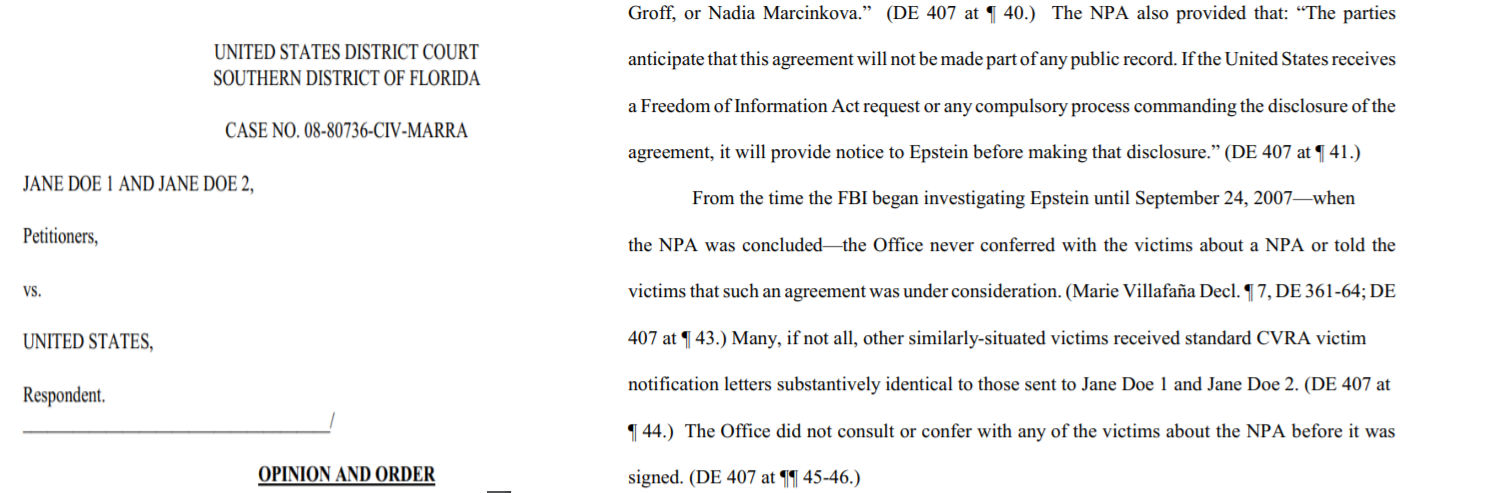
Excerpt from court ruling, February 21, 2019
Continuing with our review of the pieces of the Epstein/Trump/Deutsche Bank/Russia (ETDBR) nexus.
Donald Barr, William Barr, and Jeffrey Epstein
It’s now pretty widely known that the father of Attorney General William Barr, Donald Barr, was the headmaster of the elite Dalton School in Manhattan’s Upper East Side who hired 21-year-old Jeffrey Epstein in 1974 to teach science and math. Epstein had no college degree, but that didn’t bother Donald Barr, who was at that time embroiled in protracted battles with the school’s trustees and had submitted his resignation. At the time, Donald Barr was described as “controversial and outspoken”, but according to a wide-ranging profile in Vanity Fair, he was also a rigid defender of traditional values regarding politics, comportment, and dress.
While the headmaster was manning the barricades against wearing jeans (or pants for girls), Epstein was remembered as the cool young teacher, a 70s hipster. His photos in the school’s 1975 and 1976 yearbooks show him sporting a boule of long curly hair, tie-less in bold print shirts with long collar points and unbuttoned to mid-chest where rested a gold chain. No allegations of sexual misconduct with students have emerged, but alumni from that time recalled Epstein often flirting with female students and showing up at a party where students were drinking.
Epstein apparently left the school about 1976, dismissed for “poor performance” (the Times was unable to elicit further details). By that time, Donald Barr was also gone, replaced by Gardner Dunnan, who was later sued by a former female student who alleged that he had invited her to live with him at age 14 and had repeatedly assaulted her while in his care.
According to the Vanity Fair article, as Dalton’s headmaster, Donald Barr stood firmly opposed to changing attitudes regarding sexual morality, homosexuality, smoking marijuana or using any drugs–basically anything that smacked of counter-culture. Religiously, he was a traditionalist Catholic, even though he had been born Jewish and converted. Politically, he was staunchly old-school Republican. All of these values apparently were absorbed whole by his son Bill, who has been a conservative Republican and ardent Catholic his whole life.
The one bizarre twist on Donald Barr’s ironbound conservatism was an odd sci-fi novel called Space Relations, which he published in 1973 (reprinted in 1975). It “imagined the kingdom of Kossar, a hellscape where power, drugs, and boredom have turned the ruling caste into vicious sexual predators. The hero, John Craig—’a rising young Earth diplomat’ who is captured and enslaved—eventually triumphs, restoring virginity and monogamy to the colonized.” His hero Craig goes along with demands to assault a teenage slave as part of a program to “breed” people. Especially when seen in the context of Epstein’s later sexual career, the plot line certainly invites speculation that the author was dealing with a raging internal psychological conflict and that his puritanical ideas about sex might be a defense against a strongly felt attraction. It’s easy to wonder if he shared Epstein’s predilections, whether or not ever acted upon. (After Epstein’s arrest last year, copies of the book were reportedly selling for hundreds of dollars on line.)
Flash forward to July 6, 2019, when Epstein was arrested at Teterboro airport upon returning in his private jet from France. The arrest came as a result of a new case generated by the US attorney in the Southern District of New York (SDNY), then headed by Trump appointee Geoffrey Berman (who was later fired by Trump in June 2020 after AG Bill Barr unsuccessfully tried to force him to resign). The reopening of an inquiry in February 2019 was prompted by congressional pressure–particularly by Sen. Ben Sasse–following the furor caused by the Miami Herald investigation into the incredibly lenient deal given Epstein after his 2008 conviction in Florida.
Attorney General William Barr initially announced that he would recuse himself from the New York Epstein case because he had worked for a law firm, Kirkland & Ellis, that had represented Epstein in the Florida case. (No mention was made of his father’s link to Epstein.) Barr then reversed himself, saying that after consulting with Justice Department ethics officials he had determined there was no need to recuse. He said, however, that he would remain recused from an internal DOJ review of the Florida case.
Barr’s involvement in the case immediately raised red flags because of Trump’s own ties with Epstein and Barr’s own growing reputation as acting more as Trump’s personal attorney than as an impartial head of federal law enforcement. CNN legal analyst Elie Honig tweeted: “I have zero confidence Barr will let this case play out in its natural course if it should start to implicate or do collateral damage to powerful, politically-connected people.” Former SDNY prosecutor Mimi Rocah tweeted: “The line being drawn here makes no sense. This is very concerning.” There was speculation that Barr’s unrecusal was done at Trump’s orders.
Three days after Epstein’s arrest Vanity Fair reporter Emily Jane Fox published an article recalling remarks Trump had made at CPAC in 2015 regarding Epstein and Bill Clinton: “Nice guy. Got a lot of problems coming up, in my opinion, with the famous island with Jeffrey Epstein, lot of problems.” The implication, of course, was that this would be used against Hillary Clinton in the presidential campaign. In the weeks before Trump’s CPAC remarks, the National Enquirer had published a series of articles about Epstein including an interview with Epstein accuser Virginia Roberts Giuffre in which she claimed Epstein paid her to have sex with Britain’s Prince Andrew and said she had seen Bill Clinton around, though not with women. According to the Vanity Fair article, publisher David Pecker had brought the Enquirer article prior to publication to Trump Tower and had often delivered similar articles to Trump’s lawyer Michael Cohen so that he and Trump could clear them before they appeared in print.
Barr’s involvement in the New York case became even more intense after Epstein was found dead in his jail cell on July 10, 2019. The bizarre series of lapses in oversight of this super high profile prisoner led immediately to a proliferation of speculations and theories. One widely circulated story that Barr made a secret visit to the prison shortly before Epstein died is almost certainly untrue; Snopes labeled the story flatly “false”.
But Barr clearly wanted to get ahead of the story and, most importantly, be seen as aggressively investigating what had happened. According to the NY Times, Barr was “personally overseeing the four federal inquiries into the matter and is briefed on them multiple times a day. In less than two weeks, he suspended the two prison employees who guarded Mr. Epstein the night he died, transferred the warden and found a new permanent director for the Bureau of Prisons. He stayed apprised of the autopsy and was alerted that the coroner would officially rule the death a suicide. And federal prosecutors in New York have subpoenaed more than a dozen prison officials and employees as the fast-moving investigation into Mr. Epstein’s death intensifies.” The problem, of course, was that Barr had already squandered much of his credibility outside of TrumpWorld.
Trump didn’t help things when shortly after Epstein was found dead, he retweeted a fringe accusation that the Clintons were to blame. The original tweet by comedian Terrence Williams claimed that Mr. Epstein “had information on Bill Clinton & now he’s dead”. In an accompanying two-minute video, Mr. Williams noted that “for some odd reason, people that have information on the Clintons end up dead.”
With Epstein’s death, the New York case seemed to be at a dead end and the case was formally closed on August 29, 2019. However, a few days earlier an unusual court hearing allowed more than a dozen women to come forward to tell stories of how Epstein tricked, coerced and sexually assaulted them, and the FBI issued another appeal for victims to come forward with their stories, suggesting that prosecutors were continuing to pursue the case.
It seems that those efforts led to the arrest of Ghislaine Maxwell, Epstein’s BFF and alleged procuress, on July 2, 2020. The indictment issued by SDNY charges her with six counts, including transportation of a minor with intent to engage in criminal sexual activity. She also faces perjury charges for statements she made during a deposition in 2016 about her role in Mr. Epstein’s alleged sex trafficking operation.
Was the firing of SDNY US Attorney Geoffrey Berman related to the impending indictment of Ghislaine Maxwell? The timing is suggestive, although other SDNY cases such as those against Rudy Giuliani and Michael Cohen had displeased Trump as well. Less than two weeks before her arrest, late on Friday June 19, Barr suddenly announced that Berman was resigning his position. Berman quickly released a statement that he had not resigned and had no intention of resigning, adding that he had only learned the he was “stepping down” from a DOJ news release. The DOJ statement added that “President Trump intends to nominate Jay Clayton, currently the Chairman of the Securities and Exchange Commission, to serve as the next United States Attorney for the Southern District of New York” and that Trump had appointed Craig Carpenito, the current USA in New Jersey, to be acting USA for SDNY until Clayton could be confirmed. Clayton, it should be noted, had never served as a prosecutor.
Berman’s push back forced Barr to ask Trump to fire Berman, which Barr announced he had done the following day, even though Trump stated that he was “not involved” and that it was up to Barr. Amidst all these unexplained contradictions, Berman was able to extract an agreement to name his deputy Audrey Strauss as acting USA, thus at least temporarily keeping the leadership of SDNY in house. The whole affair, as many professional legal eminences–including the New York State Bar Association–observed, was “extremely unusual”.
As one analysis pointed out, what was happening to SDNY followed a template already used to fire the USA for the District of Columbia and take control of the office and all the cases that the office had been pursuing against Trump’s associates. “Once they seized control, Barr’s team intervened to short-circuit that process. They interceded in the sentencing of Roger Stone, and more recently, they have made an effort to dismiss the case against Michael Flynn. In both circumstances, career prosecutors were so outraged that they withdrew from the case, and some resigned from the Department of Justice altogether. This is how an authoritarian works to subvert justice.”
Berman’s exit maneuvers seem to have temporarily preserved the integrity of the SDNY cases, Meanwhile, nothing further has been heard of the announced internal DOJ review of the outrageous deal Epstein received in the Florida case.
What Happened in Florida Under Trump’s Future Secretary of Labor
In October 2007, Jeffrey Epstein was facing a 53-page federal indictment for crimes that could have put him in prison for life. However, the US Attorney for the Southern District of Florida, Alexander Acosta, agreed to a stunningly lenient deal that would, in the words of Miami Herald investigative reporter Julie K. Brown, “conceal the full extent of Epstein’s crimes and the number of people involved.” [What follows here is drawn from her prize-winning report, “Perversion of Justice”, published in November 2018.] Epstein would spend only 13 months in jail (he was released to “house arrest” five months before completing his 18 month sentence), and the non-prosecution agreement would shut down an ongoing FBI investigation into whether there were other victims and other powerful people who had taken part in Epstein’s sex crimes.
The pact required Epstein to plead guilty to two prostitution charges in state court. Epstein and four of his accomplices named in the agreement received immunity from all federal criminal charges. But even more unusual, the deal included wording that granted immunity to “any potential co-conspirators’’ who were also involved in Epstein’s crimes. These accomplices or participants were not identified in the agreement, leaving it open to interpretation whether it possibly referred to other influential people who were having sex with underage girls at Epstein’s various homes or on his plane.
As part of the arrangement, Acosta agreed, despite a federal law to the contrary, that the deal would be kept from the victims. As a result, the non-prosecution agreement was sealed until after it was approved by the judge, thereby averting any chance that the girls — or anyone else — might show up in court and try to derail it.
...”court records reveal details of the negotiations and the role that Acosta would play in arranging the deal, which scuttled the federal probe into a possible international sex trafficking operation. Among other things, Acosta allowed Epstein’s lawyers unusual freedoms in dictating the terms of the non-prosecution agreement.”
…”As a result, neither the victims — nor even the judge — would know how many girls Epstein allegedly sexually abused between 2001 and 2005, when his underage sex activities were first uncovered by police. Police referred the case to the FBI a year later, when they began to suspect that their investigation was being undermined by the Palm Beach State Attorney’s Office.“
…”as part of the plea deal, Epstein provided what the government called “valuable consideration” for unspecified information he supplied to federal investigators. While the documents obtained by the Herald don’t detail what the information was, Epstein’s sex crime case happened just as the country’s subprime mortgage market collapsed, ushering in the 2008 global financial crisis.
“Records show that Epstein was a key federal witness in the criminal prosecution of two prominent executives with Bear Stearns, the global investment brokerage that failed in 2008, who were accused of corporate securities fraud. Epstein was one of the largest investors in the hedge fund managed by the executives, who were later acquitted. It is not known what role, if any, the case played in Epstein’s plea negotiations.”
“A close look at the trove of letters and emails contained in court records provides a window into the plea negotiations, revealing an unusual level of collaboration between federal prosecutors and Epstein’s legal team that even government lawyers, in recent court documents, admitted was unorthodox.
“Acosta, in 2011, would explain that he was unduly pressured by Epstein’s heavy-hitting lawyers — Lefkowitz, Harvard professor Alan Dershowitz, Jack Goldberger, Roy Black, former U.S. Attorney Guy Lewis, Gerald Lefcourt, and Kenneth Starr, the former Whitewater special prosecutor who investigated Bill Clinton’s sexual liaisons with Monica Lewinsky.”
The evidence uncovered by the Herald suggests that Acosta and his lead prosecutor A. Marie Villafaña not only acquiesced to the demands of Epstein’s team, but actively colluded with them.
Epstein also got a incredibly cushy deal for serving his sentence. “Instead of being sent to state prison, Epstein was housed in a private wing of the Palm Beach County jail. And rather than having him sit in a cell most of the day, the Palm Beach County Sheriff’s Office allowed Epstein work release privileges, which enabled him to leave the jail six days a week, for 12 hours a day, to go to a comfortable office that Epstein had set up in West Palm Beach. This was granted despite explicit sheriff’s department rules stating that sex offenders don’t qualify for work release.”
“Prosecutors allowed Epstein’s lawyers to dictate the terms of each deal that they drew up, and repeatedly backed down on deadlines, so that the defense essentially controlled the pace of the negotiations, the emails and letters show.
“It’s clear, from emails and other records, that prosecutors spent a lot of time figuring out a way to settle the case with the least amount of scandal. Instead of charging Epstein with a sex offense, prosecutors considered witness tampering and obstruction charges, and misdemeanors that would allow Epstein to secretly plead guilty in Miami instead of in Palm Beach County, where most of the victims lived, thereby limiting media exposure and making it less likely for victims to appear at the sentencing.”
…”after his release from jail, his subsequent year of probation under house arrest was filled with trips on his corporate jet to Manhattan and to his home in the U.S. Virgin Islands — all approved by the courts with no objections from the state.”
In July 2009, Acosta left DOJ to become dean of the Florida International University College of Law.
In February 2017, Alex Acosta was confirmed as Trump’s Secretary of Labor. During his hearings, the Epstein case was raised briefly, but not explored in any depth. After the publication of the Miami Herald investigation and the re-arrest of Jeffrey Epstein in New York, Acosta resigned his cabinet post on July 9, 2019, a month before Epstein was found dead in his jail cell.
The burning question is WHY Epstein received such incredibly favorable treatment. Even allowing for his wealth and team of very expensive and well-connected lawyers and the unequal deference our legal system accords to the rich and famous, this case stands out as something special.
One might presume that Acosta would have run the jaw-dropping Epstein plea deal through his bosses at DOJ, where he had been in charge of the Civil Rights Division before being named as US Attorney in Miami. Ironically, there he specialized in human trafficking, something that he emphasized during his 2017 confirmation hearings. Before working at DOJ, Acosta had clerked for Samuel Alito at the US Court of Appeals, 3rd Circuit (before Bush named him to the Supreme Court in 2006), and following that was employed by Kirkland & Ellis, the same law firm that Epstein hired for his defense and where William Barr was “of counsel” in 2009. Thus, he was extraordinarily well wired in elite legal circles, which makes one wonder why he would bend so easily to the demands of Epstein’s defense team.
At the time the plea deal was being negotiated, DOJ was in considerable turmoil following the resignation of Bush’s second AG Alberto Gonzalez over his authorization of warrantless surveillance of US citizens and “enhanced interrogation techniques”. He left in September 2007 and was replaced in November by Michael Mukasey, who was and is a close associate of Rudy Giuliani, both socially and professionally. (His stepson, Marc Mukasey also became a partner in Giuliani’s firm, before starting his own boutique firm in February 2019 where his clients include Donald Trump and his adult children. The younger Mukasey worked to defend Trump in the case involving the House subpoenas for Trump’s financial records at Deutsche Bank and Capital One.) As AG, Michael Mukasey would presumably have had the ultimate word on the Epstein deal, though there seems to be no public record that he was involved in that decision.
According to a story in The Daily Beast, while Acosta was being vetted by the Trump transition team for the Labor job, he was asked if the Epstein deal was going to be a problem. Acosta explained “that back in the day he’d had just one meeting on the Epstein case. He’d cut the non-prosecution deal with one of Epstein’s attorneys because he had ‘been told’ to back off, that Epstein was above his pay grade. ‘I was told Epstein ‘belonged to intelligence’ [nota bene] and to leave it alone.’” Reportedly, that was enough for the transition team.
TO BE CONTINUED…
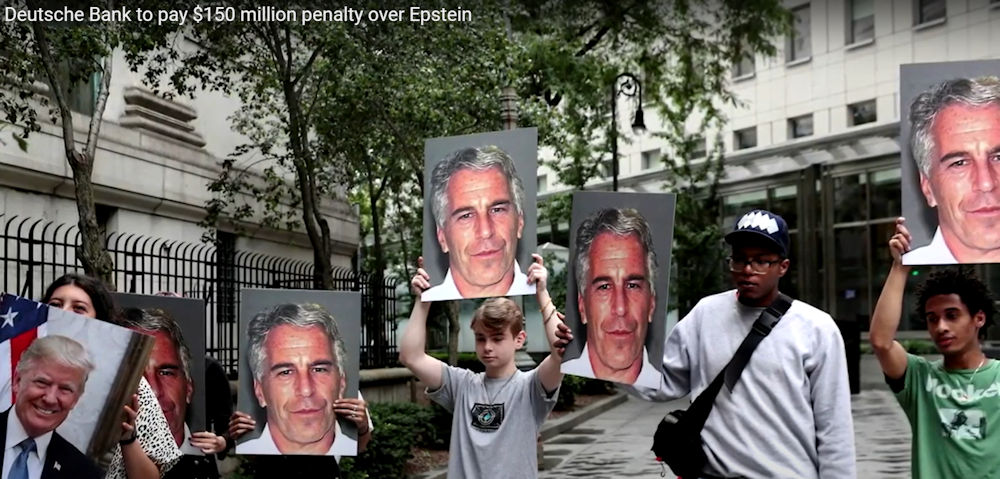
Everyone loves a good conspiracy theory, but for that you need an actual theory to explain how all the pieces fit together. Few can equal the ones swirling around erstwhile Trump pal and convicted pedophile Jeffrey Epstein, especially after his alleged suicide by hanging in a Manhattan prison cell under suspicious circumstances. So far, when it comes to linking up Epstein to Trump to Deutsche Bank to Russia, we have lots of shocking data points and some partial connections, but we still don’t know how or if all these rabbit holes connect. Clearly, there’s a lot more to the story if it is ever fully told.
The Epstein/Trump/Deutsche Bank/Russia (ETDBR) nexus is such a complicated jumble that it’s hard to know where to start. But let’s go over some of the major pieces one by one, starting with the most recent. Because there is just so much material, I am making this a multipart post. I have provided links to sources for what follows.
The Attack on Judge Esther Salas and Her Family
On July 19, a man showed up at the home of federal judge Esther Salas in North Brunswick, NJ. He shot and killed her son and wounded her husband; the judge was unharmed. Hours later, NY state police found the body of Roy Den Hollander, an apparent suicide, near Liberty, NY, and law enforcement quickly attributed the Salas family shooting to him. Den Hollander, a Trump-supporting and violently anti- feminist 73 year old lawyer with terminal melanoma, apparently had a grudge against Judge Salas because he believed she was moving too slow on a case he had in her court. He left behind 2,000+ pages of writings on the Internet Archive expressing his views on this and other subjects. Two days later, the FBI linked him to a similar killing of a men’s-rights lawyer in California on June 11. Additional information about Den Hollander released by law enforcement leaves little doubt that he committed both murders.
How does any of this connect with ETDR? Two things:
First, just four days before the attack, Judge Salas had been assigned a civil lawsuit case brought by investors that involves Deutsche Bank’s handling of financial matters relating to Jeffrey Epstein.
Second, there is a Russia connection. According to NBC News, Den Hollander spent considerable time during the 1990s in Russia, where he reportedly ran a detective agency. He also claimed to have given a speech to the Kremlin in 1993, which he posted on his website. For at least some of that time, certainly from 1999-2000, he reportedly did investigations in Russia for Kroll Associates, for whom he “managed and upgraded…security and intelligence.” According to the company’s Wikipedia page, Kroll was hired by the Yeltsin government in the 1992 to help track down vast sums of money being laundered and sent out of the country through places like Cyprus. [nota bene] The semi-official Russian organ RT calls Kroll a “shadowy firm with ties to US and Israeli intelligence” and adds that “Kroll’s ranks were stacked with former agents of the CIA, FBI, Mossad, and MI6.” The RT story definitely hinted that the official story might not be the real one, but then one must consider the source.
Intriguingly, Robert Maxwell, the British newspaper mogul father of Epstein’s dearest friend and alleged procuress Ghislaine Maxwell, met with Jules Kroll (head of Kroll Associates) two weeks before Maxwell’s mysterious death while on his yacht off the Canary Islands in November 1991. According to participants quoted in a Vanity Fair article published in March 1992, Maxwell was convinced that his enemies were out to destroy him, and he wanted Kroll to find out who was behind it. He promised to deliver a “a memorandum of suspicions and unexplained events” which he was working on when he died. Reportedly, it was never delivered and Kroll was never formally hired.
Den Hollander also briefly acquired a Russian bride in 2000, and their quick and explosive breakup and divorce evidently fueled his raging misogyny.
So does this really connect in any meaningful way with the ETDBR nexus? A good screen writer could probably concoct a rather Byzantine plot that would make this fit coherently with the larger picture. But maybe it’s all just coincidental. Sometimes the simplest explanation is the best one.
Suicide of Thomas Bowers, Deutsche Bank private banker
On November 19, 2019 the body of Thomas Bowers was found in his Malibu, California home. The Los Angeles County medical examiner quickly ruled the death was suicide by hanging. Until 2015, Bowers had been the head of Deutsche Bank’s private wealth management division, and as such had approved controversial loans to Donald Trump. (Note: There is some question about when Bowers left DB. David Enrich, who wrote extensively about the bank for the NY Times and published a book about it, says he left in 2013.)
The bare outlines of Deutsche Bank’s extraordinary relationship with Trump have been extensively reported. As the NY Times reported in March 2019: “Over nearly two decades, Deutsche Bank’s leaders repeatedly saw red flags surrounding Mr. Trump. There was a disastrous bond sale, a promised loan that relied on a banker’s forged signature, wild exaggerations of Mr. Trump’s wealth, even a claim of an act of God. But Deutsche Bank had a ravenous appetite for risk and limited concern about its clients’ reputations. Time after time, with the support of two different chief executives, the bank handed money — a total of well over $2 billion — to a man whom nearly all other banks had deemed untouchable.”
According to the NYT investigation (source for most of what follows), the first DB loan to Trump was approved in 1999 for $125 million for “a gut renovation” of 40 Wall Street. At the time, Trump was a “a casino magnate whose bankruptcies had cost banks hundreds of millions of dollars.” Next came $300 million for a building across from UN headquarters. Another request for Trump Marina casino in Atlantic City went south when a top Deutsche Bank executive, Edson Mitchell, discovered that the signature of the credit officer who had approved the deal had been forged. Tragically, Edson Mitchell died in December 2000 in the crash of a small plane in which he was the only passenger.
Nonetheless, the bank’s commercial real estate division, then headed by Justin Kennedy (son of Supreme Court Justice Anthony Kennedy), continued to lend money to Trump, including funds to buy the General Motors Building in Manhattan. [Justice Kennedy retired in July 2018, reportedly after extensive consultations with the White House, creating the vacancy filled by Brett Kavanaugh.] A DB team was formed to sell hundreds of millions of dollars in bonds for Trump Hotels and Casino Resorts. In 2004, Trump defaulted on the bonds, and the investment banking section of the bank stopped doing business with Trump–for a while.
But Trump continued to hit up Justin Kennedy and the commercial real estate unit to ask for more loans to build his 92-story Trump International Hotel and Tower in Chicago, saying that Ivanka would be in charge. Trump claimed his net worth was $3 billion, but a bank investigation concluded that it was only about $788 million. Still DB agreed to lend over $500 million for the project with Trump personally guaranteeing $40 million. When the Great Recession hit in 2008 and the bulk of the loan became due that November, Trump used a “force majeur” clause in the deal as grounds to sue Deutsche Bank for $3 billion in “damages”. DB countersued and demanded the $40 million Trump had personally guaranteed. At that point, senior investment banking executives again cut ties–sort of.
Around the same time, DB was expanding its private banking section, and in September 2006 hired Rosemary Vlablic for a reported $3 million/year. She reported directly to Thomas Bowers, head of DB’s Private Wealth Management section. According to the NYT, she was encouraged to make loans that rival banks considered too large or complex. In 2010, Trump and DB settled their litigation, with Trump promising to pay up by 2012. Jared Kushner, who had married Ivanka in 2009, was a client of Vlablic. Jared introduced her to Trump, who flew her to Miami to see the Doral resort that he needed $100 million to buy. A DB team looked over Trump’s assets and concluded that he was overvaluing his assets by as much as 70%, but he had a television hit with The Apprentice, and had money coming in from that. What Trump was asking for was a complicated and unorthodox deal, involving borrowing from one part of the bank to pay another. Vlablic and Bowers approved the loans, but needed approval from higher-ups in Frankfurt. According to the NYT account, Josef Ackermann, Deutsche Bank’s chief executive, supported the loans and the bank’s committee approved them.
[Digression: Josef Ackermann’s scandal-ridden tenure at Deutsche Bank ended in 2012. In 2014, he was recruited by Wilbur Ross and his Russian partner Viktor Vekselberg to become the new chairman of the Bank of Cyprus, which was a haven for expatriated Russian money. Ross became Trump’s Secretary of Commerce in March 2017. For more detail, see here. End of digression.]
Vlablic’s ties to the Trumps continued to deepen. “Deutsche Bank lent money to Donald Trump Jr. for a South Carolina manufacturing venture that would soon go bankrupt. It provided a $15 million credit line to Mr. Kushner and his mother, according to financial documents reviewed by The Times.”
Trump wanted to buy the Buffalo Bills NFL franchise, and needed to show that he could pull off a billion dollar transaction. He asked Vlablic for help with the loan, and produced “bare-bones financial statements” estimating his worth at $8.7 billion–a figure that his lawyer, Michael Cohen, later testified to Congress had been “inflated” with Trump’s knowledge. The bank’s own analysis reportedly concluded that they needed to reduce Trump’s valuation of his assets by up to 70%. They agreed to the loan anyway, but the bid for the Bills wasn’t successful.
Next up was Trump’s bid to turn the Old Post Office building on Pennsylvania Avenue into a luxury hotel. Trump needed about $200 million and again turned to Vlablic and DB in February 2013, as he was still considered too risky by other banks. Ultimately, DB came through with a loan for $170 million for the project two years later, and Trump plumped up his brokerage account with the bank.
By August 2015, the NYT report concludes, Deutsche Bank had lent Trump more than $300 million under Rosemary Vlablic, who (as previously mentioned) reported directly to Thomas Bowers. Thus Bowers presumably knew chapter and verse about many of Trump’s financial dealings that House of Representatives committees have been unsuccessfully trying to pry loose.
Jeffrey Epstein also had major financial ties to Deutsche Bank, the details and consequences of which are what the lawsuit in Judge Salas’ court seeks to establish.
Both the Wall Street Journal and the New York Times have reported that Epstein had been a client of DB’s private-banking division–i.e., the one formerly headed by Thomas Bowers–since at least 2013.
According to the NY Times:
In a $150 million settlement announced on Tuesday [July 7, 2020], the New York Department of Financial Services said Mr. Epstein, a convicted sex offender, had engaged in suspicious transactions for years, even though Deutsche Bank deemed him a “high risk” client from the moment he became a customer in summer 2013.
“Despite knowing Mr. Epstein’s terrible criminal history, the bank inexcusably failed to detect or prevent millions of dollars of suspicious transactions,” Linda A. Lacewell, the department’s superintendent, said in a statement.
A year and a day after Mr. Epstein was arrested on federal sex-trafficking charges, the settlement described how bank employees had relied on informal meetings and institutional momentum to allow suspicious activity to proceed largely unchecked. Instead of performing appropriate due diligence on Mr. Epstein and the activity in his accounts, regulators wrote, the bank was focused on his potential to “generate millions of dollars of revenue as well as leads for other lucrative clients.”
It wasn’t until after the Miami Herald published in late 2018 an explosive investigation into Epstein’s activities that Deutsche Bank decided that he was no longer desirable as a client. “The process proved more complicated and time-consuming than executives had initially anticipated because Deutsche Bank’s private-banking division had opened several dozen accounts for Mr. Epstein and his businesses.” In July 2020, Deutsche Bank agreed to pay a penalty of $150 million to settle charges by a New York state regulator that the bank suffered from “significant” compliance failures in its relationships with the late financier Jeffrey Epstein, Danske Bank Estonia and FBME Bank..
What’s not clear is whether or how much Epstein’s ties with Deutsche Bank involved Thomas Bowers. If, as David Enrich asserts, Bowers left his job in the private-banking division in 2013, then he probably would have had little or no knowledge of Epstein’s financial activities with the bank. If, on the other hand, he continued in that position until 2015, then he might well have known quite a lot.
Allegations that Bowers’ ties with Epstein were more extensive and long-standing appear to come mainly from a website called True Pundit, which Media Bias/Fact Check calls: “not only Questionable, but also a far right conspiracy site that rarely publishes credible news. This is a far right conspiracy source that cannot be trusted for accurate news reporting.” Politifact calls it “a conservative website and aggregator” and the one check listed for the site is rated “pants on fire”. True Pundit also seems to be the primary source for the allegation that the FBI was planning to interview Bowers at the time of his death. The aim of several right-wing websites that have picked up on these allegations appears to be to deflect attention away from the bank’s ties with Trump toward those with Epstein.
Eventually, the court cases in New York (Trump v. Vance) and New Jersey (Karimi v. Deutsche Bank–the one in Judge Salas’ court) may provide more details about Deutsche Bank’s entanglements with both Trump and Epstein, but it will probably be quite some time before such details become public. Unfortunately, the Supreme Court’s ruling on congressional attempts to subpoena Trump’s financial record (Trump v. Mazars) has dealt a major blow against success in shaking those loose and making them public.
Suicide of William S. Broeksmit
The NY Times described William S. Broeksmit as “a derivatives trader with a risk manager’s nose for spotting financial dangers”. He was recruited from Merrill Lynch by the late and aforementioned Edson Mitchell to create for Deutsche Bank “a world-class investment bank in London and spare no expense in doing so.”
But on Jan. 26, 2014, instead of meeting his wife and son for lunch, Mr. Broeksmit slung a dog leash over a door in his London home, and hanged himself from it. Left by his side was a neat stack of company documents related to Deutsche’s New York banking operations, and suicide notes addressed to relatives, as well as one to [Anshu] Jain [Mitchell’s successor and eventual co-CEO of DB, 2012-2015]. “You were good to me,” Mr. Broeksmit wrote to the man he had known for over 30 years, adding, “I am eternally sorry.”
It was really only years later, after the 2016 presidential campaign and election, that the general media started looking again at Broeksmit’s death in the light of Trump’s unorthodox financial relationship with Deutsche Bank and its involvement in a series of banking scandals. In May 2017 Daily Kos published a story headlined “Was suicide of Deutsche Bank executive linked to Trump and Russia money laundering?” The piece was prompted by an article in the German newspaper Die Welt that referred to the bank’s loans to Trump and $10 billion in laundered money for Russian customers. The unstated inference was that given revelations about Trump’s suspiciously numerous ties with Russia and his primary financial backer’s involvement in Russian money laundering that the two were somehow connected and that Broeksmit had known important things.
On October 1, 2019, David Enrich published an extraordinary account in the NY Times of his contacts with Val Broeksmit, the step-son of the deceased banker. (The source for what follows, unless otherwise indicated.) Val, a sometime musician with various personal issues, had found the passwords for his step-father’s email accounts, and in July 2014 he shared some documents with Enrich, who was then working for the Wall Street Journal. Based on that, Enrich wrote in the WSJ that DB’s “giant U.S. operations suffer from a litany of serious financial-reporting problems that the lender has known about for years but not fixed.”
The elder Broeksmit had also stumbled across, but failed to realize the import of, documents relating to the manipulation by DB and other banks of the London Inter-Bank Offered Rate (LIBOR), the benchmark that determines interest rates around the world. This blew up into a huge scandal in 2012, and Deutsche Bank ultimately paid $2.5 billion in fines and penalties in the US and Europe for its participation. William Broeksmit had been worried that he might be prosecuted or bankrupted.
In early 2017, Val Broeksmit met with Glenn Simpson of Fusion GPS (of Steele dossier fame), and they traveled together to DC, where he shared documents with a Senate investigator and a former prosecutor in the Manhattan DA’s office. The documents eventually ended up in hands of money laundering investigators in the New York Fed. “A few months later, the Fed fined Deutsche Bank $41 million for violations inside the American unit that Bill Broeksmit had overseen.”
This is all very interesting material, but so far there is nothing in the public record that specifically connects William Broeksmit to either Trump or Epstein. He clearly had extensive knowledge, however, about DB’s shady practices and was disturbed by what he knew. Whether that included knowledge about the bank’s alleged involvement in laundering money for Russian oligarchs is unclear.
TO BE CONTINUED…
This weekend, my partner and I took a short detour on a drive from DC to Miami to see for ourselves the astonishing changes on Monument Avenue, the grandiose homage to the Confederacy in its former capital, Richmond, Virginia. The avenue, which runs through the city’s most traditional upper class neighborhood, “The Fan”, until recently was studded with monumental statues of Confederate heroes in classical style: Robert E. Lee, “Stonewall” Jackson, Jefferson Davis, Jeb Stuart, Matthew Maury. In the wake of the nationwide demonstrations sparked by the murder of George Floyd, all but one of the statues has come down. Only the bronze effigy of Lee, astride his favorite horse Traveller (whose name was something all white Southern children once learned in school) is still there, but probably not for long.
Davis was pulled from his pedestal by demonstrators. Jackson, Stuart, and Maury were removed by the city, after the Richmond city council voted to place them in storage until their ultimate fate is determined. Lee remains where he is because the statue rests on on state, not city, land. Virginia’s governor, Ralph Northam, wants to remove it too, but so far has been forestalled by two lawsuits. Meanwhile, their monuments (or what’s left of them) have become memorials of a totally different kind, a raw popular protest against white supremacy and racism and police violence against black people. The results are astounding.
The Lee statue stands almost 6 stories high on an imposing pedestal in the middle of a wide circular park, now surrounded by jersey barriers covered with BLM-related graffiti. Around the base of the pedestal, protesters have created a powerfully moving memorial to the victims of racist violence with photographs of dozens of individual black Americans and an account of how exactly each of them was killed. It is devasting, especially when set against the heroic-style effigy of the general who fought to maintain the system that kept black people in chains. It’s as if generations of rage and pain had suddenly erupted and covered this symbol of repression with a visual howl in the form of crudely painted expressions of outrage. If it were up to me, I’d keep the pedestal as it now is forever; I doubt that any formal work of art could ever equal its impact.
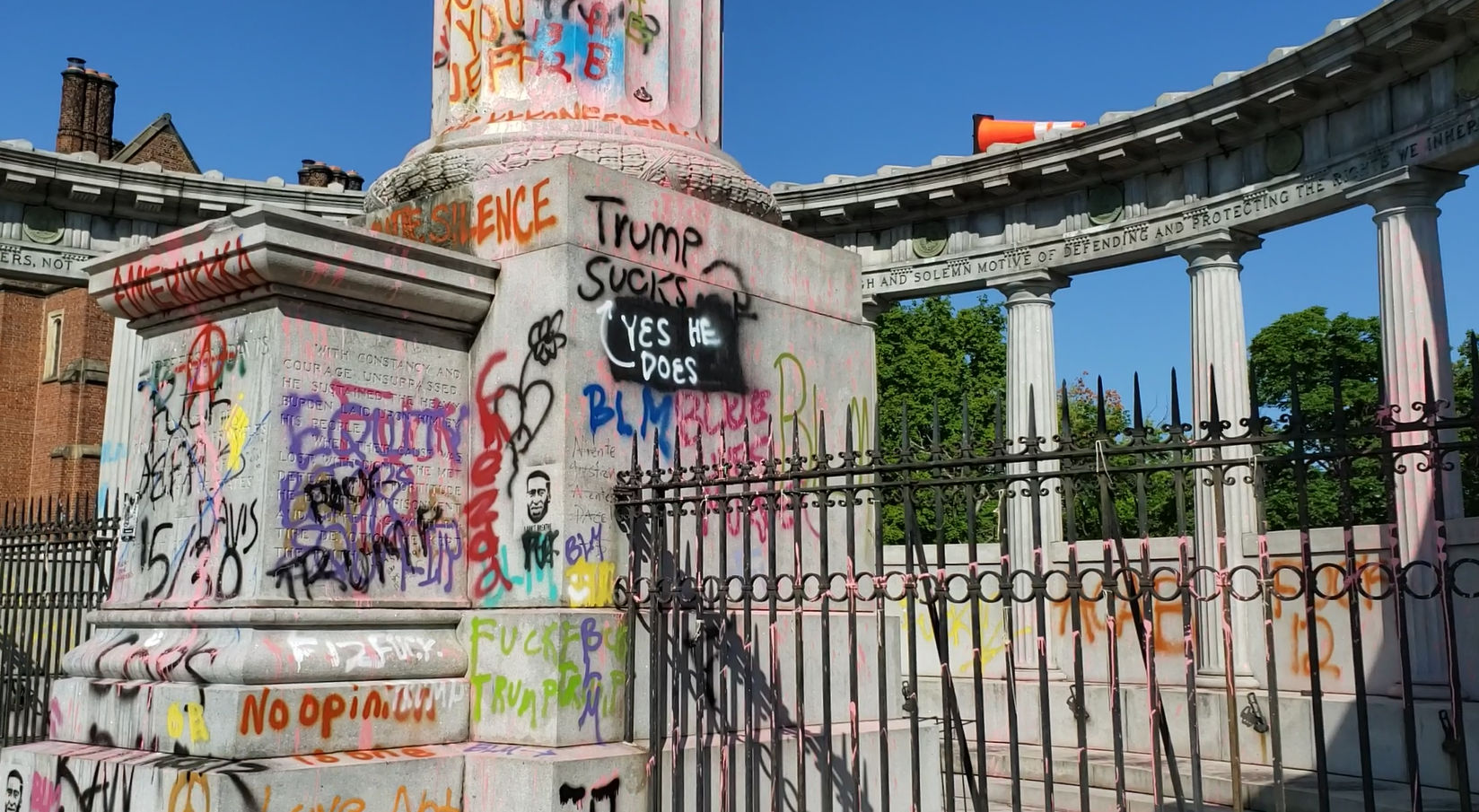
The fact that this is happening in Richmond, given its history, is almost as astonishing. I never lived there, but had some slight familiarity with the city in the 90s when my son attended college there. It always struck me as an odd place–with a complacently rigid white ruling establishment alongside a streak of arty boho funk in a black-majority city. At that time, the much of the city was in pretty sad shape. Downtown was mostly empty store fronts; not much was left except lawyers’ offices and bail bondsmen. Retail business, like most of the white population, had fled to the suburbs. The city’s population had been declining since the 70s, and crime was a serious problem. Virginia Commonwealth University, with its medical college and flourishing art school, was the leaven in the stubbornly conservative dough.
Richmond reflected old-school Virginia, which always had aristocratic pretensions and considered itself superior to the rest of the South. Virginia was the home of Founding Fathers like Washington, Jefferson, Madison, Monroe, Mason, etc., and Virginians considered themselves gentlemen, better than those cracker peckerwoods from Alabama or Mississippi. It was the first of the 13 colonies and called itself “The Old Dominion” because it stayed loyal to King Charles I during Cromwell’s revolution. The UVA athletic teams are “The Cavaliers”. It based its economy on tobacco, not cotton. It had the only significant industrial base in the Confederacy. Richmond’s Tredegar Iron Works supplied the rebel army with munitions during the Civil War, more of which was fought in Virginia than any other state. Richmond set itself ablaze as the Union Army closed in. When Lincoln visited the city a few days after its surrender, the town was a smoking ruin.
Monument Avenue itself was part of a movement following Reconstruction to mythologize the Confederacy and its heroes. The first statue to be erected was the Lee sculpture. It stirred controversy at the time, especially among the city’s black citizens. The city council still had a few black members, and they refused to vote for funds for its 1887 cornerstone ceremony or its dedication in 1890. One of them, John Mitchell, wrote: “The men who talk most about the valor of Lee and the blood of the brave Confederate dead are those who never smelt powder or engaged in battle. Most of them were at a table, either on top or under it when then war was going on…The capital of the late Confederacy has been decorated with emblems of the ‘Lost Cause,’ and the placement of the Lee statue handed down a ‘legacy of treason and blood’ to future generations.” Mitchell also wrote that “He [the African American] put up the Lee Monument, and should the time come, will be there to take it down.” The statue was indeed built with black labor.
At the time, the site was at the outer edge of the city, and the monument project was also intended to promote real estate development of the area. The Stuart and Davis monuments didn’t go up until 1907. Stonewall Jackson was added in 1917, and Matthew Maury in 1929. Lauranett Lee, curator of African-American history at the Virginia Historical Society, observed that “When the monuments were erected between 1890 and 1929, it was the nadir for black people, it was the lowest point. That’s when people were being lynched on a daily basis. … That’s when those monuments were erected.” (She believes they should stay, however. “I think we need to keep them there. We need to learn from them. We need to look at Richmond as a museum itself — the museum is not just in a building, but a landscape.”)
Virginia usually tried put a more genteel face on racism than elsewhere in the South. During the Civil Rights movement, there were no snarling police dogs or firehoses, no mobs screaming and spitting at children integrating schools. But its “massive resistance” to racial integration was no less fierce and total. Senator Harry Byrd, who ruled the state’s politics with an iron fist, promoted the “Southern Manifesto” to oppose integration, and the state passed a set of laws in 1956 to thwart it, including one that cut off state funds and closed any public school that tried to integrate. When the law was ruled unconstitutional, the Virginia General Assembly repealed the state’s compulsory school attendance law and made the operation of public schools a local option for the state’s counties and cities. In one county, public schools were simply closed for five years, denying education to black children while whites went to private “academies” supported by tax funds.
Virginia politics began to change in the 1980s with the growing population and influence of the more liberal DC suburbs in Northern Virginia and the Hampton Roads area around Norfolk. In 1989, Democrat Doug Wilder became the first African-American to be elected governor of Virginia (and indeed the first to be elected in any state), and in 2005 he became the first popularly elected mayor of the city of Richmond. Both of his successors, Dwight Jones (2009-2016), and the current incumbent Levar Stoney are also African-American. In 1996, a statue of Richmond-born African-American tennis champion and civil rights activist Arthur Ashe was added to the farther reaches of Monument Avenue, but in a city with an African-American plurality (just slightly less than 50%), it’s not surprising that those shrines to the “Lost Cause” of the Confederacy on Monument Avenue stuck in the craws of many people. Mayor Stoney has been particularly outspoken about the need to remove the Confederate statues, telling Anderson Cooper on 60 Minutes yesterday, that they represented “nostalgia masquerading as history…the fake news of their time.” But it took the Black Lives Matter movement and the national eruption of outrage over the killing of George Floyd and others to finally make it happen.
There is no shortage of people who will disagree, some of them quite violently. They clearly include Donald Trump and most of his followers. But on the sunny Saturday morning in July when we visited the site, there was a steady stream of visitors–both black and white–who were there and who seemed to be absorbing the message of the protest whether they agreed or not. Probably most of them would never have given the monuments a second glance or thought before, but now they are paying attention.
Just a few blocks from Monument Avenue, another heroic equestrian statue was installed this year in front of the Virginia Museum of Fine Art, but this one is a little different. It depicts a young black man with his dreads flying riding a dramatically rearing horse. It’s called “Rumors of War” and is the work of Kehinde Wiley, who painted the famous portrait of Barack Obama displayed in the National Portrait Gallery in Washington, DC. There are scores, perhaps hundreds, of statues of white men on horseback in cities around the world, but I have never seen one with a black rider. I don’t know how to interpret the enigmatic title or how this work would affect other viewers, but it seems to me a powerful statement for this moment in our history, especially when seen in the context of those ruined monuments erected a century or so ago to deify white men who fought to keep black people in bondage. Symbols only get you so far, but they are important, and I find these to be hopeful and inspiring.
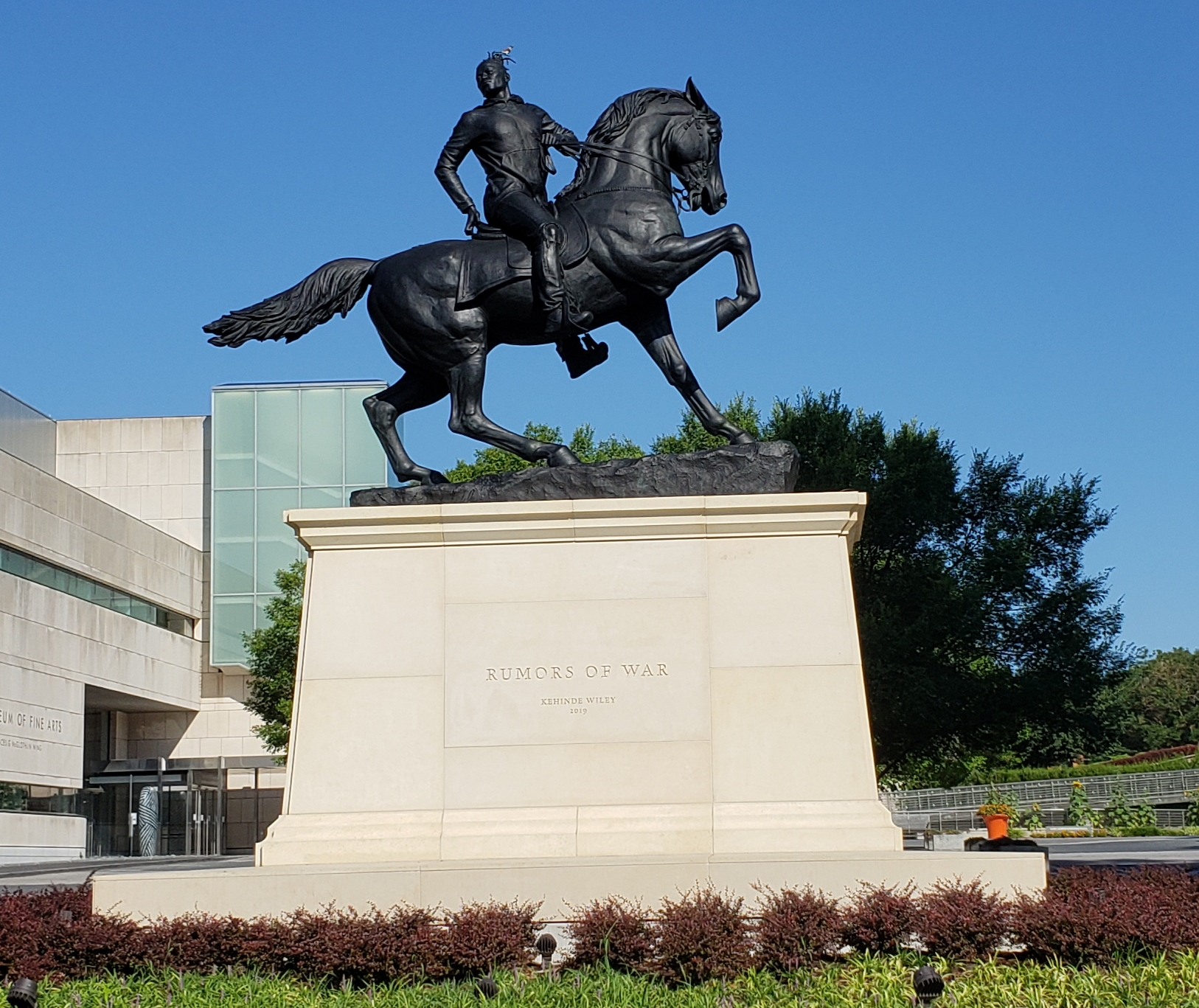
I’m not feeling celebratory on this 4th of July. What I mostly feel is angry.
Angry that the US has the worst Covid-19 pandemic in the world , and our government’s only response as it metastasizes out of control is “Get used to it”.
Angry that we have a president whose only response to racialized police brutality is to attack the protesters both rhetorically and physically.
Angry that we have a president whose response to racial inequality is to ramp up the coded white supremist language and call those demanding change “bad, evil people.”
Angry that we have a president who falsely accuses his opponents of trying to impose “a new far-left fascism” and waging “a merciless campaign to wipe out our history, defame our heroes, erase our values and indoctrinate our children.”
Angry that we have a Republican party that supports him absolutely and whose members will only criticize him after they leave office.
Angry that we have a president and Republican party whose election strategy is based solely on culture war disinformation and voter suppression.
Angry that we have a majority on the Supreme Court that consistently supports anti-democratic voter suppression measures and financial corruption in our politics.
Angry that we have an Attorney General who is eviscerating the Department of Justice and FBI of apolitical professional civil servants and installing partisan hacks in their place.
Angry that we have a president who attacks our longtime allies and cozies up dictators around the world, destroying American prestige and credibility in international affairs.
Angry that we have an administration that denies the reality of climate change and is doing everything possible to make it worse.
Angry that Trump and the Republicans have twisted the tax and regulatory power of the federal government to further enrich the wealthy while doing nothing for the poor and ordinary wage earners.
Angry that the integrity and credibility of the federal government is being destroyed by a president who appoints people who will subvert the missions of the agencies they lead.
Angry that our military is being politicized by a president who uses them as props in his campaign events and as agents of suppression of legitimate popular protests.
Angry that half of the white people in this country think all of this is just fine.
As columnist Leonard Pitts, Jr. of the Miami Herald writes:
One had only to spend a little quality time among [Trump] supporters via an online video from The New York Times, “Unfiltered: Voices From Trump’s Crowds.” Somewhere between the guy shouting “F— those dirty beaners” and the one sporting the “F— Islam” T-shirt, between the “F— that nigger” response to a mention of President Obama and the “Sieg heil” salute, it becomes impossible to ever again take seriously anyone who argues that Trump was elected because of “economic anxiety.”
And if you accept that he came to office because a critical mass of white voters felt anger, fear or vulnerability over the fact that they will soon lose the ability to muster a racial majority, then it follows that every disastrous thing stemming from his election also traces ultimately to that same cause .So we left the Paris climate accords because of race. We abrogated the Iran nuclear deal because of race. We suffered the worst economic collapse in 90 years because of race. We became an international laughingstock and object of pity because of race. We’ve lost more than 120,000 of our fellow citizens to a deadly pandemic in large part because of race. Now we might lose our country because of race. What a high price we have paid, what damage we have done ourselves. Because of race.
Most of all, I’m angry because much of this damage may well be permanent no matter who wins the election in November. As Pitts warns: “The damage is too deep — again, not just to our concrete national interests, but also to the way we see our country, to the expectations we hold for our leaders. And for ourselves.”
So save the fireworks and parades today. Today is more properly a day of mourning and self-reflection, not celebration.
Okay, here’s the plot: A white supremist cult has taken over America, but there is growing opposition and big protests keep erupting in cities across the country. The cult’s Dear Leader, a sociopath who feeds off the adulation of his followers and demands obsequious devotion from his subordinates, feels threatened and demands a massive police response and calls troops into the streets to control the protests, but this just galvanizes the protesters. They surround the White House, and Dear Leader scurries in fear to an underground bunker, but this just inspires popular derision and ridicule. So Dear Leader tells his Evil Sidekick, who controls the nation’s law enforcement, to clear the streets so he can appear strong in public. The Evil Sidekick mobilizes mounted cops and troops armed with tear gas and rubber bullets to run the protesters off. Dear Leader strides out of the White House flanked by ranks of cops in riot gear and followed by his daughter and most loyal flunkies to hold up a Bible in front of a church in a mystifying ceremony. But the protests continue.
At the same time a deadly plague is ravaging the country. More than 2 million people have caught the virus and 120,000 have been killed by it. Dear Leader tells his followers that it will miraculously disappear and everything will be fine, and they believe him. Doctors and scientists, however, say that people should close their businesses and retreat into their homes to keep the plague from spreading. Most people do that, and for a while it seems to be working. But Dear Leader is angry, because the plague makes him look weak, so he declares that it is over. Besides, he’s bored and craves the adoration of his cult. So he demands that the country open up again and people should return to their restaurants and bars and gyms and beaches and nail salons. And they do, because they want it to be over too, and they’re tired of being cooped up with their wives and husbands and children watching Netflix and Tik Tok videos. But the plague strikes back with renewed fury.
What is Dear Leader to do? The number of plague victims keeps rising and makes him look bad. Racist cops kill more black people, which multiplies the protests and brings more white people into the streets in solidarity. People start to whisper that Dear Leader is losing it and his support among the people is waning. He fears the courts might be turning on him as well, even the judges he installed himself. There are investigations led by an independent US attorney that may be going badly for him. He tells Evil Sidekick to remove the threat by firing the US Attorney, but the US Attorney refuses to leave.
Aha! says Dear Leader, I’ll stage a massive rally to show how much my followers adore me! Doctors and scientists plead that this is dangerous and people will get sick and die. But Dear Leader doesn’t care. “I’ll just make them sign a pledge not to sue me if they get the plague,” he says. “Besides, it’s probably only the old ones that will die anyway, and they’re just dead weight on the economy. Their kids will thank me because they’ll get their inheritance quicker.”
Now where and when shall we have the rally? Dear Leader consults the Malevolent Gollum, who loves putting brown children in cages. Oklahoma!, he says. They love you there. Let’s see, how about Tulsa! Next year is the centennial of the massacre there where white people rioted and destroyed a prosperous black community and killed lots of black people. The symbolism is perfect! And let’s do it on Juneteenth when black people celebrate emancipation from slavery. That’s makes it even better!
And so the decree went out, and the faithful gathered in their MAGA gear. Some burned face masks ceremonially to show how much they love Dear Leader. Actors were recruited on Craigslist just in case the crowd looked a little skimpy. Dear Leader threatened protesters with dire consequences if they showed up to demonstrate.
And now we await Dear Leader’s appearance on the stage. What will he say? What will they do?
I’m having a little trouble with the ending.
 TrumpWorld for Beginners